Thank you for visiting SNEWPapers!
Sign up free
The Arkansas Advocate
Little Rock, Pulaski County, Arkansas
What is this article about?
Extracts from French papers detail the government's non-intervention policy, impeachment proceedings against ex-ministers, contradiction of a royal statement on Netherlands, rejection of a commerce relief loan, and a heated Chamber of Deputies debate on national security, Belgium, and ministry policies, culminating in withdrawal of a proposition for a state inquiry commission.
Clipping
OCR Quality
Full Text
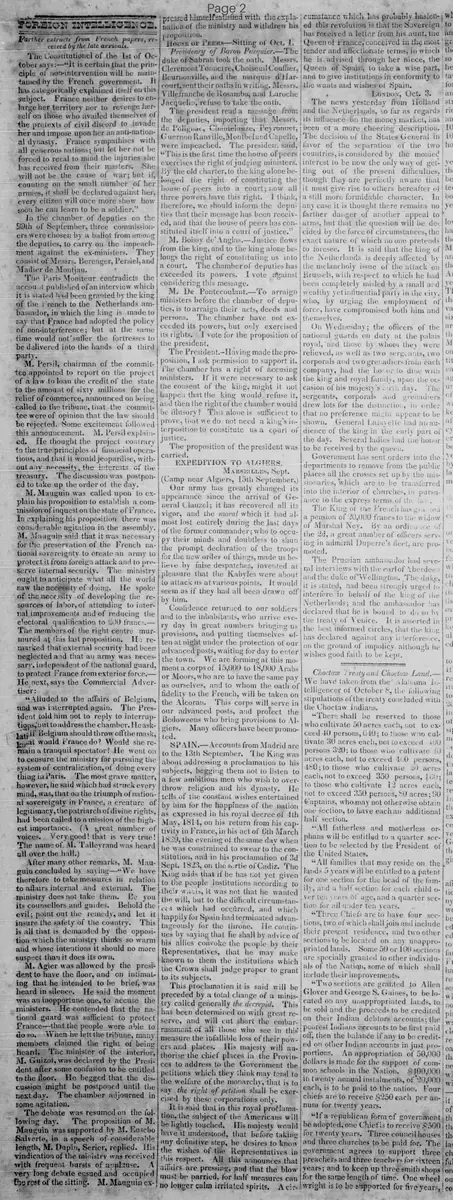
Farther extracts from French papers, received by the late arrivals.
The Constitutionel of the 1st of October says:- "It is certain that the principle of non-intervention will be maintained by the French government. It has categorically explained itself on this subject. France neither desires to enlarge her territory nor to revenge herself on those who availed themselves of the pretexts of civil discord to invade her and impose upon her an anti-national dynasty. France sympathises with all generous nations; but let her not be forced to recall to mind the injuries she has received from their masters. She will not be the cause of war; but if, counting on the small number of her armies, it shall be declared against her, every citizen will once more show how soon he can learn to be a soldier."
In the chamber of deputies on the 29th of September, three commissioners were chosen by a ballot from among the deputies, to carry on the impeachment against the ex-ministers. They consist of Messrs. Berenger, Persil, and Madier de Montjau.
The Paris Moniteur contradicts the account published of an interview which it is stated had been granted by the king of the French to the Netherlands ambassador, in which the king is made to say that France had adopted the policy of non-interference; but at the same time would not suffer the fortresses to be delivered into the hands of a third party.
M. Persil, chairman of the committee appointed to report on the project of a law to loan the credit of the state to the amount of sixty millions for the relief of commerce, announced on being called to the tribune, that the committee were of opinion that the law should be rejected. Some excitement followed this announcement. M. Persil explained. He thought the project contrary to the true principles of financial operations, and that it would jeopardise, without any necessity, the interests of the treasury. The discussion was postponed to take up the order of the day.
M. Mauguin was called upon to explain his proposition to establish a commission of inquest on the state of France. In explaining his proposition there was considerable agitation in the assembly. M. Mauguin said that it was necessary for the preservation of the French national sovereignty to create an army to protect it from foreign attack and to preserve internal security. The ministry ought to anticipate what all the world saw the necessity of doing. He spoke of the necessity of developing the resources of labor, of attending to internal improvements and of reducing the electoral qualification to 200 francs. The members of the right centre murmured at this last proposition. He remarked that external security had been neglected and that an army was necessary, independent of the national guard, to protect France from exterior force.
He next, says the Commercial Advertiser:
"Alluded to the affairs of Belgium, and was interrupted again. The President told him not to reply to interruptions, but to address the chamber. He asked if Belgium should throw off the mask, what would France do? Would she remain a tranquil spectator? He went on to censure the ministry for pursuing the system of centralization, of doing everything in Paris. The most grave matter, however, he said which had struck every mind, was, that on the triumph of national sovereignty in France, a creature of legitimacy, the patriarch of divine rights, had been called to a mission of the highest importance. (A great number of voices. Very good! that is very true! The name of M. Talleyrand was heard all over the hall.)"
After many other remarks, M. Mauguin concluded by saying— "We have therefore to take measures in relation to affairs internal and external. The ministry does not take them. Be you its counsellors and guides. Behold the evil; point out the remedy, and let it insure the safety of the country. This is all that is demanded by the opposition which the ministry thinks so warm and whose intentions it should no more suspect than it does its own."
M. Agier was allowed by the president to have the floor, and on intimating that he intended to be brief, was heard in silence. He said the moment was an inopportune one, to accuse the ministers. He contended that the national guard was sufficient to protect France--that the people were able to do so. When he left the tribune, many members claimed the right of being heard. The minister of the interior, M. Guizot, was declared by the President after some confusion to be entitled to the floor. He begged that the discussion might be postponed until the next day. The chamber adjourned in some agitation.
The debate was resumed on the following day. The proposition of M. Mauguin was supported by M. Eusèbe Salverte, in a speech of considerable length, M. Dupin, Serier, replied. His vindication of the ministry was received with frequent bursts of applause. A very long debate ensued and occupied the rest of the sitting. M. Mauguin expressed himself satisfied with the explanation of the ministry and withdrew his proposition.
What sub-type of article is it?
What keywords are associated?
What entities or persons were involved?
Where did it happen?
Foreign News Details
Primary Location
Paris
Event Date
29th Of September To 1st Of October
Key Persons
Outcome
impeachment commissioners appointed; commerce relief loan project to be rejected; m. mauguin's proposition for a commission of inquest withdrawn after debate and ministry explanations.
Event Details
French papers report on the government's commitment to non-intervention policy amid sympathy for other nations; appointment of commissioners for ex-ministers' impeachment; contradiction of a reported royal statement on Netherlands fortresses; committee's opinion against a 60 million loan for commerce; debate in Chamber of Deputies on M. Mauguin's proposition for a state inquest commission, covering army needs, Belgium affairs, centralization, and Talleyrand's role, supported and opposed, leading to postponement and eventual withdrawal.