Thank you for visiting SNEWPapers!
Sign up free
Editorial
September 18, 1959
Toledo Union Journal
Toledo, Lucas County, Ohio
What is this article about?
The AFL-CIO Executive Council warns of a dangerous economic slowdown due to restrictive government policies prioritizing inflation fears over growth. Despite recovery from 1957-58 recession, persistent 5% unemployment looms from growing labor force and productivity. Advocates 5% annual growth, critiques inflation campaign, and proposes 16-point program including wage increases, ending tight money policies, and aid for education and housing.
Clipping
OCR Quality
98%
Excellent
Full Text
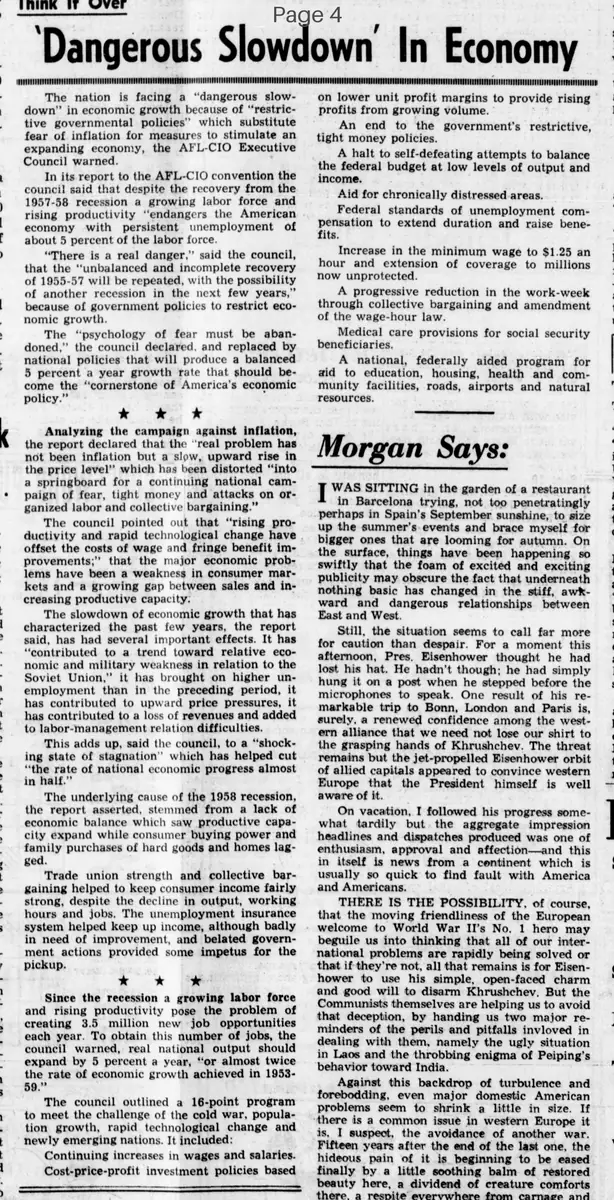
Dangerous Slowdown In Economy
The nation is facing a "dangerous slowdown" in economic growth because of "restrictive governmental policies" which substitute fear of inflation for measures to stimulate an expanding economy, the AFL-CIO Executive Council warned.
In its report to the AFL-CIO convention the council said that despite the recovery from the 1957-58 recession a growing labor force and rising productivity "endangers the American economy with persistent unemployment of about 5 percent of the labor force."
"There is a real danger," said the council, that the "unbalanced and incomplete recovery of 1955-57 will be repeated, with the possibility of another recession in the next few years, because of government policies to restrict economic growth."
The psychology of fear must be abandoned," the council declared, and replaced by national policies that will produce a balanced 5 percent a year growth rate that should become the "cornerstone of America's economic policy."
Analyzing the campaign against inflation, the report declared that the "real problem has not been inflation but a slow, upward rise in the price level" which has been distorted "into a springboard for a continuing national campaign of fear, tight money and attacks on organized labor and collective bargaining."
The council pointed out that "rising productivity and rapid technological change have offset the costs of wage and fringe benefit improvements;" that the major economic problems have been a weakness in consumer markets and a growing gap between sales and increasing productive capacity.
The slowdown of economic growth that has characterized the past few years, the report said, has had several important effects. It has "contributed to a trend toward relative economic and military weakness in relation to the Soviet Union," it has brought on higher unemployment than in the preceding period, it has contributed to upward price pressures, it has contributed to a loss of revenues and added to labor-management relation difficulties.
This adds up, said the council, to a "shocking state of stagnation" which has helped cut "the rate of national economic progress almost in half."
The underlying cause of the 1958 recession, the report asserted, stemmed from a lack of economic balance which saw productive capacity expand while consumer buying power and family purchases of hard goods and homes lagged.
Trade union strength and collective bargaining helped to keep consumer income fairly strong, despite the decline in output, working hours and jobs. The unemployment insurance system helped keep up income, although badly in need of improvement, and belated government actions provided some impetus for the pickup.
Since the recession a growing labor force and rising productivity pose the problem of creating 3.5 million new job opportunities each year. To obtain this number of jobs, the council warned, real national output should expand by 5 percent a year, "or almost twice the rate of economic growth achieved in 1953-59."
The council outlined a 16-point program to meet the challenge of the cold war, population growth, rapid technological change and newly emerging nations. It included:
Continuing increases in wages and salaries.
Cost-price-profit investment policies based on lower unit profit margins to provide rising profits from growing volume.
An end to the government's restrictive, tight money policies.
A halt to self-defeating attempts to balance the federal budget at low levels of output and income.
Aid for chronically distressed areas.
Federal standards of unemployment compensation to extend duration and raise benefits.
Increase in the minimum wage to $1.25 an hour and extension of coverage to millions now unprotected.
A progressive reduction in the work-week through collective bargaining and amendment of the wage-hour law.
Medical care provisions for social security beneficiaries.
A national, federally aided program for aid to education, housing, health and community facilities, roads, airports and natural resources.
The nation is facing a "dangerous slowdown" in economic growth because of "restrictive governmental policies" which substitute fear of inflation for measures to stimulate an expanding economy, the AFL-CIO Executive Council warned.
In its report to the AFL-CIO convention the council said that despite the recovery from the 1957-58 recession a growing labor force and rising productivity "endangers the American economy with persistent unemployment of about 5 percent of the labor force."
"There is a real danger," said the council, that the "unbalanced and incomplete recovery of 1955-57 will be repeated, with the possibility of another recession in the next few years, because of government policies to restrict economic growth."
The psychology of fear must be abandoned," the council declared, and replaced by national policies that will produce a balanced 5 percent a year growth rate that should become the "cornerstone of America's economic policy."
Analyzing the campaign against inflation, the report declared that the "real problem has not been inflation but a slow, upward rise in the price level" which has been distorted "into a springboard for a continuing national campaign of fear, tight money and attacks on organized labor and collective bargaining."
The council pointed out that "rising productivity and rapid technological change have offset the costs of wage and fringe benefit improvements;" that the major economic problems have been a weakness in consumer markets and a growing gap between sales and increasing productive capacity.
The slowdown of economic growth that has characterized the past few years, the report said, has had several important effects. It has "contributed to a trend toward relative economic and military weakness in relation to the Soviet Union," it has brought on higher unemployment than in the preceding period, it has contributed to upward price pressures, it has contributed to a loss of revenues and added to labor-management relation difficulties.
This adds up, said the council, to a "shocking state of stagnation" which has helped cut "the rate of national economic progress almost in half."
The underlying cause of the 1958 recession, the report asserted, stemmed from a lack of economic balance which saw productive capacity expand while consumer buying power and family purchases of hard goods and homes lagged.
Trade union strength and collective bargaining helped to keep consumer income fairly strong, despite the decline in output, working hours and jobs. The unemployment insurance system helped keep up income, although badly in need of improvement, and belated government actions provided some impetus for the pickup.
Since the recession a growing labor force and rising productivity pose the problem of creating 3.5 million new job opportunities each year. To obtain this number of jobs, the council warned, real national output should expand by 5 percent a year, "or almost twice the rate of economic growth achieved in 1953-59."
The council outlined a 16-point program to meet the challenge of the cold war, population growth, rapid technological change and newly emerging nations. It included:
Continuing increases in wages and salaries.
Cost-price-profit investment policies based on lower unit profit margins to provide rising profits from growing volume.
An end to the government's restrictive, tight money policies.
A halt to self-defeating attempts to balance the federal budget at low levels of output and income.
Aid for chronically distressed areas.
Federal standards of unemployment compensation to extend duration and raise benefits.
Increase in the minimum wage to $1.25 an hour and extension of coverage to millions now unprotected.
A progressive reduction in the work-week through collective bargaining and amendment of the wage-hour law.
Medical care provisions for social security beneficiaries.
A national, federally aided program for aid to education, housing, health and community facilities, roads, airports and natural resources.
What sub-type of article is it?
Economic Policy
Labor
What keywords are associated?
Economic Slowdown
Afl Cio
Inflation Fear
Unemployment
Government Policies
Labor Force
Productivity
Collective Bargaining
Minimum Wage
Economic Growth
What entities or persons were involved?
Afl Cio Executive Council
Soviet Union
Organized Labor
Editorial Details
Primary Topic
Dangerous Economic Slowdown Due To Restrictive Government Policies
Stance / Tone
Critical Of Inflation Focused Policies, Advocating For 5% Growth And Labor Supportive Measures
Key Figures
Afl Cio Executive Council
Soviet Union
Organized Labor
Key Arguments
Restrictive Policies Cause Dangerous Slowdown And Persistent 5% Unemployment
Abandon Fear Of Inflation For 5% Annual Growth Policies
Inflation Campaign Distorts Real Issues Like Slow Price Rise And Attacks On Labor
Rising Productivity Offsets Wage Increases; Problems In Consumer Markets
Slowdown Leads To Economic Stagnation, Higher Unemployment, And Relative Weakness Vs. Soviet Union
1958 Recession From Imbalance In Capacity Vs. Buying Power
Need 3.5 Million New Jobs Yearly; Requires Twice Recent Growth Rate
16 Point Program: Wage Increases, End Tight Money, Aid Distressed Areas, Raise Minimum Wage, Etc.