Thank you for visiting SNEWPapers!
Sign up free
The Evansville Daily Journal
Evansville, Vanderburgh County, Indiana
What is this article about?
U.S. Consul Thomas O. Larkin reports from Monterey, California, on July 1, 1848, confirming the extensive gold discoveries in the region. Thousands are mining along rivers near Sutter's Fort, yielding ounces of gold daily per person, causing widespread desertions, business closures, and economic disruption as people flock to the gold fields.
Clipping
OCR Quality
Full Text
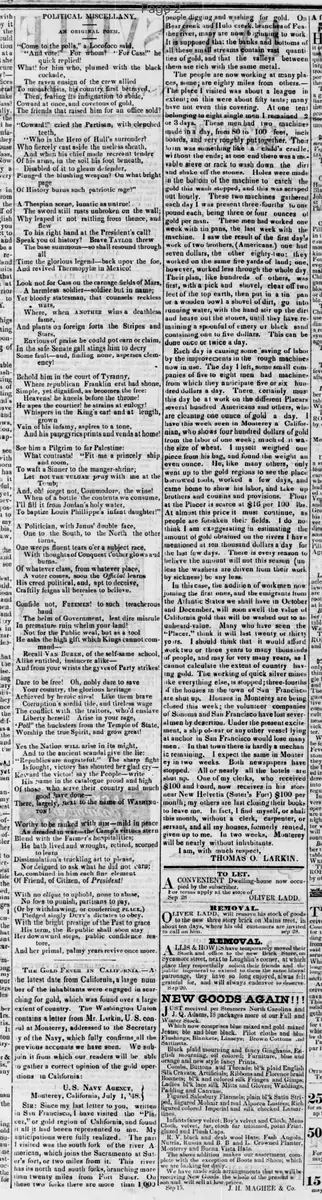
U. S. Navy Agency,
Monterey, California, July 1, 1848.
SIR: Since my last letter to you, written in San Francisco, I have visited the 'Placer,' or gold region of California, and found it all it had been represented to me. My anticipations were fully realized. The part I visited was the south fork of the river American, which joins the Sacramento at Sutter's fort, or two miles from it. This river has its north and south forks, branching more than twenty miles from Fort Sutter. On these two forks there are more than 1000 people digging and washing for gold. On Bear creek and Yulo creek, branches of Feather river, many are now beginning to work. It is supposed that the banks and bottoms of all these small streams contain vast quantities of gold, and that the valleys between them are rich with the same metal.
The people are now working at many places. Some are eighty miles from others. The place I visited was about a league in extent; on this were about fifty tents; many have not even this covering. At one tent belonging to eight single men I remained 2 or 3 days. These men had two machines made in a day, from 8 to 10 feet, inch boards, and very roughly put together. Their form was something like a child's cradle, without the ends; at one end there was a movable sieve or rack to wash down the dirt and shake off the stones. Holes were made in the bottom of the machine to catch the gold this wash stopped, and this was scraped out hourly. These two machines gathered each day I was present three-fourths to one pound each, being three or four ounces of gold per man. These men had worked one week with tin pans, the last week with the machine. I saw the result of the first day's work of two brothers, (Americans.) one had seven dollars, the other eighty-two: they worked on the same five yards of land; one, however, worked less through the whole day.
Their plan, like hundreds of others, was first, with a pick and shovel, clear off two feet of the top earth, then put in a tin pan or a wooden bowl a shovel of dirt, go into running water, with the hand stir up the dirt and heave out the stones, until they have remaining a spoonful of emery or black sand containing one to five dollars. This can be done once or twice a day.
Each day is causing some 'saving of labor' by the improvements in the rough machines now in use. The day I left, some small companies of five to eight men had machines from which they anticipate five or six hundred dollars a day. There, certainly must this day be at work on the different Placers several hundred Americans and others, who are cleaning one ounce of gold a day. I have this week seen in Monterey a Californian, who shows four hundred dollars of gold from the labor of one week; much of it was the size of wheat. I myself weighed one piece from his bag, and found the weight an even ounce. He, like many others, only went up to the gold regions to see the place, borrowed tools, worked a few days, and came home to show his labor, and take up brothers and cousins and provisions. Flour at the Placer is scarce at $16 per 100 lbs. At almost this price it must continue, as people are forsaking their fields. I do not think I am exaggerating in estimating the amount of gold obtained on the rivers I have mentioned at ten thousand dollars a day for the last few days. There is every reason to believe the amount will not this season (unless the washers are driven from their work by sickness) be any less. In this case, the addition of work men now joining the first ones, and the emigrants from the Atlantic States we shall have in October and December, will soon swell the value of California gold that will be washed out to an unheard-of value. Many who have seen the 'Placer' think it will last twenty or thirty years. I should think that it would afford work two or three years to many thousands of people, and may for very many years, as I cannot calculate the extent of country having gold. The working of quick silver mines like everything else, is stopped; three-fourths of the houses in the town of San Francisco are shut up. Houses in Monterey are being closed this week; the volunteer companies of Sonoma and San Francisco have lost several men by desertion. Under the present excitement, a ship of war or any other vessel lying at anchor in San Francisco would lose many men. In that town there is hardly a mechanic remaining. I expect the same in Monterey in two weeks. Both newspapers have stopped. All or nearly all the hotels are shut up. One of my clerks, who received $100 and board, now receives in his store near New Helvetia (Sutter's Fort) $100 per month; my others are last closing their books to leave me. In fact, I find myself, or shall this month, without a clerk, carpenter, or servant, and all my houses, formerly rented, given up to me. In two weeks, Monterey will be nearly without inhabitants.
I am, with much respect,
THOMAS O. LARKIN.
What sub-type of article is it?
What keywords are associated?
What entities or persons were involved?
Where did it happen?
Domestic News Details
Primary Location
California
Event Date
July 1, 1848
Key Persons
Outcome
daily gold yields estimated at ten thousand dollars across rivers; individual miners obtaining one to four ounces per day; widespread desertions from jobs, volunteer companies, and ships; business closures in san francisco and monterey; flour scarce at $16 per 100 lbs; anticipated influx of emigrants to increase production.
Event Details
U.S. Consul Thomas O. Larkin visits gold regions near Sutter's Fort, confirming extensive placer mining along forks of American River, Bear Creek, and Yulo Creek with over 1000 people digging and washing gold using tin pans and crude machines; reports vast quantities in streams and valleys; details mining methods and yields; notes economic impacts including forsaken fields, stopped quicksilver mines, deserted houses, newspapers, hotels, and personnel shortages.