Thank you for visiting SNEWPapers!
Sign up free
Editorial
March 20, 1946
Henderson Daily Dispatch
Henderson, Vance County, North Carolina
What is this article about?
Editorial critiques Walter Lippmann's recommendations for US foreign policy, including loans to Britain and France, military training, and anti-Soviet alliances, arguing against them due to risks of antagonism and advocating independent American initiative.
Clipping
OCR Quality
98%
Excellent
Full Text
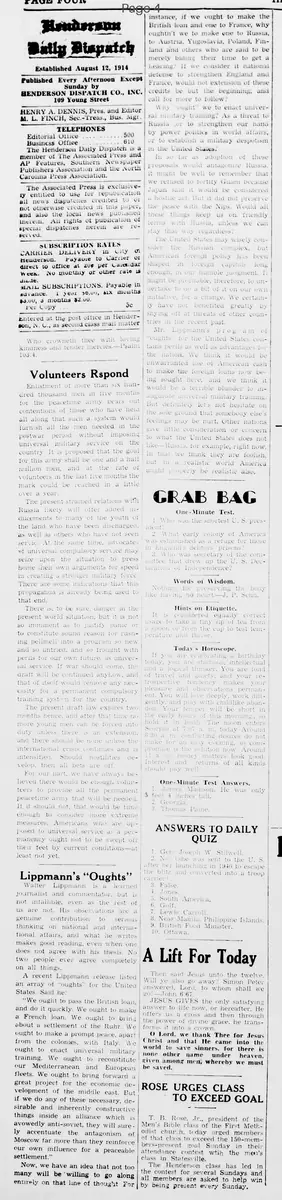
Lippmann's "Oughts"
Walter Lippmann is a learned journalist and commentator, but is not infallible, even as the rest of us are not. His observations are a genuine contribution to serious thinking on national and international affairs, and what he writes makes good reading, even when one does not agree with his thesis. No two people ever agree completely on all things.
A recent Lippmann release listed an array of "oughts" for the United States. Said he:
"We ought to pass the British loan, and do it quickly. We ought to make a French loan. We ought to bring about a settlement of the Ruhr. We ought to make a prompt peace, apart from the colonies, with Italy. We ought to enact universal military training. We ought to reconstitute our Mediterranean and European fleets. We ought to bring forward a great project for the economic development of the middle east. But if we do any of these necessary, desirable and inherently constructive things inside an alliance which is avowedly anti-soviet, they will surely accentuate the antagonism of Moscow far more than they reinforce our own influence for a peaceable settlement."
Now, we have an idea that not too many will be willing to go along entirely on that line of thought. For instance, if we ought to make the British loan and one to France, why couldn't we to make one to Russia, to Austria, Yugoslavia, Poland, Finland and others who are said to be merely biding their time to get a hearing? If we consider it national defense to strengthen England and France, would not extension of these credits be but the beginning, and call for more to follow?
Why ought we to enact universal military training? As a threat to Russia, or to strengthen our hand by power politics in world affairs, or to establish a military despotism in the United States?
In so far as adoption of these proposals would antagonize Russia, it might be well to remember that we refused to fortify Guam because Japan said it would be considered a hostile act. But it did not preserve the peace with the Nips. Would all these things keep us on friendly terms with Russia, unless we can stay that way regardless.
The United States may wisely consider the Russian complex, but American foreign policy has been shaped in foreign capitals long enough, in our humble judgment. It might be profitable, therefore, to undertake to do a bit of it on our own initiative, for a change. We certainly have not benefited greatly by shying off at threats of other countries in the recent past.
Mr. Lippmann's pious program of "oughts" for the United States contains perils as well as advantages for the nation. We think it would be unwarranted use of American cash to make the foreign loans now being sought here, and we think it would be a terrible blunder to inaugurate universal military training. But definitely let's not hesitate on the sole ground that somebody else's feelings may be hurt. Other nations give little consideration or concern to what the United States does not like—Russia, for example, right now. In that we think they are foolish, but in a realistic world America might properly be realistic also.
Walter Lippmann is a learned journalist and commentator, but is not infallible, even as the rest of us are not. His observations are a genuine contribution to serious thinking on national and international affairs, and what he writes makes good reading, even when one does not agree with his thesis. No two people ever agree completely on all things.
A recent Lippmann release listed an array of "oughts" for the United States. Said he:
"We ought to pass the British loan, and do it quickly. We ought to make a French loan. We ought to bring about a settlement of the Ruhr. We ought to make a prompt peace, apart from the colonies, with Italy. We ought to enact universal military training. We ought to reconstitute our Mediterranean and European fleets. We ought to bring forward a great project for the economic development of the middle east. But if we do any of these necessary, desirable and inherently constructive things inside an alliance which is avowedly anti-soviet, they will surely accentuate the antagonism of Moscow far more than they reinforce our own influence for a peaceable settlement."
Now, we have an idea that not too many will be willing to go along entirely on that line of thought. For instance, if we ought to make the British loan and one to France, why couldn't we to make one to Russia, to Austria, Yugoslavia, Poland, Finland and others who are said to be merely biding their time to get a hearing? If we consider it national defense to strengthen England and France, would not extension of these credits be but the beginning, and call for more to follow?
Why ought we to enact universal military training? As a threat to Russia, or to strengthen our hand by power politics in world affairs, or to establish a military despotism in the United States?
In so far as adoption of these proposals would antagonize Russia, it might be well to remember that we refused to fortify Guam because Japan said it would be considered a hostile act. But it did not preserve the peace with the Nips. Would all these things keep us on friendly terms with Russia, unless we can stay that way regardless.
The United States may wisely consider the Russian complex, but American foreign policy has been shaped in foreign capitals long enough, in our humble judgment. It might be profitable, therefore, to undertake to do a bit of it on our own initiative, for a change. We certainly have not benefited greatly by shying off at threats of other countries in the recent past.
Mr. Lippmann's pious program of "oughts" for the United States contains perils as well as advantages for the nation. We think it would be unwarranted use of American cash to make the foreign loans now being sought here, and we think it would be a terrible blunder to inaugurate universal military training. But definitely let's not hesitate on the sole ground that somebody else's feelings may be hurt. Other nations give little consideration or concern to what the United States does not like—Russia, for example, right now. In that we think they are foolish, but in a realistic world America might properly be realistic also.
What sub-type of article is it?
Foreign Affairs
Economic Policy
Military Affairs
What keywords are associated?
Walter Lippmann
Foreign Policy
British Loan
French Loan
Universal Military Training
Russia Relations
Anti Soviet Alliance
What entities or persons were involved?
Walter Lippmann
United States
Russia
Britain
France
Italy
Editorial Details
Primary Topic
Critique Of Walter Lippmann's Foreign Policy Oughts
Stance / Tone
Critical Of Loans And Military Training, Advocating Independent Us Realism
Key Figures
Walter Lippmann
United States
Russia
Britain
France
Italy
Key Arguments
Oppose British And French Loans Without Extending To Others Like Russia
Question Necessity Of Universal Military Training As Threat Or Despotism
Anti Soviet Alliances Would Heighten Antagonism Without Ensuring Peace
Us Should Pursue Independent Foreign Policy, Not Dictated By Others' Threats
Historical Example Of Guam Fortification Shows Appeasement Fails
Be Realistic Like Other Nations, Not Overly Concerned With Hurting Feelings