Thank you for visiting SNEWPapers!
Sign up free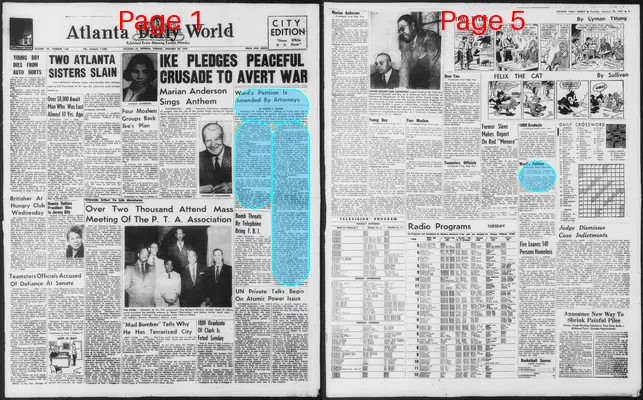
Atlanta Daily World
Atlanta, Fulton County, Georgia
What is this article about?
Attorneys for Horace Ward amended his petition in federal court to seek class action status and a declaratory judgment against racial discrimination in his potential transfer to the University of Georgia Law School. The case, ongoing since 1950, was delayed again by Judge Frank A. Hooper for further review.
Merged-components note: Continuation of the Ward's Petition legal case story; relabeled from 'story' to 'domestic_news' as it involves civil rights and local legal matters.
Clippings
1 of 2
OCR Quality
Full Text
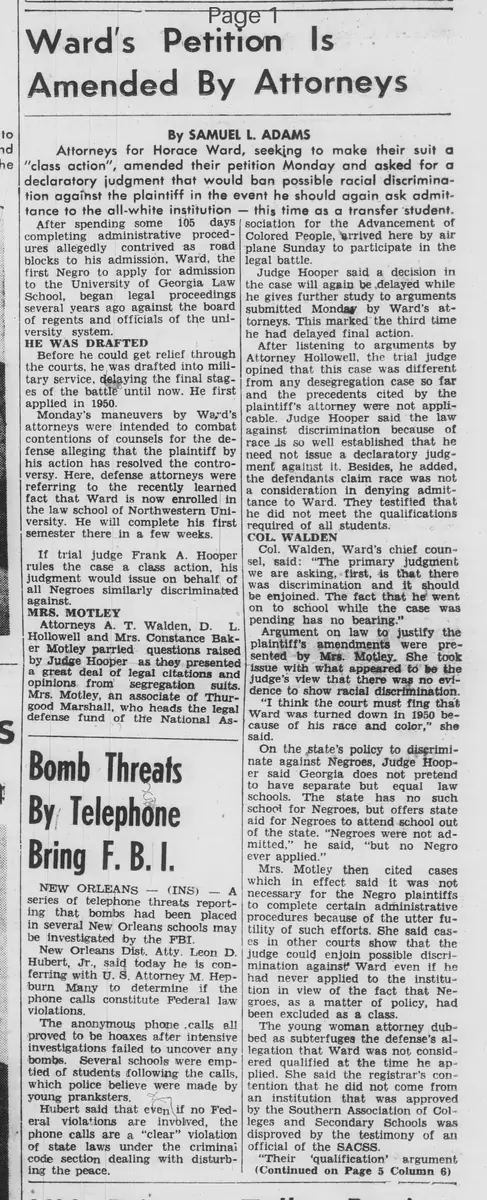
By SAMUEL L. ADAMS
Attorneys for Horace Ward, seeking to make their suit a "class action", amended their petition Monday and asked for a declaratory judgment that would ban possible racial discrimination against the plaintiff in the event he should again ask admittance to the all-white institution - this time as a transfer student.
After spending some 105 days completing administrative procedures allegedly contrived as road blocks to his admission, Ward, the first Negro to apply for admission to the University of Georgia Law School, began legal proceedings several years ago against the board of regents and officials of the university system.
HE WAS DRAFTED
Before he could get relief through the courts, he was drafted into military service, delaying the final stages of the battle until now. He first applied in 1950.
Monday's maneuvers by Ward's attorneys were intended to combat contentions of counsels for the defense alleging that the plaintiff by his action has resolved the controversy. Here, defense attorneys were referring to the recently learned fact that Ward is now enrolled in the law school of Northwestern University. He will complete his first semester there in a few weeks.
If trial judge Frank A. Hooper rules the case a class action, his judgment would issue on behalf of all Negroes similarly discriminated against.
MRS. MOTLEY
Attorneys A. T. Walden, D. L. Hollowell and Mrs. Constance Baker Motley parried questions raised by Judge Hooper as they presented a great deal of legal citations and opinions from segregation suits.
Mrs. Motley, an associate of Thurgood Marshall, who heads the legal defense fund of the National Association for the Advancement of Colored People, arrived here by air plane Sunday to participate in the legal battle.
Judge Hooper said a decision in the case will again be delayed while he gives further study to arguments submitted Monday by Ward's attorneys. This marked the third time he had delayed final action.
After listening to arguments by Attorney Hollowell, the trial judge opined that this case was different from any desegregation case so far and the precedents cited by the plaintiff's attorney were not applicable. Judge Hooper said the law against discrimination because of race is so well established that he need not issue a declaratory judgment against it. Besides, he added, the defendants claim race was not a consideration in denying admittance to Ward. They testified that he did not meet the qualifications required of all students.
COL. WALDEN
Col. Walden, Ward's chief counsel, said: "The primary judgment we are asking, first, is that there was discrimination and it should be enjoined. The fact that he went on to school while the case was pending has no bearing."
Argument on law to justify the plaintiff's amendments were presented by Mrs. Motley. She took issue with what appeared to be the judge's view that there was no evidence to show racial discrimination.
"I think the court must find that Ward was turned down in 1950 because of his race and color," she said.
On the state's policy to discriminate against Negroes, Judge Hooper said Georgia does not pretend to have separate but equal law schools. The state has no such school for Negroes, but offers state aid for Negroes to attend school out of the state. "Negroes were not admitted," he said, "but no Negro ever applied."
Mrs. Motley then cited cases which in effect said it was not necessary for the Negro plaintiffs to complete certain administrative procedures because of the utter futility of such efforts. She said cases in other courts show that the judge could enjoin possible discrimination against Ward even if he had never applied to the institution in view of the fact that Negroes, as a matter of policy, had been excluded as a class.
The young woman attorney dubbed as subterfuges the defense's allegation that Ward was not considered qualified at the time he applied. She said the registrar's contention that he did not come from an institution that was approved by the Southern Association of Colleges and Secondary Schools was disproved by the testimony of an official of the SACSS.
"Their qualification' argument
(Continued on Page 5 Column 6)
Ward's Petition (Continued From Page One)
was a subterfuge for turning him (Ward) down because of race," she said.
She read opinions from several cases in which federal courts future acts of discrimination. The citations were intended to combat Judge Hooper's present view that Ward's right as a transfer student have not accrued, because he has not yet attempted to transfer credits.
What sub-type of article is it?
What keywords are associated?
What entities or persons were involved?
Where did it happen?
Domestic News Details
Primary Location
Georgia
Event Date
Monday
Key Persons
Outcome
case delayed for further study by judge hooper; third delay in final action.
Event Details
Attorneys amended Horace Ward's petition to seek class action status and declaratory judgment against racial discrimination for his potential transfer to University of Georgia Law School. Arguments presented on discrimination since 1950 application; defense claims lack of qualifications, not race. Judge opined case differs from prior desegregation suits.