Thank you for visiting SNEWPapers!
Sign up free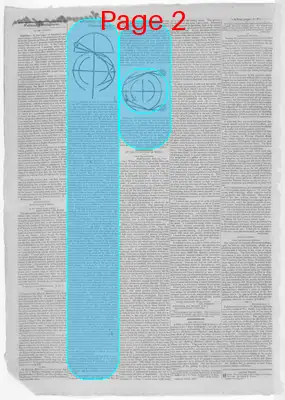
Daily National Intelligencer
Washington, District Of Columbia
What is this article about?
John Cleves Symmes describes a diagram illustrating how sunlight enters the Earth's polar openings to light the inner hollow surface via direct rays, refraction, and reflection, supporting his 1818 hollow Earth theory and addressing skepticism about internal heat and light.
Merged-components note: Merging images (diagrams) with the letter on 'Light Between the Spheres' as they are illustrative components of the same article, indicated by spatial overlap and textual reference to a diagram.
Clipping
OCR Quality
Full Text
Cincinnati Reading Room;
August 19, 1819.
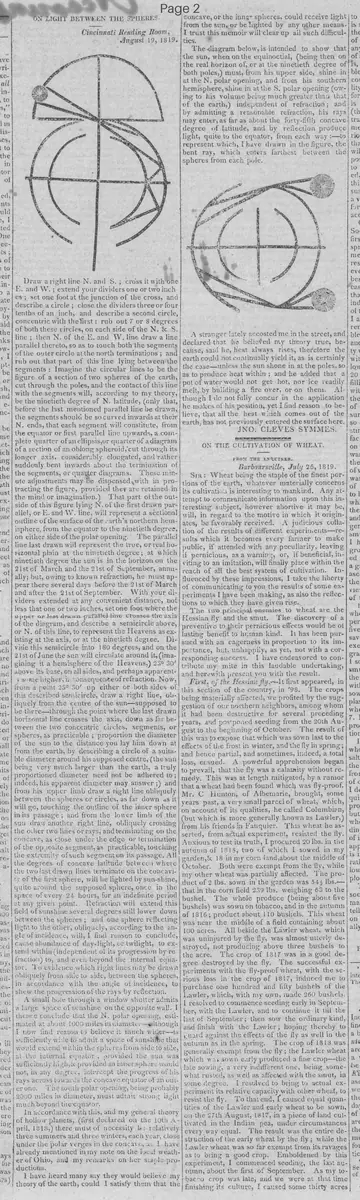
Draw a right line N. and S.; cross it with one E. and W.; extend your dividers one or two inches; set one foot at the junction of the cross, and describe a circle; close the dividers three or four tenths of an inch, and describe a second circle, concentric with the first: rub out 7 or 8 degrees of both these circles, on each side of the N. & S. line; then N. of the E. and W. line draw a line parallel thereto, so as to touch both the segments of the outer circle at the north terminations; and rub out that part of this line lying between the segments: Imagine the circular lines to be the figure of a section of two spheres of the earth, cut through the poles, and the contact of this line with the segments will, according to my theory, be the ninetieth degree of N. latitude, (only that, before the last mentioned parallel line be drawn, the segments should be so curved inwards at their N. ends, that each segment will constitute, from the equator or first parallel line upwards, a complete quarter of an ellipsis, or quarter of a diagram of a section of an oblong spheroid, cut through its longer axis, considerably elongated, and rather suddenly bent inwards about the termination of the segments, or quarter diagrams. These minute adjustments may be dispensed with in protracting the figure, provided they are retained in the mind or imagination.) That part of the outside of this figure lying N. of the first drawn parallel, or E. and W. line, will represent a sectional outline of the surface of the earth's northern hemisphere, from the equator to the ninetieth degree, on either side of the polar opening. The parallel line last drawn will represent the true, or real horizontal plain at the ninetieth degree; at which ninetieth degree the sun is in the horizon on the 21st of March and the 21st of September, annually; but, owing to known refraction, he must appear there several days before the 21st of March and after the 21st of September. With your dividers extended at any convenient distance, not less than one or two inches, set one foot where the upper or last drawn parallel line crosses the axis of the diagram, and describe a semicircle above, or N. of this line, to represent the Heavens as existing at the axis, or at the ninetieth degree. Divide this semicircle into 180 degrees, and on the 21st of June the sun will circulate around it (imagining it a hemisphere of the Heavens,) 23° 30' above its base, on all sides, and perhaps apparently some higher, in consequence of refraction. Now, from a point 23° 30' up either or both sides of this described semicircle, draw a right line, obliquely from the centre of the sun-supposed to be there-through the point where the last drawn horizontal line crosses the axis, down as far between the two concentric circles, segments, or spheres, as practicable; proportion the diameter of the sun to the distance you lay him down at from the earth, by describing a circle of a suitable diameter around his supposed centre, (the sun being very much larger than the earth, a truly proportioned diameter need not be adhered to; indeed, his apparent diameter may answer;) and from his upper limb draw a right line obliquely between the spheres or circles, as far down as it will go, touching the outline of the inner sphere in its passage; and from the lower limb of the sun draw another right line, obliquely crossing the other two lines or rays, and terminating on the concave, as close under the edge or termination of the opposite segment, as practicable, touching the extremity of such segment on its passage. All the degrees of concave latitude between where the two last drawn lines terminate on the concavity of the first sphere, will be lighted by sun-shine, quite around the supposed sphere, once in the space of every 24 hours, for an indefinite period at any given point. Refraction will extend this field of sunshine several degrees still lower down between the spheres; and one sphere reflecting light to the other, obliquely, according to the angle of incidence, will, I find reason to conclude, cause abundance of day-light, or twilight, to extend within (independent of its progression by refraction) to, and even beyond the internal equator. To evidence which right lines may be drawn obliquely from side to side, between the spheres, in accordance with the angle of incidence, to shew the progression of the rays by reflection.
A small hole through a window shutter admits a large space of sunshine on the opposite wall. I thence conclude that the N. polar opening, estimated at about 1000 miles in diameter-although I now find reason to believe it much wider-is sufficiently wide to admit a space of sunshine that would extend within the spheres from side to side, at the internal equator; or provided the sun was sufficiently high, & provided an inner sphere would not, in any degree, intercept the progress of his rays across towards the concave equator of an outer one. The south polar opening, being probably 2000 miles in diameter, must admit strong light much beyond the equator.
In accordance with this, and my general theory of hollow planets, (first declared on the 10th April, 1818,) there must of necessity be relatively three summers and three winters, each year, close under the polar verges in the concave, as I have already mentioned in my note on the local weather of Ohio, and my remarks on her staple productions.
I have heard many say they would believe my theory of the earth, could I satisfy them that the concave, or the inner spheres, could receive light from the sun, or be lighted by any other means.
I trust this memoir will clear up all such difficulties.
The diagram below, is intended to show that the sun, when on the equinoctial, (being then on the real horizon of, or at the ninetieth degree of both poles,) must, from his upper side, shine in at the N. polar opening, and from his southern hemisphere, shine in at the S. polar opening (owing to his volume being much greater than that of the earth,) independent of refraction; and by admitting a reasonable refraction, his rays may enter, as far as about the forty-fifth concave degree of latitude, and by reflection produce light, quite to the equator, from each way :-to represent which, I have drawn in the figure, the bent ray, which enters farthest between the spheres from each pole.
A stranger lately accosted me in the street, and declared that he believed my theory true, because, said he, heat always rises, therefore the earth could not continually yield it, as is certainly the case-unless the sun shone in at the poles, so as to produce heat within; and he added that a pot of water would not get hot, nor ice readily melt, by building a fire over, or on them. Although I do not fully concur in the application he makes of his position, yet I find reason to believe, that all the heat which comes out of the earth, has not previously entered the surface here.
JNO. CLEVES SYMMES.
What sub-type of article is it?
What themes does it cover?
What keywords are associated?
What entities or persons were involved?
Letter to Editor Details
Author
Jno. Cleves Symmes.
Main Argument
the letter explains how sunlight enters the polar openings of a hollow earth, illuminating the inner concave surface through direct rays, refraction, and reflection, thereby supporting the theory of hollow planets and addressing doubts about internal lighting.
Notable Details