Thank you for visiting SNEWPapers!
Sign up free
The National Intelligencer And Washington Advertiser
Washington, District Of Columbia
What is this article about?
A report on 1793 commerce from Buenos Ayres to Cadiz, Spain, detailing imports like hides, wool, and metals totaling millions in value. Emphasizes hides as key export and speculates on vast economic potential for Britain if it acquires the region, including provisions, grains, and fisheries.
Clipping
OCR Quality
Full Text
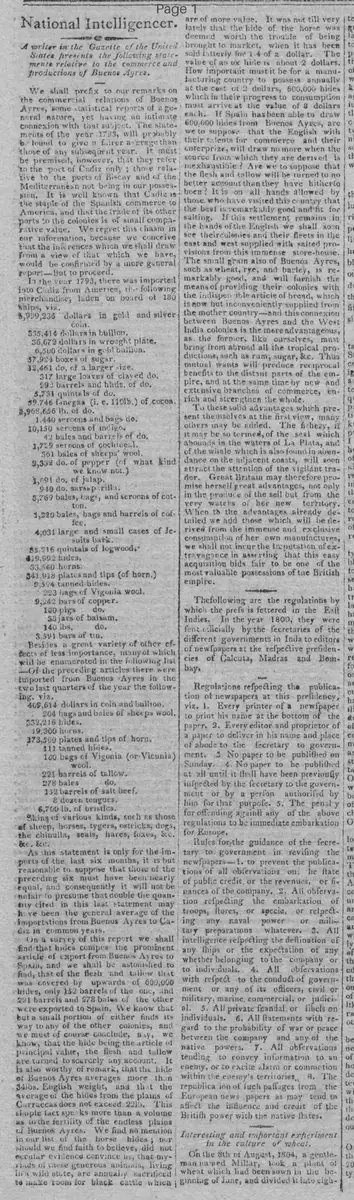
We shall prefix to our remarks on the commercial relations of Buenos Ayres, some statistical reports of a general nature, yet having an intimate connexion with that subject. The statements of the year 1793, will probably be found to give a fairer average than those of any subsequent year. It must be premised, however, that they refer to the port of Cadiz only: those relative to the ports of Biscay and of the Mediterranean not being in our possession. It is well known that Cadiz is the staple of the Spanish commerce to America, and that the trade of its other ports to the colonies is of small comparative value. We regret this chasm in our information, because we conceive that the inferences which we shall draw from a view of that which we have, would be confirmed by a more general report— But to proceed.
In the year 1793, there was imported into Cadiz from America, the following merchandise; laden on board of 180 ships, viz.
5,999,236 dollars in gold and silver coin.
335,414 dollars in bullion.
36,672 dollars in wrought plate.
6,500 dollars in gold bullion.
57,924 boxes of sugar.
32,461 do. of a larger size.
317 large loaves of clarified do.
292 barrels and hhds. of do.
5,731 quintals of do.
59,746 fanegas (i. e. 101 lb.) of cocoa.
1,968,656 lb. of do.
1,440 seroons and bags do.
10,150 seroons of indigo.
42 bales and barrels of do.
1,719 seroons of cochineal.
361 bales of sheeps' wool.
9,382 do. of pepper (of what kind we know not.)
1,061 do. of jalap.
940 do. sarsaparilla.
3,767 bales, bags, and seroons of cotton.
1,220 bales, bags and barrels of coffee.
4,031 large and small cases of leather suits.
85,216 quintals of logwood.
619,992 hides.
63,560 horns.
341,918 plates and tips (of horn.)
9,324 tanned hides.
223 bags of Vicugna wool.
9,242 bars of copper.
100 pigs do.
38 jars of balsam,
140 lbs. do.
3,591 bars of tin.
Besides a great variety of other effects of less importance, many of which will be enumerated in the following list.
Of the preceding articles there were imported from Buenos Ayres in the two last quarters of the year the following, viz.
409,614 dollars in coin and bullion.
204 bags and bales of sheeps wool.
332,216 hides.
19,300 horns,
173,500 plates and tips of horn.
111 tanned hides.
100 bags of Vicugna (or Vicunia) wool.
221 barrels of tallow.
278 bales do.,
152 barrels of salt beef.
8 dozen tongues.
6,700 lb. of bristles.
Skins of various kinds, such as those of sheep, horses, tygers, ostricks, dogs, the chinchilla, seals, hares, foxes, &c. &c.
As this statement is only for the imports of the last six months, it is but reasonable to suppose that those of the preceding six must have been nearly equal, and consequently it will not be unfair to presume that double the quantity cited in this last statement may have been the general average of the importations from Buenos Ayres to Cadiz in common years.
On a survey of this report we shall find that hides compose the prominent article of export from Buenos Ayres to Spain, and we shall be astonished to find, that of the flesh and tallow that was covered by upwards of 600,000 hides, only 152 barrels of the one, and 221 barrels and 278 bales of the other were exported to Spain. We know that but a small portion of either finds its way to any of the other colonies, and we must of course conclude, nay, we know, that the hide being the article of principal value, the flesh and tallow are turned to scarcely any account. It is also worthy of remark, that the hide of Buenos Ayres averages more than 34 lbs. English weight, and that the average of the hides from the plains of Carraccas does not exceed 22 lb. This simple fact speaks more than a volume as to the fertility of the endless plains of Buenos Ayres. We find no mention in our list of the horse hides; nor should we find faith to believe, did not ocular evidence convince us, that myriads of these generous animals, living in a wild state, are annually sacrificed to make room for black cattle which are of more value. It was not till very lately that the hide of the horse was deemed worth the trouble of being brought to market, when it has been sold latterly for 1/4 of a dollar. The value of an ox hide is about 2 dollars. How important must it be for a manufacturing country to possess annually at the cost of 2 dollars, 600,000 hides which in their progress to consumption must arrive at the value of 8 dollars each. If Spain has been able to draw 600,000 hides from Buenos Ayres, are we to suppose that the English with their talents for commerce and their enterprize, will draw no more when the source from which they are derived is inexhaustible? Are we to suppose that the flesh and tallow will be turned to no better account than they have hitherto been? It is on all hands allowed by those who have visited this country that the beef is remarkably good and fit for salting. If this settlement remains in the hands of the English we shall soon see their colonies and their fleets in the east and west supplied with salted provisions from this immense store-house. The small grain also of Buenos Ayres, such as wheat, rye, and barley, is remarkably good, and will furnish the means of providing their colonies with the indispensable article of bread, which is now but inconveniently supplied from the mother country—and this connexion between Buenos Ayres and the West India colonies is the more advantageous, as the former, like ourselves, must bring from abroad all the tropical productions, such as rum, sugar, &c. Thus mutual wants will produce reciprocal benefits to the distant parts of the empire, and at the same time by new and extensive branches of commerce, enrich and strengthen the whole. To these solid advantages which present themselves at the first view, many others may be added. The fishery, if it may be so termed, of the seal which abounds in the waters of La Plata, and of the whale which is also found in abundance on the adjacent coasts, will soon attract the attention of the vigilant trader. Great Britain may therefore promise herself great advantages, not only in the produce of the soil but from the very waters of her new territory. When to the advantages already detailed we add those which will be derived from the immense and exclusive consumption of her own manufactures, we shall not incur the imputation of extravagance in asserting that this easy acquisition bids fair to be one of the most valuable possessions of the British empire.
What sub-type of article is it?
What keywords are associated?
Where did it happen?
Foreign News Details
Primary Location
Buenos Ayres
Event Date
1793
Outcome
imports to cadiz from buenos ayres in last half of 1793 included 409,614 dollars in coin/bullion, 332,216 hides, various wools, tallow, and skins; annual estimate doubles this. speculates on british gains in hides, salted beef, grains, fisheries if acquired.
Event Details
Statistical report on 1793 imports to Cadiz from America, focusing on Buenos Ayres contributions in last six months: coin, bullion, hides, wool, tallow, beef, skins. Highlights hides as main export, notes underutilization of meat/tallow, praises fertility, discusses horse sacrifices, and envisions British commercial expansion including provisions for colonies, grains, tropical trade reciprocity, seal/whale fisheries, and manufacturing consumption.