Thank you for visiting SNEWPapers!
Sign up free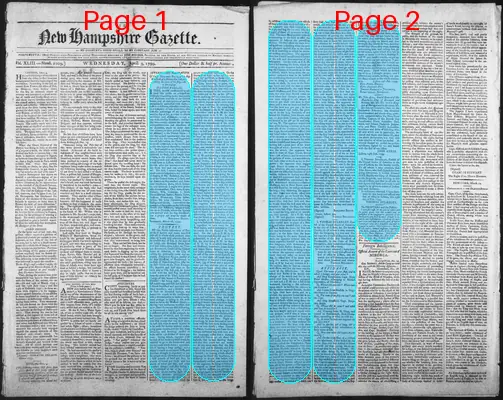
The New Hampshire Gazette
Portsmouth, Rockingham County, New Hampshire
What is this article about?
Captain Benjamin Balch's 1799 protest details a mutiny on the ship Strafford during a 1798-99 voyage from Portugal to New Hampshire. After a gale damages the vessel and provisions are rationed, the crew, led by boatswain Samuel Huffman and others, rebels, seizes the ship, and abandons Balch at sea near the West Indies.
Merged-components note: Continuation of the narrative account of the mutiny on the ship Strafford across pages 1 and 2; originally labeled as story and notice, merged into single story component.
Clippings
1 of 2
OCR Quality
Full Text
Of Capt. BENJAMIN BALCH, of the ship Strafford, of a Mutiny that took place among the crew of the ship,--in a late passage.
TO THE PUBLIC.
I FEEL myself constrained to address the public on a subject exceedingly interesting to the mercantile and maritime interests of the United States, and all descriptions of persons immediately connected with these.-- Left in a destitute, distressed condition, by a company of base mutineers, who took the advantage of my going on board a ship at sea, in order to obtain provisions and assistance; to run away with the ship Strafford; and further have cruelly injured me by their misrepresentations and aspersions of my character, made to cover their own villainy, on their arrival, (during my absence) in the United States; I take the earliest opportunity after my return to lay the true, well supported state of facts before the Public. Justice to all concerned, to the world, and to my own injured character, requires it. And painful as my feelings have been, I mean not to give a narration tinctured by these, but a simple state of facts, in the plain dress of the following protest and affidavit, sworn to in due form at Lisbon, whither I was carried, after the mutineers took my ship from me, and ran away with her. But first, I cannot suppress my warm acknowledgments, my unfeigned thanks, to Mr. Bulkeley, the Consul of the United States at Lisbon, and the American ship-masters and American merchants there, whose sympathy and kindness I ought ever gratefully to remember. They were, Capts. Mallary, Wm. Coleman, J. Steel, Wood, Mitchell, Barker, Ropes, Tyler, Haffron, Woroycutt, Titus Salter, Barker, Mr. John Hamilton, Capts. Phillips and Garde. I now solicit the attention of the public, to the following Protest and Affidavit, which I have sent on to Norfolk, where the lawless crew arrived with the ship Strafford: that a proper use may be made of them.
Benjamin Balch.
Portsmouth, March 28, 1799.
PROTEST.
BY this Public instrument of Protest be it known and made manifest unto all to whom these presents may come, or in any wise concern, that on the twelfth day of Feb. in the year of our Lord, one thousand seven hundred and ninety-nine, before me THOMAS BULKELEY, Consul of the United States of America, in the City of Lisbon, &c. personally came and appeared, Benjamin BALCH, master of the ship Strafford of Portsmouth in the state of New-Hampshire, who being duly sworn on the Holy Evangelists, deposed and said that on the ninth day of Oct. last past, he sailed in and with the said ship Strafford, from the port of St. Ubes, laden with a cargo of salt, bound to Portsmouth, aforesaid; he being tight, staunch, stiff and strong, and well and sufficiently fitted, furnished and provided with every necessary, and a suitable crew for such an intended voyage, and steered his course to the northward, with a determination to make a northward passage, in sailing to the westward as far as the Western islands.- Having very boisterous weather, that on or about the twenty-fifth following, he experienced a heavy gale of wind at different points of the compass, by the violence of which, and his mate and people's not exerting themselves with that energy that was their duty, his best sails were so much injured as to be unfit for service without undergoing great repairs, and the ship from labouring and straining caused to make about 150 strokes of water per hour. Seeing which, together with the loss of his main-top-mast head, he resolved to go to the southward and run the trade winds down; apprehensive of having a long passage and a winter's course to encounter with, and therefore thought it expedient to put the people on an allowance of one and a half pounds of beef per day, six pounds of bread per week, and two quarts of water per day, and other necessary things; and after sailing to the southward as far as lat. 27,00. and long. 25,00, having light winds and calm weather, prolonging his passage, he reduced the allowance of bread to 5 lb per week; at which the people murmured very much. On the thirtieth of Nov. in lat. 25 10', and long. 65° 30' West, he spoke with an English brig called the Nymph, from St. Kitts, mounting 12 guns, on a cruise, which being also short of provisions, could not supply him with any. He then continued to the northward and westward as far 'as lat. 28° 00, North, and long. 68° 00, when having bad weather on the coast, and not being able to depend on his crew, made him very cautious in carrying sail. On the 23d of Dec. the wind being S. E. he steered to the N. W. and had fine weather until 4 A. M. the wind hauling round to S. S. W. he close reefed his fore and main top sails and then left the deck, ordering his mate to call him immediately if the wind hauled any further to the westward, or there was any alteration in the weather; at half past 6 A. M. finding the ship to go through the water very fast, he went on deck and as soon as he could reach the helm, got it up, every sail there was set blew from the ropes, the fore-yard broke off in the slings, and main sail and mizen that were furled to the yard, blew away likewise; the wind then had got to W. N. W. and blowing a tremendous gale, and the ship lay to the mercy of the waves, and labouring very much, shipped a deal of water, having one of the starboard main chain bolts drawn, and the larboard gunnel plank split open for 6 or 8 feet in her waist, which kept both pumps going for 24 hours; on the 24th and 25th the weather became more moderate, attended with a tumbling sea, the ship making 300 strokes per hour, and the men giving out one after another, he was then obliged to let the ship lay by for 36 hours before he could get any sail on her, having but two old top sails to put on the yard, and a few light sails left, that seeing the condition of the ship, together with what provisions yet remained, having 3 cwt. of bread entirely spoiled, which had been rebaked on board, in consequence of their discovering, when a few days at sea, that the bread, or part thereof, which was bought at St. Ubes, not appearing to be sufficiently baked, he thought it expedient to bear away for the West-Indies, and determined to shape his course for the Island of St. Thomas'. On the 25th at P. M. he set the fore-top-mast-stay-sail and M. T. gallant-sail, in place of a fore-top-sail, the wind being N. W. he steered S. E. by S. at which time Samuel Huffman, boatswain, James Kelly and James Davis, Seamen, were below under pretence of being sick, and the rest of the crew could scarcely be kept to their duty, all hands then on an allowance of one and a half pound of beef, 1 lb of bread and 2 quarts of water per day, and one pint of wine with peas or beans every other day. On the 25th the weather being moderate the aforesaid persons came upon deck, and in the fore part of the day all hands were employed in bending the main-top-sail and getting it set, the appearer ordered the mate to have a spare top-sail yard that was on deck, rigged for a fore yard; and desiring him to do it as quick as possible, as the wind was veering round to the southward, and eastward, some head sail would be wanting on the ship; he expecting it would come on to blow fresh, and having been ill for four months, his own services were not so much as he could wish, but having no one he could depend on, was nevertheless, obliged to keep the deck for the preservation of the ship and lives. Night approaching, he went forward to hurry them with the fore-yard, finding work went on very slowly; when Samuel Huffman, boatswain, and Peter Snow seaman, answered him with very abusive language, called him a damned rascal, told him to go aft about his business, that he was starving them, and that they could not nor would not do any more duty, that the ship might sink and be damned, and if he wanted the fore-yard up he might do it himself; on hearing which abusive language he seized the boatswain, to endeavor to secure him below, who immediately resisted, and taking hold of the appearer, he being to leeward, attempted to throw him overboard, over the lee rusttree, but getting the advantage again he laid the boatswain on the deck, and dragged him aft on the quarter deck, in order to secure him in the steerage, when the latter
in restraint cried murder, upon which all hands left their work and came aft; the appearer was then obliged to let him go, and beg for his own life, and begged of them all to return to their duty. The mate stood present without endeavoring in the least to assist the appearer or suppress the prevailing mutiny. He then asked the mate several questions respecting what the people alleged against him as the cause of their mutining to which he declined making any answer. The appearer then saw himself necessitated to submit to the will and determination of the insurgents. On the 27th, at 6 A. M. saw a sail bearing for them, which on coming up the appearer hailed, desiring the Captain to heave to, as he was in distress, which being done, the appearer ordered a boat to be hoisted out, and finding the men took their own time in doing it, and not seeing all hands on deck, he went to the steerage hatch and told the men to come on deck immediately, the reply from Sam'l Huffman, and Peter Snow, seamen, was that they should come on deck when they thought proper, he was then obliged to use means of force to get these two men to their duty, and it was an hour and half before the boat was got out; he then went on board said vessel, she proving to be the brig Portland, of and bound for Halifax, John Stuart, master, 12 days from Jamaica, who judged himself in lat. 36° 30' N. and long. 70° 00', W. The appearer acquainted him of his having a mutiny on board, and also of the condition of the ship, but Capt. Stuart could not afford him any relief either by exchanging some of his seamen or otherwise, as he had but 3 able seamen on board his vessel besides himself, and short of provisions, having lost a great part of his water in a gale of wind; however, as bread was the article the appearer was most in want of, Capt. Stuart, spared him 1 bbl. of bread, and in return took 60 gallons of water, and accommodated each other as much as lay in their power; the appearer then begged Capt. Stuart to come on board the ship, which he did, and represented to the crew the distressed situation of both vessels, without its having any effect, as they still continued their murmuring to themselves, particularly the 2 art mentioned mutineers. Samuel Huffman, said to Peter Snow, now if you will stand by, we will go on board the brig; they observing the appearer, who stood near them, asked him if they might go on board the brig, to which he answered, no, since he had heard what they had said, and that he would shoot the first man who attempted to leave the ship. the wind then being fair, Capt. Stuart returned on board the brig, and at 12 meridian, they parted. At 2 P. M. wind S. S. W. and pleasant weather, the appearer ordered his mate to have the other topsail bent in place of a fore-sail, and other needful duty; the reply was from the mate, let him go to hell and be damned, we will do as we please; at the same time the boatswain being in the main shrouds on duty, the appearer ordered him, the latter expressed himself in some abusive language, with threatening revenge.--John Kelley, seaman, at the same time at the helm, he being a man in whom the appearer could confide more than any other on board the ship, he asked him if he knew how long this mutiny had been in agitation, or if he had any concern in it: He replied, that he had no concern with them, and that the mate was the cause of the disturbance. The then asked said Kelley if he would take charge of his watch and live in the cabin with him, which he accepted. At half past 3 P. M. saw a sail to the westward, standing to the eastward, upon which he hoisted his colours in his lee mizen topmast shrouds, the sail in sight then bore down, and at 4 o'clock the appearer hailed her & desired the Captain to heave to, as he was in distress, which being done, the appearer ordered his boat to be hoisted out, and giving orders to the mate to keep the ship in such a situation as the boat might pass and repass without danger, and if that it came on dark before he returned on board again, for him to answer with a light in a lanthorn. He then ordered the boatswain into the boat with three men, and went on board the said vessel, in hopes to get supplies of the necessary articles they were in want of, and to get some of the mutineers exchanged, and on going on board said vessel found her to be a Danish barque, called the Eneghaden, Hans Peter Molen, commander, four days out from Norfolk, bound to Oporto, who judged himself in long. 68° 00', and lat. 36° 30', the appearer informed him of the situation of his ship, and of his having mutiny on board, upon which Capt. Molen offered to assist him all in his power.-The appearer then questioned those whom he had took in the boat with him, to know if they would behave as becoming good men, and endeavor to take the vessel agreeable to the orders of himself, the said master z to which they made an wer that they had done what they could, and would not do any more; he then sent the boat back to the ship with a written note to the mate, pointing out to him that there was then an opportunity of getting the necessary supplies for taking the vessel to her destination, and to know his determination, whether he would behave himself as a becoming person in his capacity. and exert himself among the people o as that the appearer might have the command of the vessel, and exercise his power in safety; to which he waited in expectation of an answer, till the day was nearly spent, when he observed his people to make sail upon the ship, and to let the boat go adrift. The appearer then solicited Capt. Molen to make more sail that he might hail his own vessel, which was accordingly done, and he desired the mate to take in sail, upon which the latter said the people would not do it; when all hands came aft and said that the appearer might stay where he was and be damned, that they had the ship, and would keep it, and night coming on, Capt. Molen, not being able to keep his barque within hail of them with safety, the appearer on board the barque, got a light hoisted, agreeable to his orders to his mate, previous to his leaving his own vessel, to which the mate made no answer. The appearer prevailed on Capt. Molen to give chase and keep in sight of the ship till morning, in hopes that something might be done, but in course of the night they lost sight of her, at which time Capt. Molen resolved to continue on his voyage, apprehensive that the ship Strafford had altered her course--That by contrary winds the said barque Eneghaden, put into this port of Lisbon, and yesterday came to anchor at Belem-That in consequence of the aforesaid circumstances the appearer declared to protest, and have required an act of me to serve and avail him and all others concerned when and in what place soever occasion may require. Therefore, the said appearer does protest, and I, the said Consul, at his instance and request-. Do hereby solemnly and publicly protest against the officers and crew of the said ship Strafford,the winds and seas, and all which in right ought to be protested against, for all loss, costs, damages, expenses, detriments and detention that have, or hath arisen, or that may come to the said ship Strafford, the proprietors of the cargo on board the said vessel, or to him the said master in consequence thereof Thus done and protested, this appearer has hereunto subscribed his name in Lisbon, the day and year above written. (Signed) Benjamin Balch. Sworn before me, (Signed) Thomas Bulkeley I, THOMAS BULKELEY, Consul of the United States of America, in the city of Lisbon, &c. Do hereby Certify, to all whom it may concern, that the foregoing is a true and literal copy of a protest of Benjamin Balch, late master of the ship Strafford of Portsmouth, in the State of New-Hampshire, duly transcribed from the original in my office book. In Testimony whereof, I have hereunto set my hand and affixed my seal of office in Lisbon, this fifteenth day of February, one thousand seven hundred and ninety-nine. Thomas Bulkeley. AFFIDAVIT. Ques. The name of your ship, and to whom it belongs, and your name? Ans. Ship Eneghaden, Capt. Hans Peter Molen, belonging to Richlef Ingweren, of Henbury. Q. Whence did you come? Where was you bound to? Ans. I came from Norfolk in Virginia bound to Oporto. Q. The name of the ship you met? and the Capt. An. Ship Strafford, Capt. Benjamin Balch. Q. Whence did he come? and what port was he bound to? Ans. Coming from St. Ubes, and bound to Portsmouth, New-Hampshire, according to what he told me. Q. In what latitude and longitude did you meet him? Ans. In the lat. 36° 00' long. 68° 00' little according to my calculation, a little more or less. Q. How and what did happen at your meeting? Ans. Oh the 27th Dec. at 4 o'clock in the afternoon, I was hailed by the above ship, and was desired to heave too with my ship, giving me to understand that he was in distress. Directly after doing so, the Captain came on board of my ship, in his boat with four men, three of which entered the ship with him against his order. The Captain exposed to me his distress for want of provisions and sails, and that his crew were mutinous. I offered him every assistance in my power, as for provisions; but that I could not provide him with sails. Upon which he sent a note on board of his ship, and the same not returning, we saw the ship get under sail again, before the wind. steering east, and upon my following them, they steered N. & W. and coming up with them at about 7 o'clock at night the Capt. hailed them, asking them why they did not heave by, upon which they answered, that he had nothing to order on board, and that he might stay where he was, and they would stay where they were, damning and cursing him, and calling him injurious names, upon which they left us again at about 11 o'clock, steering N. and W. and sundry courses, we put up a fire which was not answered. I participated to the Capt. that I could not use my time any more to chase them, being under charter-party, and loaded with grain. Upon which he desired me to do as I thought proper, and I followed my course, making my people stand witness to the whole transaction. Lisbon, 14th Feb. 1799. Hans Peter Molen, Hans Asmussen Her, Johann Fredrick Jurgenwitz, Peter Christ. Fochem sen. We John Ayres, Consul General of His Majesty the King of Denmark and Norway, Go. &c. &c. in this Kingdom of Portugal and its dominions, Sc. Do Hereby Certify, That on the fourteenth February, one thousand seven hundred and ninety-nine, personally appeared before Us, Hans Peter Molen, Captain of the Danish ship Eneghaden, Hans Asmussen Hee, mate, and Johann Frederick Jurgenwitz and Peter Christ'r Jochemen, boatman and sailor of said ship, who all and every one in particular, declared and made oath before Us, that the above declaration, is a real and true relation of what has passed. In witness thereof we passed the present certificate, signed by us, and sealed with the seal of our office. JOHN AYRES. Lisbon, 14th Feb. 1799. I, Thomas Bulkeley, Consul of the United States of America in the city of Lisbon, &c. Do hereby certify. To all whom it may concern, that John Ayres, who hath signed the foregoing instrument, is Consul General of His Majesty the King of Denmark in this kingdom, and residing in this city of Lisbon, and that to all acts by him signed full faith and credit is and ought to be given in courts of Judicature and thereout. In testimony whereof, I have hereunto set my hand and affixed my seal of office in Lisbon, this 15th day of Feb. 1799. THOMAS BULKELEY. To PRINTERS and the Public I earnestly wish for the sake of justice and the public good, that this account may be published in the newspapers, especially at the southward, and shall be much obliged by it, and by any information, respecting the mate and crew, who have probably gone off before I could get home, that if possible they may be brought to justice. Their names are, Michael Welch, mate; Samuel Huffman, boatswain; John Kelly, seaman: James Kelly, do; Peter Snow, do; Peter Rauway. John Cross, or ordinary; James Davis, do; John Lewis, do; John Sorway, do; Francis Paper, cook; Wm. Douglas, ordinary.
What sub-type of article is it?
What themes does it cover?
What keywords are associated?
What entities or persons were involved?
Where did it happen?
Story Details
Key Persons
Location
Atlantic Ocean, En Route From St. Ubes To Portsmouth, Near West Indies
Event Date
October 9, 1798 To December 27, 1798
Story Details
Captain Benjamin Balch sails from St. Ubes on the ship Strafford with salt cargo. Encounters severe gale damaging ship and sails, leading to reduced provisions. Crew mutinies on December 27, 1798, after abusive confrontations. Balch seeks aid from other vessels but is abandoned by mutineers who seize the ship, leaving him on the Danish barque Eneghaden which takes him to Lisbon.