Thank you for visiting SNEWPapers!
Sign up free
Daily National Intelligencer
Washington, District Of Columbia
What is this article about?
In Philadelphia, the Grand Jury of the US Circuit Court requests a copy of Judge Bushrod Washington's charge for publication, praising its emphasis on US neutrality duties amid Spanish American revolutions. The judge agrees, and the charge details offenses like murder, smuggling, resisting officers, and neutrality violations such as fitting out privateers.
Clipping
OCR Quality
Full Text
[Polit. Reg.
To the Honorable Bushrod Washington and Richard Peters, Judges of the Circuit Court of the United States.
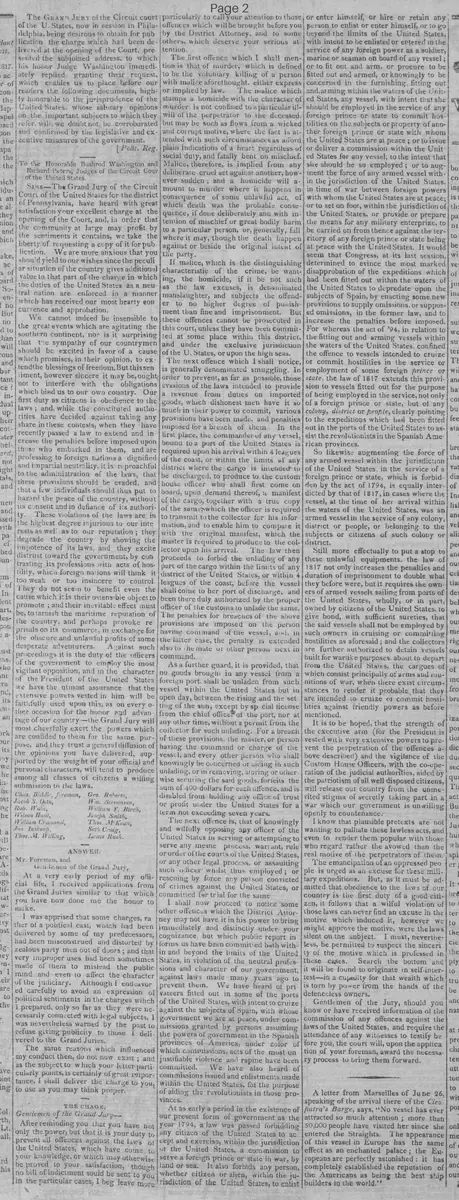
SIRS- The Grand Jury of the Circuit Court of the United States for the district of Pennsylvania, have heard with great satisfaction your excellent charge at the opening of the Court, and, in order that the community at large may profit by the sentiments it contains, we take the liberty of requesting a copy of it for publication. We are more anxious that you should yield to our wishes since the peculiar situation of the country gives additional value to that part of the charge in which the duties of the United States as a neutral nation are enforced in a manner which has received our most hearty concurrence and approbation,
We cannot indeed be insensible to the great events which are agitating the southern continent, nor is it surprising that the sympathy of our countrymen should be excited in favor of a cause which promises, in their opinion, to extend the blessings of freedom. But this sentiment, however sincere it may be, ought not to interfere with the obligations which bind us to our own country. Our first duty as citizens is obedience to the laws: and, while the constituted authorities have decided against taking any share in these contests, when they have recently passed a law to extend and increase the penalties before imposed upon those who embarked in them, and are professing to foreign nations a dignified and impartial neutrality, it is reproachful to the administration of the laws, that these provisions should be evaded, and that a few individuals should thus put to hazard the peace of the country, without its consent and in defiance of its authority. These violations of the laws are in the highest degree injurious to our interests as well as to our reputation; they degrade the country by showing the impotence of its laws, and they excite distrust toward the government, by contrasting its professions with acts of hostility, which foreign nations will think it too weak or too insincere to control.
They do not seem to benefit even the cause which it is their ostensible object to promote : and their inevitable effect must be, to tarnish the maritime reputation of the country, and perhaps provoke reprisals on its commerce, in exchange for the obscure and unlawful profits of some desperate adventurers. Against such proceedings it is the duty of the officers of the government to employ the most vigilant opposition, and in the character of the President of the United States we have the utmost assurance that the extensive powers vested in him will be faithfully used upon this, as on every other occasion for the honor and advantage of our country—the Grand Jury will most cheerfully exert the powers which are confided to them for the same purpose, and they trust a general diffusion of the opinions you have delivered, supported by the weight of your official and personal characters, will tend to produce among all classes of citizens a willing submission to the laws.
Chas. Biddle, Foreman,
Geo. Roberts,
Jacob S. Otto,
Wm. Stevenson,
Rob. Waln,
William Y. Birch,
Wilson Hunt,
Joseph Smith,
William Cramond,
Thos. M.Kean,
Jno. Inskeep,
Seth Craig,
Thos. M. Willing,
Lewis Rush.
ANSWER.
Mr. Foreman, and Gentlemen of the Grand Jury,
At a very early period of my official life, I received applications from the Grand Juries similar to that which you have now done me the honor to make.
I was apprised that some charges, rather of a political cast, which had been delivered by some of my predecessors, had been misconstrued and distorted by zealous party men out of doors; and that very improper uses had been sometimes made of them to mislead the public mind and even to affect the character of the judiciary. Although I endeavored carefully to avoid an expression of political sentiments in the charges which I prepared, only so far as they were necessarily connected with legal subjects, I was nevertheless warned by the past to refuse giving publicity to those I delivered to the Grand Juries.
The same reasons which influenced my conduct then, do not now exist ; and as the subject to which your letter particularly points, is certainly of great importance, I shall deliver the charge to you, to use as you may think proper.
THE CHARGE.
Gentlemen of the Grand Jury-
After reminding you that you have not only the power, but that it is your duty to present all offences against the laws of the United States, which have come to your knowledge, or which may otherwise be proved to your satisfaction, though no bill of indictment should be sent to you in the particular cases, I beg leave more particularly to call your attention to those offences which will be brought before you by the District Attorney, and to some others, which deserve your serious attention.
The first offence which I shall mention is that of murder, which is defined to be the voluntary killing of a person with malice aforethought, either express or implied by law. The malice which stamps a homicide with the character of murder. is not confined to a particular ill-will of the perpetrator to the deceased. but may be such as flows from a wicked and corrupt motive, where the fact is attended with such circumstances as afford plain indications of a heart regardless of social duty, and fatally bent on mischief.
Malice, therefore, is implied from any deliberate cruel act against another, however sudden; and a homicide will amount to murder where it happens in consequence of some unlawful act, of which death was the probable consequence, if done deliberately and with intention of mischief or great bodily harm to a particular person, or, generally, fall where it may, though the death happen against or beside the original intent of the party.
If malice, which is the distinguishing characteristic of the crime, be wanting, the homicide, if it be not such as the law excuses, is denominated manslaughter, and subjects the offender to no higher degree of punishment than fine and imprisonment. But these offences cannot be prosecuted in this court, unless they have been committed at some place within this district and under the exclusive jurisdiction of the U. States, or upon the high seas.
The next offence which I shall notice, is generally denominated smuggling. In order to prevent, as far as possible, those evasions of the laws intended to provide a revenue from duties on imported goods, which dishonest men have it so much in their power to commit, various provisions have been made, and penalties imposed for a breach of them. In the first place, the commander of any vessel, bound to a port of the United States is required upon his arrival within 4 leagues of the coast, or within the limits of any district where the cargo is intended to be discharged, to produce to the custom house officer who shall first come on board, upon demand thereof, a manifest of the cargo, together with a true copy of the same, which the officer is required to transmit to the collector for his information, and to enable him to compare it with the original manifest, which the master is required to produce to the collector upon his arrival. The law then proceeds to forbid the unlading of any part of the cargo within the limits of any district of the United States, or within 4 leagues of the coast, before the vessel shall come to her port of discharge, and been there duly authorized by the proper officer of the customs to unlade the same.
The penalties for breaches of the above provisions are imposed on the person having command of the vessel, and, in the latter case, the penalty is extended also to the mate or other person next in command.
As a further guard, it is provided, that no goods brought in any vessel from a foreign port, shall be unladen from such vessel within the United States but in open day, between the rising and the setting of the sun, except by special license from the chief officer of the port, nor at any other time, without a permit from the collector for such unlading. For a breach of these provisions. the master, or person having the command or charge of the vessel, and every other person who shall knowingly be concerned or aiding in such unlading, or in removing, storing or otherwise securing the said goods, forfeits the sum of 400 dollars for each offence, and is disabled from holding any office of trust or profit under the United States for a term not exceeding seven years.
The next offence is, that of knowingly and wilfully opposing any officer of the United States in serving or attempting to serve any mesne process, warrant, rule or order of the courts of the United States, or any other legal process, or assaulting such officer whilst thus employed; or rescuing by force any person convicted of crimes against the United States, or committed for trial for the same
I shall now proceed to notice some other offences which the District Attorney may not have it in his power to bring immediately and distinctly under your cognizance, but which public report informs us have been committed both within and beyond the limits of the United States, in violation of the neutral professions and character of our government, against laws made many years ago to prevent them. We have heard of privateers fitted out in some of the ports of the United States, with intent to cruize against the subjects of Spain, with whose government we are at peace, under commissions granted by persons assuming the powers of government in the Spanish provinces of America, under color of which commissions, acts of the most unjustifiable violence and rapine have been committed. We have also heard of commissions issued and enlistments made within the United States, for the purpose of aiding the revolutionists in those provinces.
At as early a period in the existence of our present form of government as the year 1794, a law was passed forbidding any citizen of the United States to accept and exercise, within the jurisdiction of the United States, a commission to serve a foreign prince or state in war, by land or sea. It also forbids any person, whether citizen or alien, within the jurisdiction of the United States, to enlist or enter himself, or hire or retain any person to enlist or enter himself, or to go beyond the limits of the United States, with intent to be enlisted or entered in the service of any foreign power as a soldier marine or seaman on board of any vessel ; or to fit out and arm, or procure to be fitted out and armed, or knowingly to be concerned in the furnishing, fitting out and arming within the waters of the United States, any vessel, with intent that she should be employed in the service of any foreign prince or state to commit hostilities on the subjects or property of another foreign prince or state with whom the United States are at peace ; or to issue or deliver a commission within the United States for any vessel, to the intent that she should be so employed; or to augment the force of any armed vessel within the jurisdiction of the United States, in time of war between foreign powers with whom the United States are at peace; or to set on foot, within the jurisdiction of the United States, or provide or prepare the means for any military enterprize, to be carried on from thence against the territory of any foreign prince or state being at peace with the United States.
It would seem that Congress, at its last session, determined to evince the most marked disapprobation of the expeditions which had been fitted out within the waters of the United States to depredate upon the subjects of Spain, by enacting some new provisions to supply omissions, or supposed omissions, in the former law, and to increase the penalties before imposed.
For whereas the act of '94, in relation to the fitting out and arming vessels within the waters of the United States, confined the offence to vessels intended to cruize or commit hostilities in the service or employment of some foreign prince or state, the law of 1817 extends this provision to vessels fitted out for the purpose of being employed in the service, not only of a foreign prince or state, but of any colony, district or people, clearly pointing to the expeditions which had been fitted out in the ports of the United States to assist the revolutionists in the Spanish American provinces.
So likewise augmenting the force of any armed vessel within the jurisdiction of the United States, in the service of a foreign prince or state, which is forbidden by the act of 1794, is equally interdicted by that of 1817, in cases where the vessel, at the time of her arrival within the waters of the United States, was an armed vessel in the service of any colony, district or people, or belonging to the subjects or citizens of such colony or district.
Still more effectually to put a stop to these unlawful equipments, the law of 1817 not only increases the penalties and duration of imprisonment to double what they before were, but it requires the owners of armed vessels sailing from ports of the United States, wholly, or in part, owned by citizens of the United States, to give bond, with sufficient sureties, that the said vessels shall not be employed by such owners in cruising or committing hostilities as aforesaid; and the collectors are further authorized to detain vessels built for warlike purposes, about to depart from the United States, the cargoes of which consist principally of arms and munitions of war, when there exist circumstances to render it probable that they are intended to cruize or commit hostilities against friendly powers as before mentioned.
It is to be hoped, that the strength of the executive arm (for the President is vested with very extensive powers to prevent the perpetration of the offences above described) and the vigilance of the Custom House Officers, with the co-operation of the judicial authorities, aided by the patriotism of all well disposed citizens, will release our country from the unmerited stigma of secretly taking part in a war which our government is unwilling openly to countenance.
I know that plausible pretexts are not wanting to palliate these lawless acts, and even to render them popular with those who regard rather the avowed than the real motive of the perpetrators of them. The emancipation of an oppressed people is urged as an excuse for these military expeditions. But, as it must be admitted that obedience to the laws of our country is the first duty of a good citizen, it follows that a wilful violation of those laws can never find an excuse in the motive which induced it, however we might approve the motive, were the laws silent on the subject. I must, nevertheless, be permitted to suspect the sincerity of the motive which is professed in these cases. Search the bottom and it will be found to originate in self-interest-in a cupidity for that wealth which is torn by power from the hands of the defenceless owners.
Gentlemen of the Jury, should you know or have received information of the commission of any offences against the laws of the United States, and require the attendance of any witnesses to testify before you, the court will, upon the application of your foreman, award the necessary process to bring them forward.
What sub-type of article is it?
What themes does it cover?
What keywords are associated?
What entities or persons were involved?
Where did it happen?
Story Details
Key Persons
Location
Philadelphia, Pennsylvania
Event Date
Now In Session
Story Details
The Grand Jury addresses Judges Washington and Peters requesting a copy of the court's opening charge for publication, emphasizing US neutrality in Spanish American conflicts. Judge Washington replies affirmatively. The charge instructs on offenses including murder, smuggling, resisting officers, and violations of neutrality laws like fitting out privateers and enlistments against Spain, referencing acts of 1794 and 1817.