Thank you for visiting SNEWPapers!
Sign up free
The Rhode Island American, And General Advertiser
Providence, Providence County, Rhode Island
What is this article about?
In 1814, a runaway enslaved woman and her two young children, who had hidden in North Carolina swamps for seven years to avoid separation, are captured after surviving on foraged food and trapped mice while maintaining strict silence.
Clipping
OCR Quality
Full Text
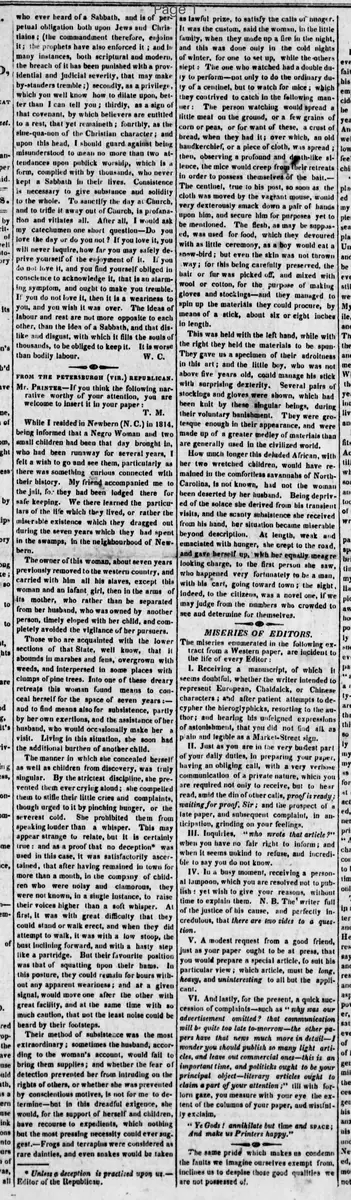
Mr. Printer-If you think the following narrative worthy of your attention, you are welcome to insert it in your paper:
T. M.
While I resided in Newbern (N. C.) in 1814, being informed that a Negro Woman and two small children had been that day brought in, who had been runaway for several years, I felt a wish to go and see them, particularly as there was something curious connected with their history. My friend accompanied me to the jail, for they had been lodged there for safe keeping. We there learned the particulars of the life which they lived, or rather the miserable existence which they dragged out during the seven years which they had spent in the swamps, in the neighbourhood of Newbern.
The owner of this woman, about seven years previously removed to the western country, and carried with him all his slaves, except this woman and an infant girl, then in the arms of its mother, who rather than be separated from her husband, who was owned by another person, timely eloped with her child, and completely avoided the vigilance of her pursuers. Those who are acquainted with the lower sections of that State, well know, that it abounds in marshes and fens, overgrown with weeds, and interspersed in some places with clumps of pine trees. Into one of these dreary retreats this woman found means to conceal herself for the space of seven years:- and to find means also for subsistence, partly by her own exertions, and the assistance of her husband, who would occasionally make her a visit. Living in this situation, she soon had the additional burthen of another child.
The manner in which she concealed herself as well as children from discovery, was truly singular. By the strictest discipline, she prevented them ever crying aloud; she compelled them to stifle their little cries and complaints, though urged to it by pinching hunger, or the severest cold. She prohibited them from speaking louder than a whisper. This may appear strange to relate, but it is certainly true: and as a proof that no deception was used in this case, it was satisfactorily ascertained, that after having remained in town for more than a month, in the company of children who were noisy and clamorous, they were not known, in a single instance, to raise their voices higher than a soft whisper. At first, it was with great difficulty that they could stand or walk erect, and when they did attempt to walk, it was with a low stoop, the bust inclining forward, and with a hasty step like a partridge. But their favourite position was that of squatting upon their hams. In this posture, they could remain for hours without any apparent weariness; and at a given signal, would move one after the other with great facility, and at the same time with so much caution, that not the least noise could be heard by their footsteps.
Their method of subsistence was the most extraordinary; sometimes the husband, according to the woman's account, would fail to bring them supplies; and whether the fear of detection prevented her from intruding on the rights of others, or whether she was prevented by conscientious motives, is not for me to determine-but in this dreadful exigence, she would, for the support of herself and children, have recourse to expedients, which nothing but the most pressing necessity could ever suggest. Frogs and terrapins were considered as rare dainties, and even snakes would be taken as lawful prize, to satisfy the calls of hunger. It was the custom, said the woman, in the little family, when they made up a fire in the night, and this was done only in the cold nights of winter, for one to set up, while the others slept: The one who watched had a double duty to perform—not only to do the ordinary duty of a centinel, but to watch for mice; which they contrived to catch in the following manner: The person watching would spread a little meal on the ground, or a few grains of corn or peas, or for want of these, a crust of bread, when they had it; over which, an old handkerchief, or a piece of cloth, was spread; then, observing a profound and death-like silence, the mice would creep from their retreats in order to possess themselves of the bait.— The centinel, true to his post, so soon as the cloth was moved by the vagrant mouse, would very dexterously smack down a pair of hands upon him, and secure him for purposes yet to be mentioned. The flesh, as may be supposed, was used for food, which they devoured with as little ceremony, as a boy would eat a snow-bird; but even the skin was not thrown away; for this being carefully preserved, the hair or fur was picked off, and mixed with wool or cotton, for the purpose of making gloves and stockings—and they managed to spin up the materials they could procure, by means of a stick, about six or eight inches in length.
This was held with the left hand, while with the right they held the materials to be spun- They gave us a specimen of their adroitness in this art; and the little boy, who was not above five years old, could manage his stick with surprising dexterity. Several pairs of stockings and gloves were shown, which had been knit by these singular beings, during their voluntary banishment. They were grotesque enough in their appearance, and were made up of a greater medley of materials than are generally used in the civilized world.
How much longer this deluded African, with her two wretched children, would have remained in the comfortless savannas of North-Carolina, is not known, had not the woman been deserted by her husband. Being deprived of the solace she derived from his transient visits, and the scanty subsistence she received from his hand, her situation became miserable beyond description. At length, weak and emaciated with hunger, she crept to the road, and gave herself up, with her equally meagre looking charge, to the first person she saw, who happened very fortunately to be a man, with his cart, going toward town; the sight, indeed, to the citizens, was a novel one, if we may judge from the numbers who crowded to see and determine for themselves.
* Unless a deception is practised upon us.- Editor of the Republican.
What sub-type of article is it?
What themes does it cover?
What keywords are associated?
What entities or persons were involved?
Where did it happen?
Story Details
Key Persons
Location
Swamps In The Neighbourhood Of Newbern (N. C.)
Event Date
1814 (After Seven Years In Swamps)
Story Details
A runaway enslaved woman and her infant daughter elope to avoid separation from her husband, surviving seven years in North Carolina swamps by foraging frogs, snakes, terrapins, and trapping mice, while disciplining her children to remain silent and hidden; deserted by her husband, she surrenders to authorities in 1814.