Thank you for visiting SNEWPapers!
Sign up free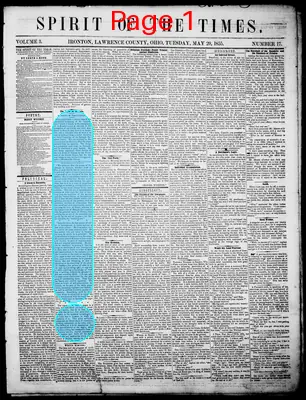
Spirit Of The Times
Portsmouth, Ironton, Scioto County, Lawrence County, Ohio
What is this article about?
Article excerpts Judge Lumpkin's opinion from Georgia Supreme Court on the degraded legal status of free and enslaved African Americans in Georgia, denying them civil rights and imposing strict restrictions to maintain white supremacy.
Merged-components note: Continuation of the same article discussing Judge Lumpkin's opinion on the status of African Americans in Georgia, with sequential reading order and adjacent bounding boxes.
Clipping
OCR Quality
Full Text
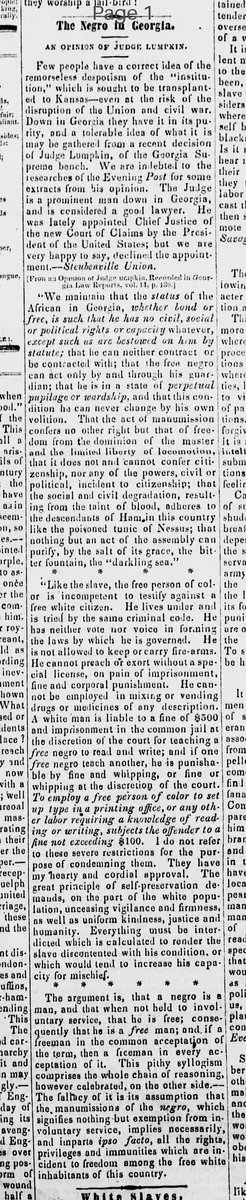
AN OPINION OF JUDGE LUMPKIN.
Few people have a correct idea of the remorseless despotism of the "institution," which is sought to be transplanted to Kansas--even at the risk of the disruption of the Union and civil war.
Down in Georgia they have it in its purity, and a tolerable idea of what it is may be gathered from a recent decision of Judge Lumpkin, of the Georgia Supreme bench. We are indebted to the researches of the Evening Post for some extracts from his opinion. The Judge is a prominent man down in Georgia, and is considered a good lawyer. He was lately appointed Chief Justice of the new Court of Claims by the President of the United States; but we are very happy to say, declined the appointment.--Steubenville Union.
[From an Opinion of Judge Lumpkin, Recorded in Georgia Law Reports, vol. 14, p. 135.]
We maintain that the status of the African in Georgia, whether bond or free, is such that he has no civil, social or political rights or capacity whatever, except such as are bestowed on him by statute; that he can neither contract or be contracted with; that the free negro can act only by and through his guardian; that he is in a state of perpetual pupilage or wardship, and that this condition he can never change by his own volition. That the act of manumission confers no other right but that of freedom from the dominion of the master and the limited liberty of locomotion, that it does not and cannot confer citizenship, nor any of the powers, civil or political, incident to citizenship; that the social and civil degradation, resulting from the taint of blood, adheres to the descendants of Ham in this country like the poisoned tunic of Nessus; that nothing but an act of the assembly can purify, by the salt of its grace, the bitter fountain, the "darkling sea."
Like the slave, the free person of color is incompetent to testify against a free white citizen. He lives under and is tried by the same criminal code. He has neither vote nor voice in forming the laws by which he is governed. He is not allowed to keep or carry fire-arms. He cannot preach or exhort without a special license, on pain of imprisonment, fine and corporal punishment. He cannot be employed in mixing or vending drugs or medicines of any description. A white man is liable to a fine of $500 and imprisonment in the common jail at the discretion of the court for teaching a free negro to read and write; and if one free negro teach another, he is punishable by fine and whipping, or fine or whipping at the discretion of the court.
To employ a free person of color to set up type in a printing office, or any other labor requiring a knowledge of reading or writing, subjects the offender to a fine not exceeding $100. I do not refer to these severe restrictions for the purpose of condemning them. They have my hearty and cordial approval. The great principle of self-preservation demands, on the part of the white population, unceasing vigilance and firmness as well as uniform kindness, justice and humanity. Everything must be interdicted which is calculated to render the slave discontented with his condition, or which would tend to increase his capacity for mischief.
The argument is, that a negro is a man, and that when not held to involuntary service, that he is free; consequently that he is a free man; and, if a freeman in the common acceptation of the term, then a freeman in every acceptation of it. This pithy syllogism comprises the whole chain of reasoning, however celebrated, on the other side.--
The fallacy of it is its assumption that the manumission of the negro, which signifies nothing but exemption from involuntary service, implies necessarily, and imparts ipso facto, all the rights, privileges and immunities which are incident to freedom among the free white inhabitants of this country.
What sub-type of article is it?
What keywords are associated?
What entities or persons were involved?
Where did it happen?
Domestic News Details
Primary Location
Georgia
Event Date
Recorded In Georgia Law Reports, Vol. 14, P. 135
Key Persons
Event Details
Judge Lumpkin's opinion asserts that Africans in Georgia, bond or free, possess no civil, social, or political rights except those granted by statute; free negroes remain in perpetual wardship, cannot contract, testify against whites, vote, bear arms, preach without license, or be taught to read/write under penalty; restrictions approved for white self-preservation.