Thank you for visiting SNEWPapers!
Sign up free
Story
September 30, 1865
The Shasta Courier
Shasta, Shasta County, California
What is this article about?
Small fish are ejected from artesian wells in the northern Sahara desert at depths of 150-200 feet. Swiss naturalist M. Desor confirms their authenticity, noting the healthy, eyed Cyprinodon fish, unlike blind cave fish, likely due to subterranean connections to surface ponds.
Clipping
OCR Quality
95%
Excellent
Full Text
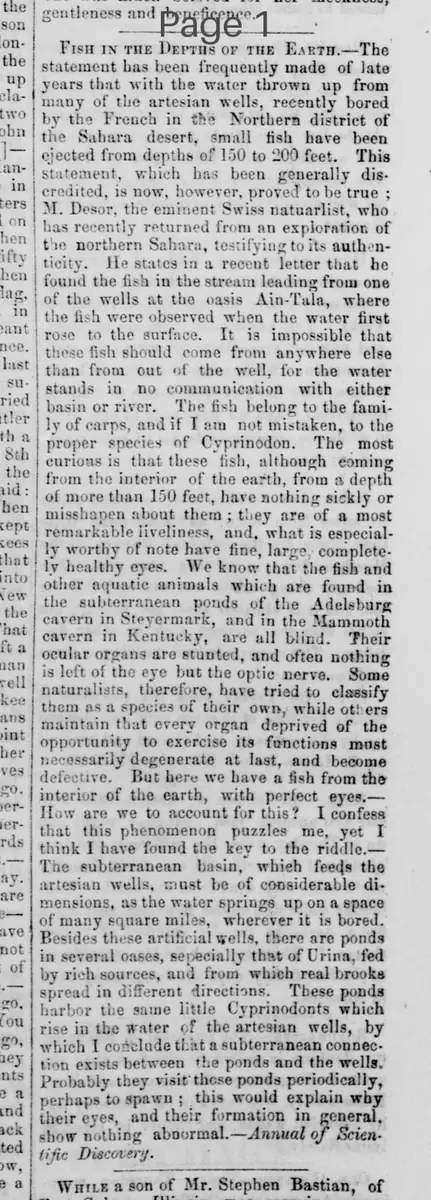
Fish in the Depths of the Earth.—The statement has been frequently made of late years that with the water thrown up from many of the artesian wells, recently bored by the French in the Northern district of the Sahara desert, small fish have been ejected from depths of 150 to 200 feet. This statement, which has been generally discredited, is now, however, proved to be true; M. Desor, the eminent Swiss naturalist, who has recently returned from an exploration of the northern Sahara, testifying to its authenticity. He states in a recent letter that he found the fish in the stream leading from one of the wells at the oasis Ain-Tala, where the fish were observed when the water first rose to the surface. It is impossible that these fish should come from anywhere else than from out of the well, for the water stands in no communication with either basin or river. The fish belong to the family of carps, and if I am not mistaken, to the proper species of Cyprinodon. The most curious is that these fish, although coming from the interior of the earth, from a depth of more than 150 feet, have nothing sickly or misshapen about them; they are of a most remarkable liveliness, and, what is especially worthy of note have fine, large, completely healthy eyes. We know that the fish and other aquatic animals which are found in the subterranean ponds of the Adelsburg cavern in Styermark, and in the Mammoth cavern in Kentucky, are all blind. Their ocular organs are stunted, and often nothing is left of the eye but the optic nerve. Some naturalists, therefore, have tried to classify them as a species of their own, while others maintain that every organ deprived of the opportunity to exercise its functions must necessarily degenerate at last, and become defective. But here we have a fish from the interior of the earth, with perfect eyes.—How are we to account for this? I confess that this phenomenon puzzles me, yet I think I have found the key to the riddle.—The subterranean basin, which feeds the artesian wells, must be of considerable dimensions, as the water springs up on a space of many square miles, wherever it is bored. Besides these artificial wells, there are ponds in several oases, especially that of Urina, fed by rich sources, and from which real brooks spread in different directions. These ponds harbor the same little Cyprinodonts which rise in the water of the artesian wells, by which I conclude that a subterranean connection exists between the ponds and the wells. Probably they visit these ponds periodically, perhaps to spawn; this would explain why their eyes, and their formation in general, show nothing abnormal.—Annual of Scientific Discovery.
What sub-type of article is it?
Curiosity
Extraordinary Event
What themes does it cover?
Nature
What keywords are associated?
Artesian Wells
Sahara Fish
Subterranean Fish
Cyprinodon
Blind Cave Fish
Naturalist Exploration
What entities or persons were involved?
M. Desor
Where did it happen?
Northern Sahara Desert, Oasis Ain Tala, Oasis Urina
Story Details
Key Persons
M. Desor
Location
Northern Sahara Desert, Oasis Ain Tala, Oasis Urina
Story Details
Small fish are found emerging from artesian wells in the Sahara at depths over 150 feet; unlike blind subterranean fish, these Cyprinodon are healthy and eyed, explained by periodic access to surface ponds via subterranean connections.