Thank you for visiting SNEWPapers!
Sign up free
Editorial
April 2, 1871
New York Dispatch
New York, New York County, New York
What is this article about?
Rev. L. A. Alford argues that Freemasonry's greatest threats come from unworthy members rather than external critics, emphasizing its moral superiority, charitable ethos, and eternal symbols rooted in divine truths, ensuring its immortality.
Clipping
OCR Quality
95%
Excellent
Full Text
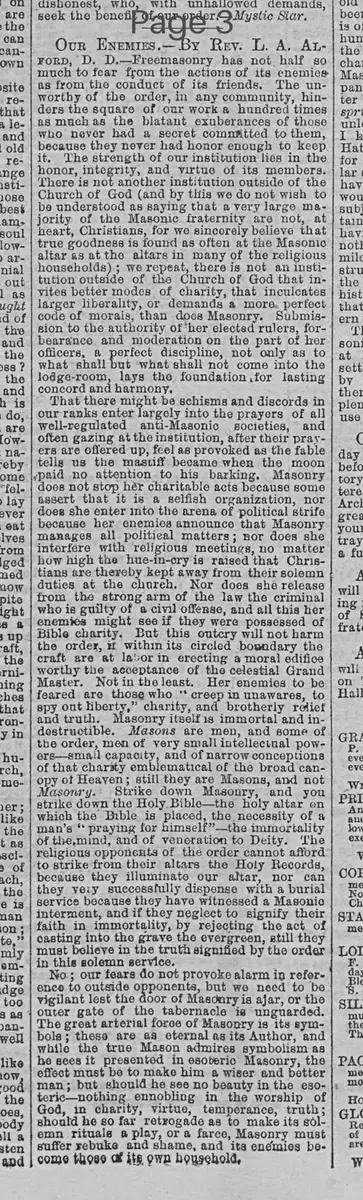
Our Enemies.—By Rev. L. A. Alford, D. D.—Freemasonry has not half so much to fear from the actions of its enemies as from the conduct of its friends. The unworthy of the order, in any community, hinders the square of our work a hundred times as much as the blatant exuberances of those who never had a secret committed to them, because they never had honor enough to keep it. The strength of our institution lies in the honor, integrity, and virtue of its members. There is not another institution outside of the Church of God (and by this we do not wish to be understood as saying that a very large majority of the Masonic fraternity are not, at heart, Christians, for we sincerely believe that true goodness is found as often at the Masonic altar as at the altars in many of the religious households); we repeat, there is not an institution outside of the Church of God that invites better modes of charity, that inculcates larger liberality, or demands a more perfect code of morals, than does Masonry. Submission to the authority of her elected rulers, forbearance and moderation on the part of her officers, a perfect discipline, not only as to what shall but what shall not come into the lodge-room, lays the foundation for lasting concord and harmony.
That there might be schisms and discords in our ranks enter largely into the prayers of all well-regulated anti-Masonic societies, and often gazing at the institution, after their prayers are offered up, feel as provoked as the fable tells us the mastiff became when the moon paid no attention to his barking. Masonry does not stop her charitable acts because some assert that it is a selfish organization, nor does she enter into the arena of political strife because her enemies announce that Masonry manages all political matters: nor does she interfere with religious meetings, no matter how high the hue-and-cry is raised that Christians are thereby kept away from their solemn duties at the church. Nor does she release from the strong arm of the law the criminal who is guilty of a civil offense, and all this her enemies might see if they were possessed of Bible charity. But this outcry will not harm the order, if within its circled boundary the craft are at labor in erecting a moral edifice worthy the acceptance of the celestial Grand Master. Not in the least. Her enemies to be feared are those who "creep in unawares, to spy out liberty," charity, and brotherly relief and truth, Masonry itself is immortal and indestructible. Masons are men, and some of the order, men of very small intellectual powers—small capacity, and of narrow conceptions of that charity emblematical of the broad canopy of Heaven; still they are Masons, and not Masonry. Strike down Masonry, and you strike down the Holy Bible the holy altar on which the Bible is placed, the necessity of a man's "praying for himself" the immortality of the mind, and of veneration to Deity. The religious opponents of the order cannot afford to strike from their altars the Holy Records, because they illuminate our altar, nor can they very successfully dispense with a burial service because they have witnessed a Masonic interment, and if they neglect to signify their faith in immortality, by rejecting the act of casting into the grave the evergreen, still they must believe in the truth signified by the order in this solemn service.
No; our fears do not provoke alarm in reference to outside opponents, but we need to be vigilant lest the door of Masonry is ajar, or the outer gate of the tabernacle is unguarded The great arterial force of Masonry is its symbols: these are as eternal as its Author, and while the true Mason admires symbolism as he sees it presented in esoteric Masonry, the effect must be to make him a wiser and better man; but should he see no beauty in the esoteric—nothing ennobling in the worship of God, in charity, virtue, temperance, truth; should he so far retrograde as to make its solemn rituals a play, or a farce, Masonry must suffer rebuke and shame, and its enemies become those of its own household We do not fear such an occurrence, because its symbols, many of them, are the reflex light of the Divine, and must remain on earth so long as God governs it. The canopy—the altar the checkered pavement the seven golden candlesticks—the ark and the lights—are as perfectly parts of symbolic Masonry to-day as they were in the days of the prophets, and of the model king of human architecture King Solomon. And on, till waves cease to dash upon the shore, and comets cease to sweep their wondrous course, and geometry and all the liberal arts crumble and fall. Masonry must survive.—Voice of Masonry.
That there might be schisms and discords in our ranks enter largely into the prayers of all well-regulated anti-Masonic societies, and often gazing at the institution, after their prayers are offered up, feel as provoked as the fable tells us the mastiff became when the moon paid no attention to his barking. Masonry does not stop her charitable acts because some assert that it is a selfish organization, nor does she enter into the arena of political strife because her enemies announce that Masonry manages all political matters: nor does she interfere with religious meetings, no matter how high the hue-and-cry is raised that Christians are thereby kept away from their solemn duties at the church. Nor does she release from the strong arm of the law the criminal who is guilty of a civil offense, and all this her enemies might see if they were possessed of Bible charity. But this outcry will not harm the order, if within its circled boundary the craft are at labor in erecting a moral edifice worthy the acceptance of the celestial Grand Master. Not in the least. Her enemies to be feared are those who "creep in unawares, to spy out liberty," charity, and brotherly relief and truth, Masonry itself is immortal and indestructible. Masons are men, and some of the order, men of very small intellectual powers—small capacity, and of narrow conceptions of that charity emblematical of the broad canopy of Heaven; still they are Masons, and not Masonry. Strike down Masonry, and you strike down the Holy Bible the holy altar on which the Bible is placed, the necessity of a man's "praying for himself" the immortality of the mind, and of veneration to Deity. The religious opponents of the order cannot afford to strike from their altars the Holy Records, because they illuminate our altar, nor can they very successfully dispense with a burial service because they have witnessed a Masonic interment, and if they neglect to signify their faith in immortality, by rejecting the act of casting into the grave the evergreen, still they must believe in the truth signified by the order in this solemn service.
No; our fears do not provoke alarm in reference to outside opponents, but we need to be vigilant lest the door of Masonry is ajar, or the outer gate of the tabernacle is unguarded The great arterial force of Masonry is its symbols: these are as eternal as its Author, and while the true Mason admires symbolism as he sees it presented in esoteric Masonry, the effect must be to make him a wiser and better man; but should he see no beauty in the esoteric—nothing ennobling in the worship of God, in charity, virtue, temperance, truth; should he so far retrograde as to make its solemn rituals a play, or a farce, Masonry must suffer rebuke and shame, and its enemies become those of its own household We do not fear such an occurrence, because its symbols, many of them, are the reflex light of the Divine, and must remain on earth so long as God governs it. The canopy—the altar the checkered pavement the seven golden candlesticks—the ark and the lights—are as perfectly parts of symbolic Masonry to-day as they were in the days of the prophets, and of the model king of human architecture King Solomon. And on, till waves cease to dash upon the shore, and comets cease to sweep their wondrous course, and geometry and all the liberal arts crumble and fall. Masonry must survive.—Voice of Masonry.
What sub-type of article is it?
Moral Or Religious
What keywords are associated?
Freemasonry
Enemies
Morality
Charity
Symbols
Anti Masonic
Masonic Principles
What entities or persons were involved?
Rev. L. A. Alford
Freemasonry
Anti Masonic Societies
Church Of God
King Solomon
Editorial Details
Primary Topic
Defense Of Freemasonry Against Internal And External Enemies
Stance / Tone
Defensive And Affirming Of Masonic Principles
Key Figures
Rev. L. A. Alford
Freemasonry
Anti Masonic Societies
Church Of God
King Solomon
Key Arguments
Freemasonry Fears Unworthy Members More Than External Enemies
Strength Lies In Honor, Integrity, And Virtue Of Members
Masonry Promotes Charity, Liberality, And Moral Code Superior To Most Institutions
External Critics' Attacks Do Not Harm If Internal Conduct Is Proper
Masonic Symbols Are Eternal And Divine
True Masons Improve Through Esoteric Teachings
Masonry Survives As Long As Divine Truths Endure