Thank you for visiting SNEWPapers!
Sign up free
The Daily Phoenix
Columbia, Richland County, South Carolina
What is this article about?
In Columbia, S.C., the Alexander Convention nominates incumbent Mayor John Alexander for re-election on March 16, 1872, despite some dissent from colored citizens. Alexander thanks supporters, defends his record as a working man's champion, and warns against the citizens' movement. The article criticizes his past actions and role in city frauds, illustrated by an anecdote about praising the devil's talents.
Clipping
OCR Quality
Full Text
Sunday Morning, March 17, 1872.
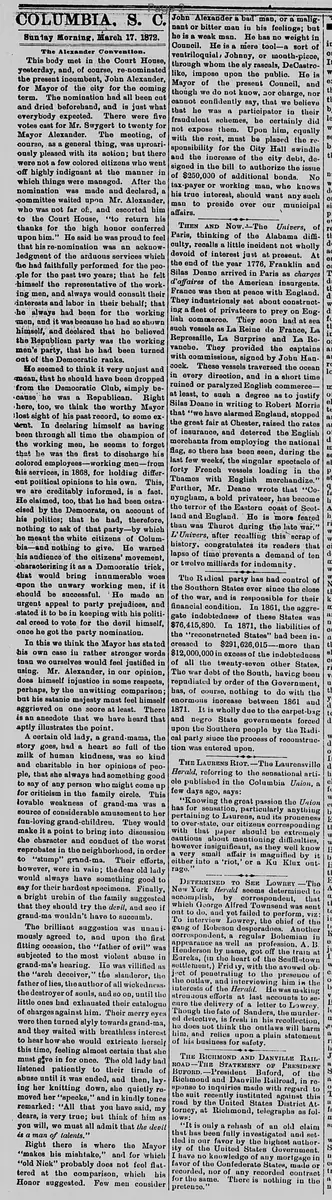
The Alexander Convention.
This body met in the Court House, yesterday, and, of course, re-nominated the present incumbent, John Alexander, for Mayor of the city for the coming term. The nomination had all been cut and dried beforehand, and is just what everybody expected. There were five votes cast for Mr. Swygert to twenty for Mayor Alexander. The meeting, of course, as a general thing, was uproariously pleased with its action; but there were not a few colored citizens who went off highly indignant at the manner in which things were managed. After the nomination was made and declared, a committee waited upon Mr. Alexander, who was not far off, and escorted him to the Court House, "to return his thanks for the high honor conferred upon him." He said he was proud to feel that his re-nomination was an acknowledgment of the arduous services which he had faithfully performed for the people for the past two years; that he felt himself the representative of the working men, and always would consult their interests and labor in their behalf; that he always had been for the working men, and it was because he had so shown himself, and declared that he believed the Republican party was the working men's party, that he had been turned out of the Democratic ranks.
He seemed to think it very unjust and mean, that he should have been dropped from the Democratic Club, simply because he was a Republican. Right here, too, we think the worthy Mayor lost sight of his past record, to some extent. In declaring himself as having through all time the champion of the working men, he seems to forget that he was the first to discharge his colored employees--working men--from his services, in 1868, for holding different political opinions to his own. This, we are creditably informed, is a fact.
He claimed, too, that he had been ostracised by the Democrats, on account of his politics; that he had, therefore, nothing to ask of that party--by which he meant the white citizens of Columbia--and nothing to give. He warned his audience of the citizens' movement, characterizing it as a Democratic trick, that would bring innumerable woes upon the unwary working men, if it should be successful. He made an urgent appeal to party prejudices, and stated it to be in keeping with his political creed to vote for the devil himself, once he got the party nomination.
In this we think the Mayor has stated his own case in rather stronger words than we ourselves would feel justified in using. Mr. Alexander, in our opinion, does himself injustice in some respects, perhaps, by the unwitting comparison; but his satanic majesty must feel himself aggrieved on one score at least. There is an anecdote that we have heard that aptly illustrates the point.
A certain old lady, a grand-mama, the story goes, had a heart so full of the milk of human kindness, was so kind and charitable in her opinions of people, that she always had something good to say of any person who might come up for criticism in the family circle. This lovable weakness of grand-ma was a source of considerable amusement to her fun-loving grand-children. They would make it a point to bring into discussion the character and conduct of the worst reprobates in the neighborhood, in order to "stump" grand-ma. Their efforts, however, were in vain; the dear old lady would always have something good to say for their baddest specimens. Finally, a bright urchin of the family suggested that they should try the devil, and see if grand-ma wouldn't have to succumb.
The brilliant suggestion was unanimously agreed to, and upon the first fitting occasion, the "father of evil" was subjected to the most violent abuse in grand-ma's hearing. He was vilified as the "arch deceiver," the slanderer, the father of lies, the author of all wickedness, the destroyer of souls, and so on, until the little ones had exhausted their catalogue of charges against him. Their merry eyes were then turned slyly towards grand-ma, and they waited with breathless interest to hear how she would extricate herself this time, feeling almost certain that she must give in for once. The old lady had listened patiently to their tirade of abuse until it was ended, and then, laying her knitting down, she quietly removed her "specks," and in kindly tones remarked: "All that you have said, my dears, is very true; but think of him as you will, we must all admit that the devil is a man of talents."
Right there is where the Mayor "makes his mistake," and for which "old Nick" probably does not feel flattered at the comparison, which his Honor suggested. Few men consider John Alexander a bad man, or a malignant or bitter man in his feelings; but he is a weak man. He has no weight in Council. He is a mere tool--a sort of ventriloquial Johnny, or mouth-piece, through whom the sly rascals, DeCastro-like, impose upon the public. He is Mayor of the present Council, and though we do not know, nor charge, nor cannot confidently say, that we believe that he was a participator in their fraudulent schemes, he certainly did not expose them. Upon him, equally with the rest, must be placed the responsibility for the City Hall swindle and the increase of the city debt, designed in the bill to authorize the issue of $250,000 of additional bonds. No tax-payer or working man, who knows his true interest, should want any such man to preside over our municipal affairs.
What sub-type of article is it?
What themes does it cover?
What keywords are associated?
What entities or persons were involved?
Where did it happen?
Story Details
Key Persons
Location
Columbia, S. C., Court House
Event Date
March 16, 1872
Story Details
The Alexander Convention nominates John Alexander for re-election as Mayor amid dissent from some colored citizens. Alexander delivers a speech defending his service to working men and Republican affiliation, warning against Democratic tricks. The article critiques his hypocrisy, past dismissal of colored employees in 1868, weakness, and complicity in city frauds, using an anecdote about an old lady praising the devil's talents to illustrate forced compliments.