Thank you for visiting SNEWPapers!
Sign up free
The St. Paul Echo
St. Paul, Minneapolis, Ramsey County, Hennepin County, Minnesota
What is this article about?
Colonel Deport, inventor of the French '75' rapid-firing gun, revealed how early models were accidentally shipped to Germany, examined but dismissed by officers as unmanageable, and returned, allowing France to retain the technology that saved it in World War I.
Clipping
OCR Quality
Full Text
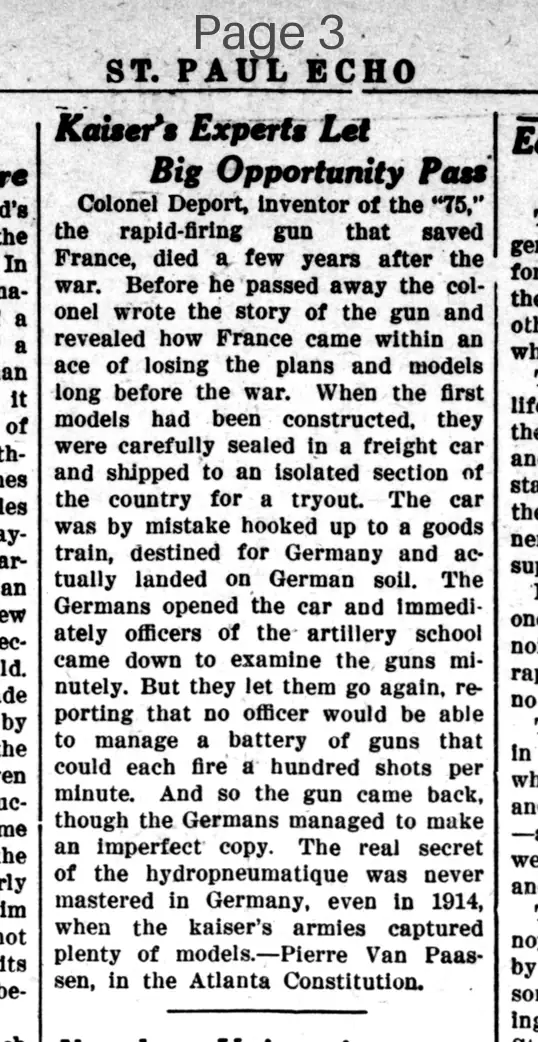
Kaiser's Experts Let Big Opportunity Pass
Colonel Deport, inventor of the "75," the rapid-firing gun that saved France, died a few years after the war. Before he passed away the colonel wrote the story of the gun and revealed how France came within an ace of losing the plans and models long before the war. When the first models had been constructed, they were carefully sealed in a freight car and shipped to an isolated section of the country for a tryout. The car was by mistake hooked up to a goods train, destined for Germany and actually landed on German soil. The Germans opened the car and immediately officers of the artillery school came down to examine the guns minutely. But they let them go again, reporting that no officer would be able to manage a battery of guns that could each fire a hundred shots per minute. And so the gun came back, though the Germans managed to make an imperfect copy. The real secret of the hydropneumatique was never mastered in Germany, even in 1914, when the kaiser's armies captured plenty of models.—Pierre Van Paassen, in the Atlanta Constitution.
What sub-type of article is it?
What keywords are associated?
What entities or persons were involved?
Where did it happen?
Foreign News Details
Primary Location
France, Germany
Event Date
Long Before The War; 1914
Key Persons
Outcome
models returned to france; germans made imperfect copy but never mastered hydropneumatique secret, even after capturing models in 1914
Event Details
First models of the '75' gun sealed in freight car for tryout but mistakenly hooked to train for Germany, landed on German soil, examined by artillery officers who dismissed them as unmanageable and let them go; gun saved France in the war