Thank you for visiting SNEWPapers!
Sign up free
Editorial
January 25, 1834
Republican Herald
Providence, Providence County, Rhode Island
What is this article about?
Editorial opposes the U.S. Bank as unconstitutional and economically destabilizing, citing crises in 1818, 1825, and current events. Praises Sen. Benton's speech and defends Pres. Jackson's legal removal of deposits, criticizing Bank allies like Clay as corrupt.
Clipping
OCR Quality
95%
Excellent
Full Text
FOR THE HERALD.
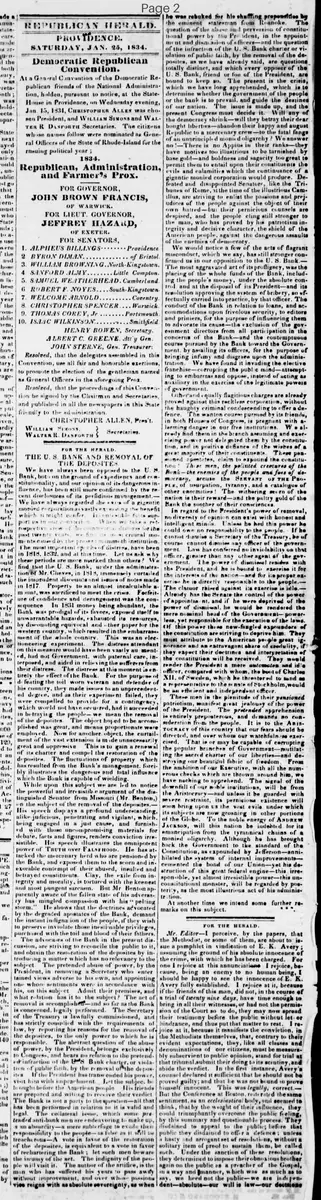
THE U. S. BANK AND REMOVAL OF THE DEPOSITES.
We have always been opposed to the U. S. Bank, both on the ground of expediency and constitutionality, and our opinion of its dangerous influence, has been still more confirmed by the recent disclosures of its perfidious management.—We have always regarded the evil of a gigantic monied corporation as vastly exceeding the benefit which it might confer. Irresistible fascination supports us in our conviction, when we take a retrospective view of the scenes darkening the past twenty years. We have seen crises and embarrassments caused by the present mammoth institution. The most important epochs of distress, have been in 1818, 1825, and at this time. Let us ask why these periods are more marked than others? We find that the U. S. Bank, under the administration of Mr. Cheves, in 1818, immensely curtailed the imprudent discounts and issues of notes made in 1817. Property to an almost incalculable amount, was sacrificed to meet the crisis. Forfeiture of confidence and derangement was the consequence.
In 1825 money being abundant, the Bank was prodigal of its favors, exposed itself to unwarrantable hazards, exhausted its resources, by discounting equivocal and other paper for the western country, which resulted in the embarrassment of the whole country. This was an electioneering experiment. The distress attendant on this measure would have been vastly augmented, had not Government, with paternal care, interposed, and aided in relieving the sufferers from their distress. The distress at this moment is entirely the effect of the Bank. For the purpose of defeating the toil worn veteran and defender of his country, they made issues to an unprecedented degree, and as their experiment failed, they were compelled to provide for a contingency, which would not have occurred, had it succeeded in betraying the people—we mean the removal of the deposits. The object hoped to be accomplished was great, and means proportionate were employed. Now for another object, the curtailment of the vast extension is made unnecessarily great and oppressive. This is to gain a renewal of its charter and compel the restoration of the deposits. The fluctuations of property which has resulted from the Bank's management, forcibly illustrates the dangerous and fatal influence which the Bank is capable of wielding.
While upon this subject we are led to notice the powerful and irresistible argument of the distinguished Senator from Missouri (Mr. Benton,) on the subject of the removal of the deposits.—His speech displays a profound understanding alike judicious, penetrating and vigilant, which, being engaged in a just cause, and furnished with those uncompromising materials for debate, facts and figures, renders conviction irresistible. His speech illustrates the omnipotent power of Truth over Falsehood. He has attacked the mercenary herd who are pensioned by the Bank, and exposed them to the scorn and inexorable contempt of their abused, insulted and betrayed constituents. Clay, the exile from integrity and morality, is tortured with the keenest and most pungent sarcasm. But Mr. Benton apparently aware of the fallen state of his adversary has mingled compassion with his "pelting storm." He shows that the doctrines advocated by the degraded apostates of the Bank, demand the instant indignation of the people, if they wish to preserve inviolate those inestimable privileges, purchased with the toil and blood of their fathers. The advocates of the Bank in the present discussion, are striving to reconcile the public to it, and obtain the restoration of the deposits by introducing a matter which has no relevancy to the subject. The pretended abuse of power, by the President, in removing a Secretary who entertained views adverse to his own, and appointing one whose sentiments were in accordance with his, on this subject. Admit their premises, and what relation has it to the subject? The act of removal is accomplished—and so far as the Bank is concerned, legally performed. The Secretary of the Treasury is lawfully commissioned, and has strictly complied with the requirements of law, by reporting his reasons for the removal of the deposits, to the only power to which he is responsible. The abstract question of the abuse of power, by the President, belongs exclusively to Congress, and bears no relation to the pretended infraction of the U. S. Bank charter, or violation of public faith, by the removal of the deposits. If the President has transcended his power, visit him with impeachment. Let the subject be brought before the American people. His friends are prepared and willing to receive their verdict. The Bank is not a party to the question—all that has been performed in relation to it is valid and legal. The collateral issue, which some pretended anti-bank men are endeavoring to make up, is an absurdity—a mere subterfuge to evade their responsibility to the people—as false as it will be treacherous. A vote in favor of the restoration of the deposits, is equivalent to a vote in favor of rechartering the Bank; let such men beware the infamy of the act. The indignity of the people will visit it. The author of the artifice, is the man who has suffered his years to pass away without improvement, and over whose passions vice reigns with an absolute sovereignty, as when he was rebuked for his assuming propensities by the eminent statesman from Roanoke. The question of the abuse and perversion of constitutional power by the President, in the appointment and dismission of officers—and the question of the infraction of the U. S. Bank charter or violation of public faith, by the removal of the deposits, as we have already said, are questions totally distinct, and which every opposer of the U. S. Bank, friend or foe of the President, are bound to keep so. The present is the crisis which we have long apprehended, which is to determine whether the government of the people or the bank is to prevail, and guide the destiny of our nation. The issue is made up, and the present Congress must decide it. Will any of the democracy shrink—will they betray their dear bought liberties—abandon their happy and august Republic to a mercenary crew—to the fatal fangs of an unprincipled monied oligarchy? We answer no! There is no Appius in their ranks—they have motives too illustrious to be tarnished by base gold—and boldness and sagacity too great to permit them to entail upon their constituents the evils and calamities which the continuance of gigantic monied corporation would produce. Defeated and disappointed Senators, like the Tribunes of Rome, at the time of the illustrious Camillus, are striving to enlist the passions and prejudices of the people against the object of their own hatred—but their pernicious counsels are despised, and the people cling still stronger to the man, who has proved by his patriotism integrity and decisive character, the shield of the American people, against the dangerous assaults of the enemies of democracy.
We would notice a few of the acts of flagrant misconduct, which we say, has still stronger confirmed us in our opposition to the U. S. Bank.—The most aggravated act of its profligacy, was the placing of the whole funds of the Bank, including the people's money, under the absolute control and at the disposal of its President—and its resolution approving the system of bribery, so effectually carried into practice, by that officer. The conduct of the Bank in relation to loans, and accommodations upon frivolous security, to editors and printers, for the purpose of influencing them to advocate its cause—the exclusion of the government directors from all participation in the concerns of the Bank—and the contemptuous course pursued by the Bank toward the Government, by assailing its officers, for the purpose of bringing infamy and disgrace upon the administration. We have found it invading the elective franchise—corrupting the public mind—attempting to embarrass and oppose, instead of acting as auxiliary in the exercise of illegitimate powers of government.
Other and equally flagitious charges are already proved against this reckless corporation, without the haughty criminal condescending to offer defence. The wanton course pursued by its friends, in both Houses of Congress, is pregnant with alarming danger to our free institutions. We already find them in the branch assuming and exercising power not delegated them by the constitution, and in positive defiance of the wishes of a great majority of their constituents. These pensioned apostates, claim to expound the constitution. These men, the polluted creatures of the Bank—the enemies of the people and foes of democracy, accuse the Servant of The People, of usurpation, tyranny, and a catalogue of other enormities! The withering scorn of the nation is their reward—and the paltry gold of the Bank the soother of their consciences.
In regard to the President's power of removal, no diversity of opinion can exist with honest and intelligent minds. Unless he had this power he could owe no responsibility to the people. If he cannot dismiss a Secretary of the Treasury, he of course cannot dismiss any officer of the government. Law has conferred no inviolability on that officer, greater than any other agent of the government. The power of dismissal resides with the President, and he is bound to exercise it for the interests of the nation—and for its proper exercise he is directly responsible to the people.—The clamor raised against its exercise is idle.
Already has the Senate—the control of the power of appointment, and if he were deprived of the power of dismissal, he would be rendered the mere nominal head of the Government—powerless, yet responsible for the execution of the laws. Of this power these new-fangled expounders of the constitution are striving to deprive him. They must attribute to the American people great ignorance and an extravagant share of credulity, if they expect their doctrines and interpretation of the constitution will be received. They would render the President a mere automaton and idle officer, compared with whom, the boot of Charles XII. of Sweden, which he threatened to send a representative to the senate of Stockholm, would be an efficient and independent officer.
These men in the plenitude of their pensioned patriotism, manifest great jealousy of the power of the President. The pretended apprehension is entirely preposterous, and demands no consideration from the people. It is to the Aristocracy of this country that our fears should be directed, and over whom our watchfulness exercised. That it or may be capable of corrupting the popular branches of Government—mutilating the sacred charter of our liberties—and destroying our beautiful fabric of freedom. From the ambition of our Executive, with all the numerous checks which are thrown around him, we have nothing to apprehend. The signal of the downfall of our noble institutions, will be from the Aristocracy—and unless it be guarded with severe restraint, its pernicious existence will soon bring upon us the vast evils under which its subjects are now groaning in other portions of the Globe. To the noble energy of Andrew Jackson, will this nation be indebted for its emancipation from the tyrannical chains of monied oligarchy. Although he has brought back the Government to the standard of the Constitution, as expounded by Jefferson—annihilated the system of internal improvements—cemented the bond of our Union—yet his destruction of this great federal engine—this irresponsible, yet almost irresistible power—this unconstitutional monster, will be regarded by posterity, as the most illustrious act of his administration.
At another time we intend some further remarks on this subject.
THE U. S. BANK AND REMOVAL OF THE DEPOSITES.
We have always been opposed to the U. S. Bank, both on the ground of expediency and constitutionality, and our opinion of its dangerous influence, has been still more confirmed by the recent disclosures of its perfidious management.—We have always regarded the evil of a gigantic monied corporation as vastly exceeding the benefit which it might confer. Irresistible fascination supports us in our conviction, when we take a retrospective view of the scenes darkening the past twenty years. We have seen crises and embarrassments caused by the present mammoth institution. The most important epochs of distress, have been in 1818, 1825, and at this time. Let us ask why these periods are more marked than others? We find that the U. S. Bank, under the administration of Mr. Cheves, in 1818, immensely curtailed the imprudent discounts and issues of notes made in 1817. Property to an almost incalculable amount, was sacrificed to meet the crisis. Forfeiture of confidence and derangement was the consequence.
In 1825 money being abundant, the Bank was prodigal of its favors, exposed itself to unwarrantable hazards, exhausted its resources, by discounting equivocal and other paper for the western country, which resulted in the embarrassment of the whole country. This was an electioneering experiment. The distress attendant on this measure would have been vastly augmented, had not Government, with paternal care, interposed, and aided in relieving the sufferers from their distress. The distress at this moment is entirely the effect of the Bank. For the purpose of defeating the toil worn veteran and defender of his country, they made issues to an unprecedented degree, and as their experiment failed, they were compelled to provide for a contingency, which would not have occurred, had it succeeded in betraying the people—we mean the removal of the deposits. The object hoped to be accomplished was great, and means proportionate were employed. Now for another object, the curtailment of the vast extension is made unnecessarily great and oppressive. This is to gain a renewal of its charter and compel the restoration of the deposits. The fluctuations of property which has resulted from the Bank's management, forcibly illustrates the dangerous and fatal influence which the Bank is capable of wielding.
While upon this subject we are led to notice the powerful and irresistible argument of the distinguished Senator from Missouri (Mr. Benton,) on the subject of the removal of the deposits.—His speech displays a profound understanding alike judicious, penetrating and vigilant, which, being engaged in a just cause, and furnished with those uncompromising materials for debate, facts and figures, renders conviction irresistible. His speech illustrates the omnipotent power of Truth over Falsehood. He has attacked the mercenary herd who are pensioned by the Bank, and exposed them to the scorn and inexorable contempt of their abused, insulted and betrayed constituents. Clay, the exile from integrity and morality, is tortured with the keenest and most pungent sarcasm. But Mr. Benton apparently aware of the fallen state of his adversary has mingled compassion with his "pelting storm." He shows that the doctrines advocated by the degraded apostates of the Bank, demand the instant indignation of the people, if they wish to preserve inviolate those inestimable privileges, purchased with the toil and blood of their fathers. The advocates of the Bank in the present discussion, are striving to reconcile the public to it, and obtain the restoration of the deposits by introducing a matter which has no relevancy to the subject. The pretended abuse of power, by the President, in removing a Secretary who entertained views adverse to his own, and appointing one whose sentiments were in accordance with his, on this subject. Admit their premises, and what relation has it to the subject? The act of removal is accomplished—and so far as the Bank is concerned, legally performed. The Secretary of the Treasury is lawfully commissioned, and has strictly complied with the requirements of law, by reporting his reasons for the removal of the deposits, to the only power to which he is responsible. The abstract question of the abuse of power, by the President, belongs exclusively to Congress, and bears no relation to the pretended infraction of the U. S. Bank charter, or violation of public faith, by the removal of the deposits. If the President has transcended his power, visit him with impeachment. Let the subject be brought before the American people. His friends are prepared and willing to receive their verdict. The Bank is not a party to the question—all that has been performed in relation to it is valid and legal. The collateral issue, which some pretended anti-bank men are endeavoring to make up, is an absurdity—a mere subterfuge to evade their responsibility to the people—as false as it will be treacherous. A vote in favor of the restoration of the deposits, is equivalent to a vote in favor of rechartering the Bank; let such men beware the infamy of the act. The indignity of the people will visit it. The author of the artifice, is the man who has suffered his years to pass away without improvement, and over whose passions vice reigns with an absolute sovereignty, as when he was rebuked for his assuming propensities by the eminent statesman from Roanoke. The question of the abuse and perversion of constitutional power by the President, in the appointment and dismission of officers—and the question of the infraction of the U. S. Bank charter or violation of public faith, by the removal of the deposits, as we have already said, are questions totally distinct, and which every opposer of the U. S. Bank, friend or foe of the President, are bound to keep so. The present is the crisis which we have long apprehended, which is to determine whether the government of the people or the bank is to prevail, and guide the destiny of our nation. The issue is made up, and the present Congress must decide it. Will any of the democracy shrink—will they betray their dear bought liberties—abandon their happy and august Republic to a mercenary crew—to the fatal fangs of an unprincipled monied oligarchy? We answer no! There is no Appius in their ranks—they have motives too illustrious to be tarnished by base gold—and boldness and sagacity too great to permit them to entail upon their constituents the evils and calamities which the continuance of gigantic monied corporation would produce. Defeated and disappointed Senators, like the Tribunes of Rome, at the time of the illustrious Camillus, are striving to enlist the passions and prejudices of the people against the object of their own hatred—but their pernicious counsels are despised, and the people cling still stronger to the man, who has proved by his patriotism integrity and decisive character, the shield of the American people, against the dangerous assaults of the enemies of democracy.
We would notice a few of the acts of flagrant misconduct, which we say, has still stronger confirmed us in our opposition to the U. S. Bank.—The most aggravated act of its profligacy, was the placing of the whole funds of the Bank, including the people's money, under the absolute control and at the disposal of its President—and its resolution approving the system of bribery, so effectually carried into practice, by that officer. The conduct of the Bank in relation to loans, and accommodations upon frivolous security, to editors and printers, for the purpose of influencing them to advocate its cause—the exclusion of the government directors from all participation in the concerns of the Bank—and the contemptuous course pursued by the Bank toward the Government, by assailing its officers, for the purpose of bringing infamy and disgrace upon the administration. We have found it invading the elective franchise—corrupting the public mind—attempting to embarrass and oppose, instead of acting as auxiliary in the exercise of illegitimate powers of government.
Other and equally flagitious charges are already proved against this reckless corporation, without the haughty criminal condescending to offer defence. The wanton course pursued by its friends, in both Houses of Congress, is pregnant with alarming danger to our free institutions. We already find them in the branch assuming and exercising power not delegated them by the constitution, and in positive defiance of the wishes of a great majority of their constituents. These pensioned apostates, claim to expound the constitution. These men, the polluted creatures of the Bank—the enemies of the people and foes of democracy, accuse the Servant of The People, of usurpation, tyranny, and a catalogue of other enormities! The withering scorn of the nation is their reward—and the paltry gold of the Bank the soother of their consciences.
In regard to the President's power of removal, no diversity of opinion can exist with honest and intelligent minds. Unless he had this power he could owe no responsibility to the people. If he cannot dismiss a Secretary of the Treasury, he of course cannot dismiss any officer of the government. Law has conferred no inviolability on that officer, greater than any other agent of the government. The power of dismissal resides with the President, and he is bound to exercise it for the interests of the nation—and for its proper exercise he is directly responsible to the people.—The clamor raised against its exercise is idle.
Already has the Senate—the control of the power of appointment, and if he were deprived of the power of dismissal, he would be rendered the mere nominal head of the Government—powerless, yet responsible for the execution of the laws. Of this power these new-fangled expounders of the constitution are striving to deprive him. They must attribute to the American people great ignorance and an extravagant share of credulity, if they expect their doctrines and interpretation of the constitution will be received. They would render the President a mere automaton and idle officer, compared with whom, the boot of Charles XII. of Sweden, which he threatened to send a representative to the senate of Stockholm, would be an efficient and independent officer.
These men in the plenitude of their pensioned patriotism, manifest great jealousy of the power of the President. The pretended apprehension is entirely preposterous, and demands no consideration from the people. It is to the Aristocracy of this country that our fears should be directed, and over whom our watchfulness exercised. That it or may be capable of corrupting the popular branches of Government—mutilating the sacred charter of our liberties—and destroying our beautiful fabric of freedom. From the ambition of our Executive, with all the numerous checks which are thrown around him, we have nothing to apprehend. The signal of the downfall of our noble institutions, will be from the Aristocracy—and unless it be guarded with severe restraint, its pernicious existence will soon bring upon us the vast evils under which its subjects are now groaning in other portions of the Globe. To the noble energy of Andrew Jackson, will this nation be indebted for its emancipation from the tyrannical chains of monied oligarchy. Although he has brought back the Government to the standard of the Constitution, as expounded by Jefferson—annihilated the system of internal improvements—cemented the bond of our Union—yet his destruction of this great federal engine—this irresponsible, yet almost irresistible power—this unconstitutional monster, will be regarded by posterity, as the most illustrious act of his administration.
At another time we intend some further remarks on this subject.
What sub-type of article is it?
Economic Policy
Constitutional
Partisan Politics
What keywords are associated?
Us Bank
Removal Of Deposits
Economic Crises
Thomas Benton
Henry Clay
Andrew Jackson
Constitutional Power
Monied Corporation
What entities or persons were involved?
U. S. Bank
Mr. Cheves
Mr. Benton
Clay
President
Secretary Of The Treasury
Andrew Jackson
Jefferson
Editorial Details
Primary Topic
Opposition To The U.S. Bank And Removal Of Deposits
Stance / Tone
Strongly Anti Bank And Pro Jackson
Key Figures
U. S. Bank
Mr. Cheves
Mr. Benton
Clay
President
Secretary Of The Treasury
Andrew Jackson
Jefferson
Key Arguments
U.S. Bank Is Unconstitutional And Causes Economic Crises In 1818, 1825, And Present
Bank's Management Involves Perfidy And Bribery
Removal Of Deposits Is Legal And Necessary To Defeat The Bank's Influence
Senator Benton's Speech Exposes Bank's Supporters
President's Power Of Removal Is Essential And Constitutional
Opposition To Bank Prevents Monied Oligarchy
Bank Invades Elective Franchise And Corrupts Public Mind