Thank you for visiting SNEWPapers!
Sign up free
Editorial
March 14, 1818
Philanthropist
Mount Pleasant, Jefferson County, Ohio
What is this article about?
Editorial praises temperance as a biblical virtue controlling passions, fostering righteousness, and preventing physical and mental diseases, referencing Apostle Paul and Felix. Signed T.F.
Clipping
OCR Quality
95%
Excellent
Full Text
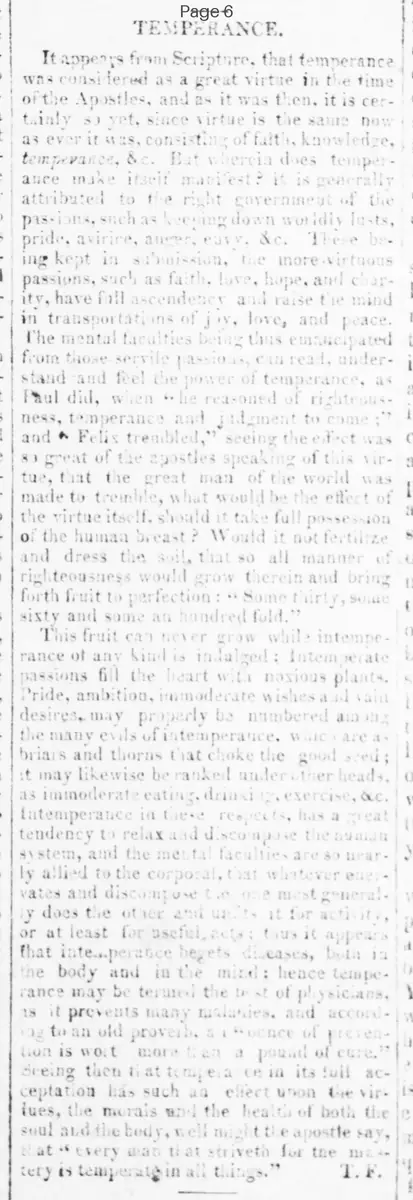
TEMPERANCE.
It appears from Scripture, that temperance was considered as a great virtue in the time of the Apostles, and as it was then, it is certainly so yet, since virtue is the same now as ever it was, consisting of faith, knowledge, temperance, &c. But wherein does temperance make itself manifest? It is generally attributed to the right government of the passions, such as keeping down worldly lusts, pride, avarice, anger, envy, &c. These being kept in subjection, the more virtuous passions, such as faith, love, hope, and charity, have full ascendency and raise the mind in transportations of joy, love, and peace.
The mental faculties being thus emancipated from those servile chains can read, understand and feel the power of temperance, as Paul did, when he reasoned of righteousness, temperance and judgment to come; and Felix trembled, seeing the effect was so great of the apostle's speaking of this virtue, that the great man of the world was made to tremble, what would be the effect of the virtue itself, should it take full possession of the human breast? Would it not fertilize and dress the soil that so all manner of righteousness would grow therein and bring forth fruit to perfection: some thirty, some sixty and some an hundred fold.
This fruit can never grow while intemperance of any kind is indulged: Intemperate passions fill the heart with noxious plants. Pride, ambition, inmoderate wishes and vain desires, may properly be numbered among the many evils of intemperance, which are briars and thorns that choke the good seed: it may likewise be ranked under several heads, as immoderate eating, drinking, exercise, &c.
Intemperance in these respects, has a great tendency to relax and decompose the human system, and the mental faculties are so nearly allied to the corporeal, that whatever enervates and discomposes the one must generally do the other end likewise, or at least for a useful purpose: to us it appears that intemperance begets diseases, both in the body and in the mind: hence temperance may be termed the first of physicians, as it prevents many maladies, and according to an old proverb, an ounce of prevention is not more than a pound of cure.
Seeing then that temperance in its full acceptation has such an effect upon the virtues, the morals and the health, of both the soul and the body, well might the apostle say, "every day that striveth for the mastery is temperate in all things."
T.F.
It appears from Scripture, that temperance was considered as a great virtue in the time of the Apostles, and as it was then, it is certainly so yet, since virtue is the same now as ever it was, consisting of faith, knowledge, temperance, &c. But wherein does temperance make itself manifest? It is generally attributed to the right government of the passions, such as keeping down worldly lusts, pride, avarice, anger, envy, &c. These being kept in subjection, the more virtuous passions, such as faith, love, hope, and charity, have full ascendency and raise the mind in transportations of joy, love, and peace.
The mental faculties being thus emancipated from those servile chains can read, understand and feel the power of temperance, as Paul did, when he reasoned of righteousness, temperance and judgment to come; and Felix trembled, seeing the effect was so great of the apostle's speaking of this virtue, that the great man of the world was made to tremble, what would be the effect of the virtue itself, should it take full possession of the human breast? Would it not fertilize and dress the soil that so all manner of righteousness would grow therein and bring forth fruit to perfection: some thirty, some sixty and some an hundred fold.
This fruit can never grow while intemperance of any kind is indulged: Intemperate passions fill the heart with noxious plants. Pride, ambition, inmoderate wishes and vain desires, may properly be numbered among the many evils of intemperance, which are briars and thorns that choke the good seed: it may likewise be ranked under several heads, as immoderate eating, drinking, exercise, &c.
Intemperance in these respects, has a great tendency to relax and decompose the human system, and the mental faculties are so nearly allied to the corporeal, that whatever enervates and discomposes the one must generally do the other end likewise, or at least for a useful purpose: to us it appears that intemperance begets diseases, both in the body and in the mind: hence temperance may be termed the first of physicians, as it prevents many maladies, and according to an old proverb, an ounce of prevention is not more than a pound of cure.
Seeing then that temperance in its full acceptation has such an effect upon the virtues, the morals and the health, of both the soul and the body, well might the apostle say, "every day that striveth for the mastery is temperate in all things."
T.F.
What sub-type of article is it?
Moral Or Religious
Temperance
What keywords are associated?
Temperance
Virtue
Scripture
Intemperance
Passions
Righteousness
Health
Apostle Paul
What entities or persons were involved?
Apostles
Paul
Felix
Editorial Details
Primary Topic
Virtue Of Temperance
Stance / Tone
Advocacy For Temperance As Essential Virtue
Key Figures
Apostles
Paul
Felix
Key Arguments
Temperance Is A Great Virtue From Scripture, Involving Right Government Of Passions Like Lust, Pride, Avarice, Anger, Envy
Subduing Intemperate Passions Allows Virtuous Ones Like Faith, Love, Hope, Charity To Prevail
Paul Reasoned On Temperance, Causing Felix To Tremble
Temperance Fertilizes The Soul For Righteousness To Grow Abundantly
Intemperance Indulges Passions That Choke Good Seed, Including Pride, Ambition, Immoderate Eating And Drinking
Intemperance Causes Diseases In Body And Mind; Temperance Prevents Maladies
Apostle States Every Striver For Mastery Is Temperate In All Things