Thank you for visiting SNEWPapers!
Sign up free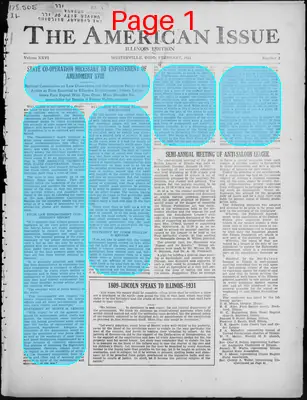
The American Issue
Westerville, Delaware County, Ohio
What is this article about?
The National Commission on Law Observance and Enforcement stresses the need for state cooperation, especially in Illinois, to effectively enforce the 18th Amendment. Reports and statements from members highlight federal limitations without local support, urging legislators against nullification to avoid lawlessness.
Merged-components note: Continuation of the same article on state cooperation for prohibition enforcement; text flows sequentially across components.
Clipping
OCR Quality
Full Text
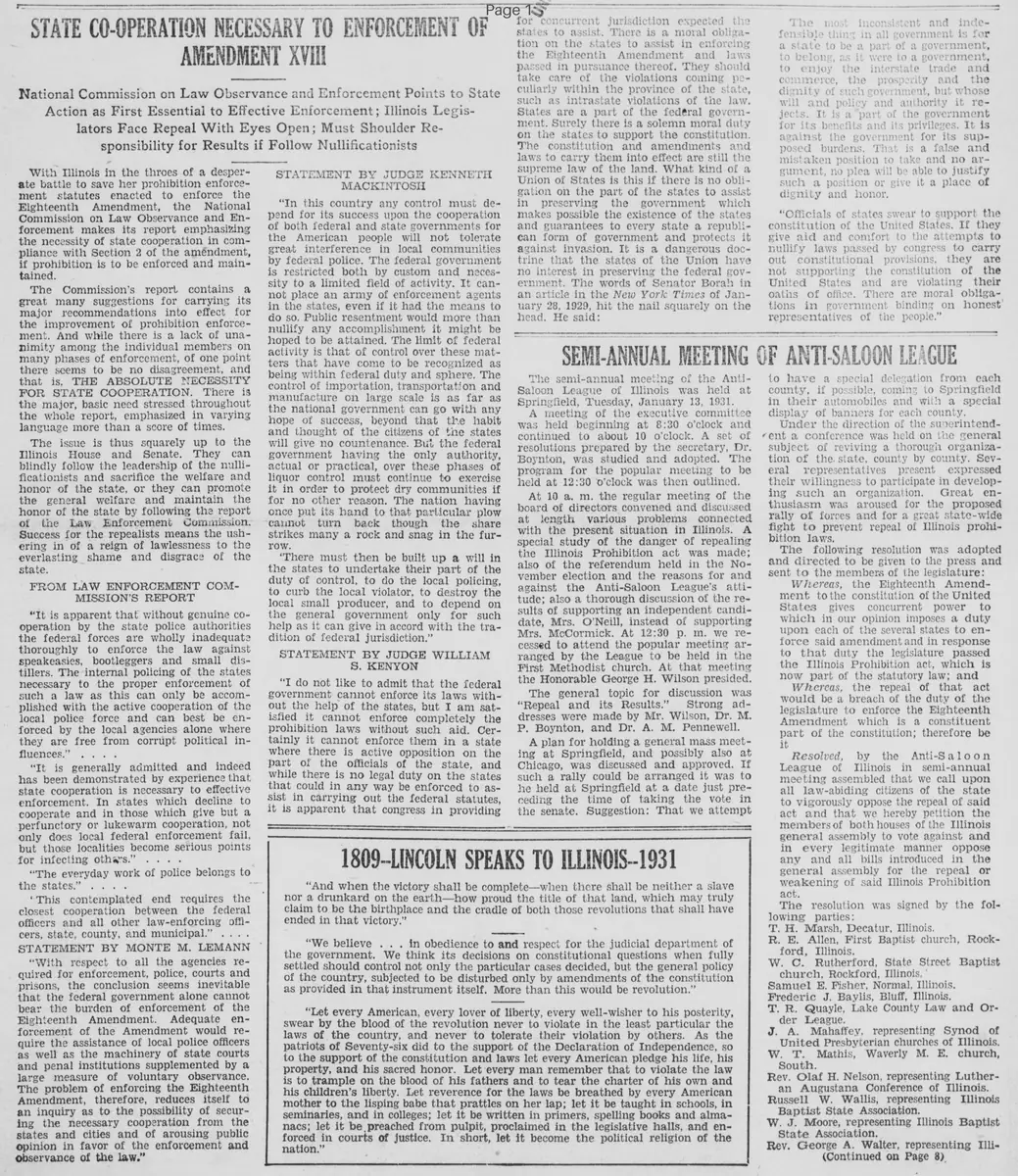
National Commission on Law Observance and Enforcement Points to State Action as First Essential to Effective Enforcement; Illinois Legislators Face Repeal With Eyes Open; Must Shoulder Responsibility for Results if Follow Nullificationists
With Illinois in the throes of a desperate battle to save her prohibition enforcement statutes enacted to enforce the Eighteenth Amendment, the National Commission on Law Observance and Enforcement makes its report emphasizing the necessity of state cooperation in compliance with Section 2 of the amendment, if prohibition is to be enforced and maintained.
The Commission's report contains a great many suggestions for carrying its major recommendations into effect for the improvement of prohibition enforcement. And while there is a lack of unanimity among the individual members on many phases of enforcement, of one point there seems to be no disagreement, and that is. THE ABSOLUTE NECESSITY FOR STATE COOPERATION. There is the major. basic need stressed throughout the whole report, emphasized in varying language more than a score of times.
The issue is thus squarely up to the Illinois House and Senate. They can blindly follow the leadership of the nullificationists and sacrifice the welfare and honor of the state. or they can promote the general welfare and maintain the honor of the state by following the report of the Law Enforcement Commission. Success for the repealists means the ushering in of a reign of lawlessness to the everlasting shame and disgrace of the state.
FROM LAW ENFORCEMENT COMMISSION'S REPORT
"It is apparent that without genuine cooperation by the state police authorities the federal forces are wholly inadequate thoroughly to enforce the law against speakeasies, bootleggers and small distillers. The internal policing of the states necessary to the proper enforcement of such a law as this can only be accomplished with the active cooperation of the local police force and can best be enforced by the local agencies alone where they are free from corrupt political influences."
"It is generally admitted and indeed has been demonstrated by experience that state cooperation is necessary to effective enforcement. In states which decline to cooperate and in those which give but a perfunctory or lukewarm cooperation, not only does local federal enforcement fail, but those localities become serious points for infecting others."
"The everyday work of police belongs to the states."
'This contemplated end requires the closest cooperation between the federal officers and all other law-enforcing officers, state, county, and municipal.' . . . .
STATEMENT BY MONTE M. LEMANN
"With respect to all the agencies required for enforcement, police, courts and prisons, the conclusion seems inevitable that the federal government alone cannot bear the burden of enforcement of the Eighteenth Amendment. Adequate enforcement of the Amendment would require the assistance of local police officers as well as the machinery of state courts and penal institutions supplemented by a large measure of voluntary observance. The problem of enforcing the Eighteenth Amendment, therefore, reduces itself to an inquiry as to the possibility of securing the necessary cooperation from the states and cities and of arousing public opinion in favor of the enforcement and observance of the law."
STATEMENT BY JUDGE KENNETH MACKINTOSH
"In this country any control must depend for its success upon the cooperation of both federal and state governments for the American people will not tolerate great interference in local communities by federal police. The federal government is restricted both by custom and necessity to a limited field of activity. It cannot place an army of enforcement agents in the states, even if it had the means to do so. Public resentment would more than nullify any accomplishment it might be hoped to be attained. The limit of federal activity is that of control over these matters that have come to be recognized as being within federal duty and sphere. The control of importation, transportation and manufacture on large scale is as far as the national government can go with any hope of success, beyond that the habit and thought of the citizens of the states will give no countenance. But the federal government having the only authority, actual or practical, over these phases of liquor control must continue to exercise it in order to protect dry communities if for no other reason. The nation having once put its hand to that particular plow cannot turn back though the share strikes many a rock and snag in the furrow.
There must then be built up a will in the states to undertake their part of the duty of control, to do the local policing, to curb the local violator, to destroy the local small producer, and to depend on the general government only for such help as it can give in accord with the tradition of federal jurisdiction."
STATEMENT BY JUDGE WILLIAM S. KENYON
"I do not like to admit that the federal government cannot enforce its laws without the help of the states, but I am satisfied it cannot enforce completely the prohibition laws without such aid. Certainly it cannot enforce them in a state where there is active opposition on the part of the officials of the state, and while there is no legal duty on the states that could in any way be enforced to assist in carrying out the federal statutes, it is apparent that congress in providing for concurrent jurisdiction expected the states to assist. There is a moral obligation on the states to assist in enforcing the Eighteenth Amendment and laws passed in pursuance thereof. They should take care of the violations coming peculiarly within the province of the state, such as intrastate violations of the law. States are a part of the federal government. Surely there is a solemn moral duty on the states to support the constitution. The constitution and amendments and laws to carry them into effect are still the supreme law of the land. What kind of a Union of States is this if there is no obligation on the part of the states to assist in preserving the government which makes possible the existence of the states and guarantees to every state a republican form of government and protects it against invasion. It is a dangerous doctrine that the states of the Union have no interest in preserving the federal government. The words of Senator Borah in an article in the New York Times of January 28, 1929, hit the nail squarely on the head. He said:
The most inconsistent and indefensible thing in all government is for a state to be a part of a government, to belong, as it were to a government, to enjoy the interstate trade and commerce, the prosperity and the dignity of such government, but whose will and policy and authority it rejects. It is a part of the government for its benefits and its privileges. It is against the government for its supposed burdens. That is a false and mistaken position to take and no argument, no plea will be able to justify such a position or give it a place of dignity and honor.
"Officials of states swear to support the constitution of the United States. If they give aid and comfort to the attempts to nullify laws passed by congress to carry out constitutional provisions, they are not supporting the constitution of the United States and are violating their oaths of office. There are moral obligations in government binding on honest representatives of the people."
What sub-type of article is it?
What themes does it cover?
What keywords are associated?
What entities or persons were involved?
Where did it happen?
Story Details
Key Persons
Location
Illinois
Event Date
1929
Story Details
The National Commission emphasizes state cooperation for enforcing the 18th Amendment, warning Illinois legislators against nullification, with quotes from commission members on federal limitations and moral duties.