Thank you for visiting SNEWPapers!
Sign up free
Oxford Democrat
Paris, South Paris, Oxford County, Maine
What is this article about?
Reports on U.S. Congressional proceedings from March 3-8, focusing on Senate and House debates over Kansas statehood under the Lecompton Constitution, including speeches by Seward, Douglas, and others on slavery in territories, alongside resolutions on naval officers, executive patronage, Texas volunteers, French vessel seizure, and other bills.
Clipping
OCR Quality
Full Text
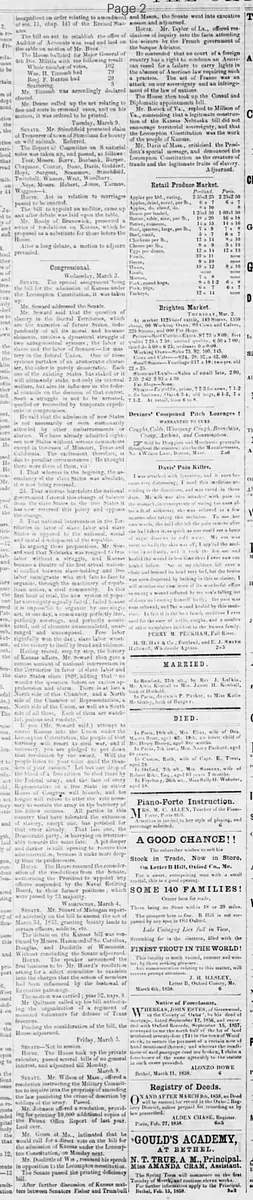
Wednesday, March 3.
SENATE.
The special assignment being the bill for the admission of Kansas under the Lecompton Constitution, it was taken up.
Mr. Seward addressed the Senate.
Mr. Seward said that the question of slavery in the federal Territories, which are the nurseries of future States, independently of all its moral and human elements, involves a dynastic struggle of two antagonistic systems: the labor of slaves and the labor of freemen for mastery in the federal Union. One of these systems partakes of an aristocratic character, the other is purely democratic. Each one of the existing States has staked or it will ultimately stake not only its internal welfare, but also its influence in the federal councils on the decision of that contest. Such a struggle is not to be arrested, quelled or reconciled by temperate expedients or compromises.
He said that the admission of new States is not necessarily or even customarily attended by other embarrassments or alarms. We have already admitted eighteen new States without serious commotions except in the cases of Missouri, Texas and California. The excitement therefore, is due to peculiar circumstances: He thought there were three of them, viz:
1. That whereas in the beginning, the ascendency of the slave States was absolute, it is now being reversed.
2. That whereas heretofore the national government favored this change of balance from the slave States to the free States it has now reversed this policy and opposes the change.
3. That national intervention in the Territories in favor of slave labor and slave States is opposed to the national, social and moral development of the republic.
In arguing this proposition, Mr. Seward [noted] without a struggle, and Kansas at war between slaveholding and free immigration why not fare to free to see to through the teaching of republican morals, a civil community, in fact a State perfectly sovereign, and particularly anti-slavish, out of elements unassimilated, unrefined and unwary.
A word about [the] trial [by the] doctrine of popular sovereignty usually said; called because it is impossible to organize by one single act, in one day, a community partially free, perfectly sovereign, and particularly anti-[slavish], out of elements unassimilated, unrefined and unwary.
Free [soil] tightly won the day; slave labor went the victor [by] fraud and [violence].
Having traced, step by step, the history of Kansas in brief, Mr. Seward then gave a concise account of national intervention in the Territories in favor of slave labor and slave States since 1850, adding that "under the question before us the quietism and alarm, those in at least a South side of this Chamber, say a South side of the Chamber of Representatives, a South side of the Union, as well as South side of all this, each of them are watchful, jealous and absolute.
If you (Mr. Seward said) attempt to force Kansas into the Union under the Lecompton Constitution, the people of that Territory will resort to civil war, and I [warn you], you are pledged to fight down that revolution by fire Brand, "Will the people listen to your voice amid the thunder of the guns? Let but one drop of the blood of a free citizen flow to quell them by the Federal army, and the face of every Representative of a Free State in either House or Congress will blanch, and his tongue will refuse to utter the vote treacherous of slavery, every one has pointed for that error already, That less one, the administration, because it makes more decorum than its predecessors.
House. The House resumed the consideration of the resolutions from the Senate, authorizing the President to appoint any officers suspended by the Naval Retiring Board, to their former positions, which were passed by 73 majority.
Washington, March 4.
Senate. Mr. Stuart of Michigan reported adversely on the bill to amend the act of March 3d, 1853, granting bounty lands to certain officers, soldiers, etc.
The debate on the Kansas bill was continued by Messrs. Hammond of So. Carolina, Douglas, and Doolittle of Wisconsin.
Without concluding the Senate adjourned.
House. The speaker announced the first business to be Mr. Hoard's resolution asking for a select committee to examine into the charges that the action of members had been influenced by the bestowal of Executive patronage.
The motion was carried: yeas 92, nays, 8.
Mr. Quitman called up his bill authorizing the organization of a regiment of mounted volunteers for defense of Texas frontiers.
Pending the consideration of the bill, the House adjourned.
Friday, March 5.
Senate—Not in session.
House. The House took up the private calendar, passed several bills of no general interest, and adjourned till Monday.
March 8.
Senate. Mr. Wilson of Mass., offered a resolution instructing the Military Committee to inquire into the propriety of amending the law punishing the crime of desertion by soldiers of the army. Passed.
Mr. Johnson offered a resolution, providing for printing 10,000 additional copies of the Patent Office Report of last year. Laid over.
Mr. Green of Mo., intimated that he would call for a direct vote on the bill for the admission of Kansas under the Lecompton Constitution, on Monday next.
Mr. Doolittle of Wis., resumed his speech in opposition to the Lecompton constitution.
The Senate passed the printing deficiency bill.
All further discussion of Kansas being cut off by the expiration of the time, and Mason, the Senate went into executive session and adjourned.
House. Mr. Taylor of La., offered resolutions of inquiry into the facts attending the seizure by the French government of the bark Adriatic.
He contended that no court of a foreign country has a right to condemn an American vessel for a failure to carry lights in the absence of American law requiring such a practice.
The act of France was an attack on our sovereignty and an infringement of the law of nations.
The House then took up the Consul and Diplomatic appointments bill.
Mr. Bocock of Va., replied to Millson of Va., contending that a legitimate construction of the Kansas Nebraska bill did not encourage territorial sovereignty, and that the Lecompton Constitution was the work of the people of Kansas.
Mr. Davis of Mass., criticised the President's special message, and denounced the Lecompton Constitution as the creature of frauds and the legitimate fruits of slavery.
Adjourned.
What sub-type of article is it?
What keywords are associated?
What entities or persons were involved?
Where did it happen?
Domestic News Details
Primary Location
Washington
Event Date
March 3 8
Key Persons
Outcome
debates continued without conclusion on kansas bill; house passed naval officers resolution (73 majority); select committee on executive patronage (yeas 92, nays 8); resolutions offered and passed on military desertion, printing reports; adverse report on bounty lands bill; printing deficiency bill passed; discussions on french seizure of bark adriatic and diplomatic appointments.
Event Details
Senate and House proceedings centered on the bill for Kansas admission under Lecompton Constitution, with speeches by Seward on slavery struggle in territories, Hammond, Douglas, Doolittle opposing or supporting; historical context of national intervention since 1850; warnings of civil war if forced; other business included naval retiring board resolutions, bounty lands amendment, executive patronage inquiry, Texas mounted volunteers organization, private bills, military desertion law amendment, patent office report printing, direct vote call on Kansas, French vessel seizure inquiry, Kansas-Nebraska bill interpretations, and criticism of President's message.