Thank you for visiting SNEWPapers!
Sign up free
Literary
May 29, 1874
Springfield Weekly Republican
Springfield, Hampden County, Massachusetts
What is this article about?
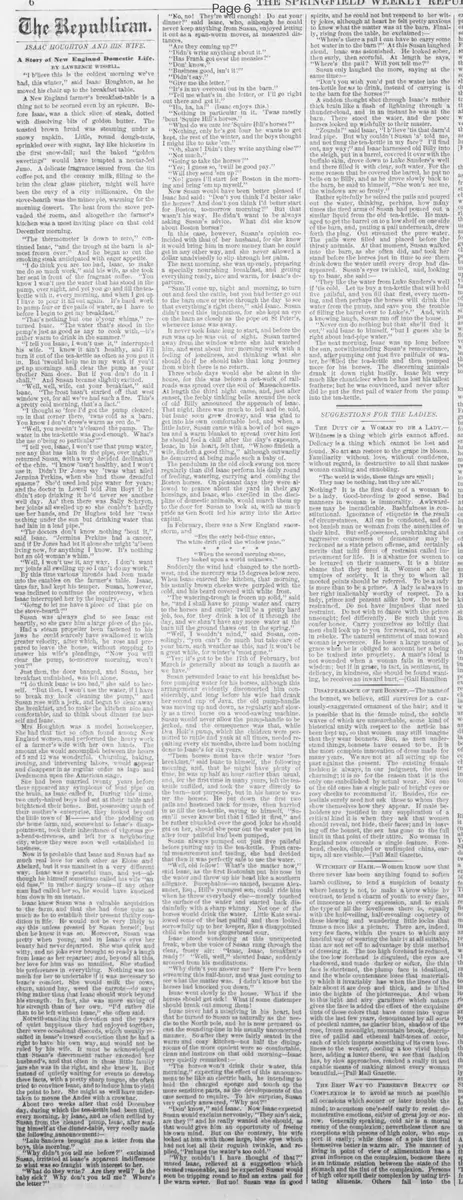
A narrative of New England farmer Isaac Houghton and his wife Susan's daily life, including quarrels over using overnight pump water due to health concerns, caring for Boston horses in winter, and their mutual devotion despite minor discords.
Clipping
OCR Quality
95%
Excellent
Full Text
The Republican.
ISAAC HOUGHTON AND HIS WIFE.
A Story of New England Domestic Life.
BY LAWRENCE WISSELL.
"I b'lieve this is the coldest morning we've had, this winter," said Isaac Houghton, as he moved his chair up to the breakfast table.
A New England farmer's breakfast-table is a thing not to be scorned even by an epicure. Before Isaac, was a thick slice of steak, dotted with dissolving bits of golden butter. The toasted brown bread was steaming under a snowy napkin. Little, round dough-nuts sprinkled over with sugar, lay like hickories in the first snow-fall; and the baked "golden sweetings" would have tempted a nectar-fed Juno. A delicate fragrance issued from the tin coffee pot, and the creamy milk, filling to the brim the clear glass pitcher, might well have been the envy of a city millionaire. On the stove-hearth was the mince pie, warming for the morning dessert. The heat from the stove pervaded the room, and altogether the farmer's kitchen was a most inviting place on that cold December morning.
"The thermometer is down to zero," continued Isaac, "and the trough at the barn is almost frozen over." And he began to cut the smoking steak anticipated with eager appetite.
"I do think you are too bad, Isaac. to make me do so much work," said his wife. as she took her seat in front of the fragrant coffee. "You know I won't use the water that has stood in the pump, over night, and yet you go and fill the tea-kettle with it, every morning, and when I get up I have to pour it all out again. It's hard work to pump four or five pails of water, as I have to before I begin to get my breakfast."
"That's nothing but one o'your whims,"returned Isaac. "The water that's stood in the pump's just as good as any to cook with,—it's rather warm to drink in the summer."
"I tell you Isaac, I won't use it." interrupted his wife. "I know it ain't healthy, and Ill turn it out of the tea-kettle as often as you put it in. But 'twould help me in my work if you'd get up mornings and clear the pump as your brother Sam does. But if you don't do it I shall," And Susan became slightly excited.
"Well, well. wife, eat your breakfast," said Isaac. The frost hasn'tstarted off that west window yet, for all we've had such a fire. This's a pretty cold morning, that's a fact.
"I thought so 'fore I'd got the pump cleared; up in that corner there, 'twas cold as a barn. You know I don't dress's warm as you do."
"Well, you needn't 'a'cleared the pump. The water in the tea-kettle was good enough. What's the use o'being so particular?"
I tell you, Isaac, I won't use that pump water, nor any that has lain in the pipe, over night.' returned Susan, with a very decided declination of the chin."I know 'tisn't healthy, and I won't use it. Didn't Dr Jones say 'twas what ailed Jermina Perkins, when she had those dreadful spasms? She'd used lead pipe water for years; and the doctor in Lowell told Jim Hoyt if he didn't stop drinking it he'd never see another well day." An' then there was Sally Schryon, her joints all swelled up so she couldn't hardly use her hands, and Dr Hughes told her 'twas nothing underthe sun but drinking water that had lain in a lead pipe."
The doctors don't know nothing bout it,' said Isaac. "Jermina Perkins had a cancer, and if Dr Jones had let it alone she might 'a'been living now. for anything I know. It's nothing but an old woman's whim."
"Well, I won't use it, any way. I don't want my joints all swelling up so I can't do my work." By this time various inroads had been made into the eatables on the farmer's table. Isaac, thus far. had kept his temper. Susan, however, was inclined to continue the controversy, when Isaac interrupted her by the inquiry.-
"Going to let me have a piece of that pie on the stove-hearth?"
Susan was always glad to see Isaac eat heartily. so she gave him a large piece of the pie. Had a steam propeller been fastened to his jaws he could scarcelyhave swallowed it with greater velocity, after which, he rose and prepared to leave the house, without stopping to answer his wife's pleadings,
"Now you will clear the pump,to-morrow morning, won't you?"
Just then, the door banged, and Susan, her breakfast unfinished. was left alone,
"I do think Isaac is too bad." she said to herself. "But then, I won't use the water, if I have to break my back cleaning the pump," and Susan rose with a jerk, and began to clear away the breakfast, and to make the kitchen nice and comfortable, and to think about dinner for her-self and Isaac.
Mrs Houghton was a model housekeeper. She had that tact so often found among New England women, and performed the heavy work of a farmer's wife with her own hands. The amount she would accomplish between the hours of 5 and 12 was wonderful. Churning, baking, ironing, and intervening labors, would appear and disappear in as regular order as lago and Desdemona upon the American stage.
She had been married twenty years before there appeared any symptoms of lead pipe on the brain, as Isaac called it. During this time, two curly-haired boys had sat at their table and brightened their home. But, possessing much of their mother's enterprise, they looked beyond the little town of M.--and the plodding on the home farm, and, somewhat to Isaac's disappointment, took their inheritance of vigorous go-ahead-ativeness, and left for a neighboring city,where they were soon well establishedin business.
Now it is probable that Isaac and Susan had as much real love for each other as Eloise and Abelard, but it was manifest in a very different way. Isaac was a peaceful man, and yet although he himself sometimes called his wife "an old fuss,"in rather angry tonesif any other man had called her so, he would have knocked him down in an instant.
Isaac knew Susan was a valuable acquisition to the farm, and that she had done quite as much as he to establish their present thrifty condition in life. He would not be very likely to say this unless pressed by Susan herself; but then he knew it was so. Moreover, Susan was pretty when young, and in Isaac's eyes her beauty had never departed. She was quick and witty, and no joke ever brought so ready a laugh from Isaac as her repartee; and, beyond all this, her love for him was so manifest. She studied his preferences in everything. Nothing was too much for her to undertake if it was necessary to Isaac's comfort. She would milk the cows, churn, unload hay, weed the carrots-do anything rather than that Isaac should work beyond his strength. In fact, she was more saving of his strength than of her own. "I'd rather die than to be left without Isaac." she often said.
Notwithstanding this devotion and the years of quiet happiness they had enjoyed together, there were occasional discords, which usually resulted in Isaac's inward conviction that he had a right to have his own way, and would not be ruled by his wife. It must be acknowledged that Susan's discernment rather exceeded her husband's, and that often in these little family jars she was in the right, and she knew it. But instead of quietly waiting for events to develop there facts, with a pretty sharp tongue, she often tried to convince Isaac, and to induce him to yield the point to her. She might as well have undertaken to move the Andes with a crowbar.
About two weeks after that cold December day, during which the tea-kettle had been filled. every morning. by Isaac, and as often refilled by Susan from the cleaned pump, Isaac, after seating himself at the dinner-table, very coolly made the following announcement:-
'Lulu Sanders brought me a letter from the boys, this morning.'
"Why didn't you tell me before?" exclaimed Susan, irritated at Isaac's apparent indifference to what was so fraught with interest to her.
"What do they write? Are they well? Is the baby sick? Why don't you tell me? Where's the letter?"
"No, no! They're well enough!Do eat your dinner!' said Isaac, who, although he could never keep anything from Susan. enjoyed letting it out as a span-worm moves, at measured distances.
"Are they coming up?"
"Didn't write anything about it."
Has Frank got over the measles?"
"Don'know.
"Business good, isn't it?"
"Didn'tsay."
"Give me the letter."
"It's in my overcoat out in the barn."
"Tell me what's in the letter, or I'll go right out there and get it."
"Ha, ha, ha!" (Isaac enjoys this.)
"Nothing in particular in it. 'Twas mostly 'bout 'Squire Hill's horses."
"What do we care for'Squire Hill's horses?"
"Nothing, only he's got four he wants to get kept, the rest of the winter, and the boys thought I might like to take 'em."
"Oh, shaw! Didn't they write anything else?"
"Not much."
"Going to take the horses?"
"Yes; I guess so, 'twill be good pay."
"Will they send'em up?"
"No! guess I'll start for Bostonin the morning and bring 'em up myself."
Now Susan would have been better pleased if Isaac had said: "Don't you think I'd better take the horses? And don't you think I'd better start for Boston, to-morrow morning?" But that wasn't his way. He didn't want to be always asking Susan's advice. What did she know about Boston horses?
In this case, however. Susan's opinion coincided with that of her husband, for she knew it would bring him in more money than he could get in any other way, and she never allowed a dollar unadvisedly to slip through her palm.
The next morning, she was up early, preparing a specially nourishing breakfast, and getting everything ready, nice and warm, for Isaac's departure.
"Sam'll come up, night and morning, to turn out and feed the cattle, but you had better go out to the barn once or twice through the day to see that everything's right there," said Isaac. Susan didn't need this injunction, for she kept an eye on the barn as closely as the pope on St Peter's, whenever Isaac was away.
It never took Isaac long to start, and before the sun was up he was out of sight. Susan turned away from the window where she had watched him, and went about her morning work with a feeling of loneliness. and thinking what she should do if he should take that long journey from which there is no return.
Three whole days would she be alone in the house, for this was before a net-work of rail roads was spread over the soil of Massachusetts.
At length the third night came, and, just after sunset, the feebly tinkling bells around the neck of old Billy announced the approach of Isaac.
That night. there was much to tell and be told. but Isaac soon grew drowsy, and was glad to get into his own comfortable'bed, and when, a little later, Susan came with a bowl of hot sage-tea and a warm blanket to spread over him lest he should feel a chill after the day's exposure, Isaac. in his heart, felt that, "Whoso findeth a wife, findeth a good thing,"although outwardly he demurred at being made such a baby of.
The pendulum in the old clock swung not more regularly than did Isaac perform his daily round of feeding, watering, currying and combing the Boston horses. On pleasant days they were allowed to prance about the yard in their gay housings, and Isaac, who excelled in the discipline of domestic animals, would march them up to the door for Susan to look at, with as much pride as Gen Scott led his army into the Aztec capital.
In February, there was a New England snow-storm, and
"Ere the early bed-time came, The white drift piled the window pane,
"When the second morning shone, They looked upon a world unknown,
Suddenly the wind had changed to the north-west, and the mercury was 15 degrees below zero.
When Isaac entered the kitchen, that morning, his usually brown cheeks were purpled with the cold, and his beard covered with white frost.
"The watering-trough is frozen up solid,"said he. "and I shall have to pump water and carry to the horses and cattle; 'twill be a pretty hard job, too, for they drink a lot of it through the day, and we shan't have any more water at the barn till the ground thaws out in the spring."
"Well. I wouldn't mind." said Susan, consolingly. "you can't do much but take care of your barn. such weather as this, and it won't be a great while, for winter's'mos t gone."
"Yes: it's got to be the 17th ofFebruary, but March is generally about as tough a month as we have,
Susan persuaded Isaac to eat his breakfast before pumping water for his horses, although this arrangement evidently disconcerted him considerably, and long before his wife had drank her second cup of Java, the old pump-handle was moving up and down, as regularly and slowly as a tired horse on a wood-sawing machine.
Susan would never allow the pump-handle to be jerked, and the consequence was that, while Dea Holt's pump, which the children were permitted to rattle and yank at all times, needed repairing every six months, there had been nothing done to Isaac's for six years.
"Them horses must have their water 'fore breakfast."said Isaac to himself. the following morning, and, that he might have plenty of time, he was up half an hour earlier than usual. and, for the first time in many years, left the tea-kettle unfilled, and took the water' directly to the barn-not purposely, but in his haste to water the horses. He put down the first two pails and hastened back for more, then hurried in to fill the tea-kettle, saying to' himself. "Susan'll never know but that I filled it first," and he rather chuckled over the good joke he should get on her, should she pour out the water put in after four pailsful had been pumped.
Susan always pumped out just five pailsful before putting anyin the tea-kettle. From careful measurement and tasting, she had decided that the pipe it was perfectly safe to use the water.
"Well, old fellow! What's the matter now," said Isaac, as the first Bostonian put his nose in the water and threw up his head like a southern alligator. Bucephalus-so named, because Alexander, Esq., Hill's youngest son, could ride him when he threw everybody else--merely touched the surface of the water and started back disdainfully with a sharp whinny. Not one of the horses would drink the water. Little Kate swallowed some of the last pailful and then looked sorrowfully up to her keeper, like a disappointed child who finds her gingerbread sour.
Isaac stood wondering at this unexpected freak, when the voice of Susan rang through the clear. frosty air: "Isaac, Isaac, breakfast's ready!" "Well, well," shouted Isaac, suddenly aroused from his meditations.
"Why didn't you answer me? Here I've been screaming this half-hour, and was just coming to see what the matter was. I didn't know but the horses had knocked you down."
Isaac went slowly to the house. What if the horses should get sick! What if some distemper should break out among them!
Isaac never had a misgiving in his heart, but that he turned to Susan as naturally as the needle to the North pole, and he is now prepared to cast the sounding-line in his usually unconcerned manner. So after they were fairly seated in the warm and cozy kitchen—not half the dining-rooms of the more opulent were so comfortable, clean and lustrous on that cold morning-Isaac very quietly remarked:
The horses won't drink their water, this morning," expecting the effect of this announcement to be like an electric bath, he intending to hold the charged sponge and touch up the more sensitive parts, as the developments of the case seemed to require. To his surprise, Susan very quietly answered. "Why not?"
"Don' know," said Isaac. Now Isaac expected Susan would exclaim nervously, "They ain't sick, are they?" and he really wanted she should, a that would give him an opportunity of freeing his own mind. But on the contrary, his wife looked at him with those large, blue eyes which had not lost all their roguish 'twinkle, and replied, "Perhaps the water's too cold."
"Why couldn't I have thought of that?" mused Isaac, relieved at a suggestion which seemed reasonable, and be expected Susan would soon be tripping round to find an extra pail for the warm water. But no! Susan was in good
ISAAC HOUGHTON AND HIS WIFE.
A Story of New England Domestic Life.
BY LAWRENCE WISSELL.
"I b'lieve this is the coldest morning we've had, this winter," said Isaac Houghton, as he moved his chair up to the breakfast table.
A New England farmer's breakfast-table is a thing not to be scorned even by an epicure. Before Isaac, was a thick slice of steak, dotted with dissolving bits of golden butter. The toasted brown bread was steaming under a snowy napkin. Little, round dough-nuts sprinkled over with sugar, lay like hickories in the first snow-fall; and the baked "golden sweetings" would have tempted a nectar-fed Juno. A delicate fragrance issued from the tin coffee pot, and the creamy milk, filling to the brim the clear glass pitcher, might well have been the envy of a city millionaire. On the stove-hearth was the mince pie, warming for the morning dessert. The heat from the stove pervaded the room, and altogether the farmer's kitchen was a most inviting place on that cold December morning.
"The thermometer is down to zero," continued Isaac, "and the trough at the barn is almost frozen over." And he began to cut the smoking steak anticipated with eager appetite.
"I do think you are too bad, Isaac. to make me do so much work," said his wife. as she took her seat in front of the fragrant coffee. "You know I won't use the water that has stood in the pump, over night, and yet you go and fill the tea-kettle with it, every morning, and when I get up I have to pour it all out again. It's hard work to pump four or five pails of water, as I have to before I begin to get my breakfast."
"That's nothing but one o'your whims,"returned Isaac. "The water that's stood in the pump's just as good as any to cook with,—it's rather warm to drink in the summer."
"I tell you Isaac, I won't use it." interrupted his wife. "I know it ain't healthy, and Ill turn it out of the tea-kettle as often as you put it in. But 'twould help me in my work if you'd get up mornings and clear the pump as your brother Sam does. But if you don't do it I shall," And Susan became slightly excited.
"Well, well. wife, eat your breakfast," said Isaac. The frost hasn'tstarted off that west window yet, for all we've had such a fire. This's a pretty cold morning, that's a fact.
"I thought so 'fore I'd got the pump cleared; up in that corner there, 'twas cold as a barn. You know I don't dress's warm as you do."
"Well, you needn't 'a'cleared the pump. The water in the tea-kettle was good enough. What's the use o'being so particular?"
I tell you, Isaac, I won't use that pump water, nor any that has lain in the pipe, over night.' returned Susan, with a very decided declination of the chin."I know 'tisn't healthy, and I won't use it. Didn't Dr Jones say 'twas what ailed Jermina Perkins, when she had those dreadful spasms? She'd used lead pipe water for years; and the doctor in Lowell told Jim Hoyt if he didn't stop drinking it he'd never see another well day." An' then there was Sally Schryon, her joints all swelled up so she couldn't hardly use her hands, and Dr Hughes told her 'twas nothing underthe sun but drinking water that had lain in a lead pipe."
The doctors don't know nothing bout it,' said Isaac. "Jermina Perkins had a cancer, and if Dr Jones had let it alone she might 'a'been living now. for anything I know. It's nothing but an old woman's whim."
"Well, I won't use it, any way. I don't want my joints all swelling up so I can't do my work." By this time various inroads had been made into the eatables on the farmer's table. Isaac, thus far. had kept his temper. Susan, however, was inclined to continue the controversy, when Isaac interrupted her by the inquiry.-
"Going to let me have a piece of that pie on the stove-hearth?"
Susan was always glad to see Isaac eat heartily. so she gave him a large piece of the pie. Had a steam propeller been fastened to his jaws he could scarcelyhave swallowed it with greater velocity, after which, he rose and prepared to leave the house, without stopping to answer his wife's pleadings,
"Now you will clear the pump,to-morrow morning, won't you?"
Just then, the door banged, and Susan, her breakfast unfinished. was left alone,
"I do think Isaac is too bad." she said to herself. "But then, I won't use the water, if I have to break my back cleaning the pump," and Susan rose with a jerk, and began to clear away the breakfast, and to make the kitchen nice and comfortable, and to think about dinner for her-self and Isaac.
Mrs Houghton was a model housekeeper. She had that tact so often found among New England women, and performed the heavy work of a farmer's wife with her own hands. The amount she would accomplish between the hours of 5 and 12 was wonderful. Churning, baking, ironing, and intervening labors, would appear and disappear in as regular order as lago and Desdemona upon the American stage.
She had been married twenty years before there appeared any symptoms of lead pipe on the brain, as Isaac called it. During this time, two curly-haired boys had sat at their table and brightened their home. But, possessing much of their mother's enterprise, they looked beyond the little town of M.--and the plodding on the home farm, and, somewhat to Isaac's disappointment, took their inheritance of vigorous go-ahead-ativeness, and left for a neighboring city,where they were soon well establishedin business.
Now it is probable that Isaac and Susan had as much real love for each other as Eloise and Abelard, but it was manifest in a very different way. Isaac was a peaceful man, and yet although he himself sometimes called his wife "an old fuss,"in rather angry tonesif any other man had called her so, he would have knocked him down in an instant.
Isaac knew Susan was a valuable acquisition to the farm, and that she had done quite as much as he to establish their present thrifty condition in life. He would not be very likely to say this unless pressed by Susan herself; but then he knew it was so. Moreover, Susan was pretty when young, and in Isaac's eyes her beauty had never departed. She was quick and witty, and no joke ever brought so ready a laugh from Isaac as her repartee; and, beyond all this, her love for him was so manifest. She studied his preferences in everything. Nothing was too much for her to undertake if it was necessary to Isaac's comfort. She would milk the cows, churn, unload hay, weed the carrots-do anything rather than that Isaac should work beyond his strength. In fact, she was more saving of his strength than of her own. "I'd rather die than to be left without Isaac." she often said.
Notwithstanding this devotion and the years of quiet happiness they had enjoyed together, there were occasional discords, which usually resulted in Isaac's inward conviction that he had a right to have his own way, and would not be ruled by his wife. It must be acknowledged that Susan's discernment rather exceeded her husband's, and that often in these little family jars she was in the right, and she knew it. But instead of quietly waiting for events to develop there facts, with a pretty sharp tongue, she often tried to convince Isaac, and to induce him to yield the point to her. She might as well have undertaken to move the Andes with a crowbar.
About two weeks after that cold December day, during which the tea-kettle had been filled. every morning. by Isaac, and as often refilled by Susan from the cleaned pump, Isaac, after seating himself at the dinner-table, very coolly made the following announcement:-
'Lulu Sanders brought me a letter from the boys, this morning.'
"Why didn't you tell me before?" exclaimed Susan, irritated at Isaac's apparent indifference to what was so fraught with interest to her.
"What do they write? Are they well? Is the baby sick? Why don't you tell me? Where's the letter?"
"No, no! They're well enough!Do eat your dinner!' said Isaac, who, although he could never keep anything from Susan. enjoyed letting it out as a span-worm moves, at measured distances.
"Are they coming up?"
"Didn't write anything about it."
Has Frank got over the measles?"
"Don'know.
"Business good, isn't it?"
"Didn'tsay."
"Give me the letter."
"It's in my overcoat out in the barn."
"Tell me what's in the letter, or I'll go right out there and get it."
"Ha, ha, ha!" (Isaac enjoys this.)
"Nothing in particular in it. 'Twas mostly 'bout 'Squire Hill's horses."
"What do we care for'Squire Hill's horses?"
"Nothing, only he's got four he wants to get kept, the rest of the winter, and the boys thought I might like to take 'em."
"Oh, shaw! Didn't they write anything else?"
"Not much."
"Going to take the horses?"
"Yes; I guess so, 'twill be good pay."
"Will they send'em up?"
"No! guess I'll start for Bostonin the morning and bring 'em up myself."
Now Susan would have been better pleased if Isaac had said: "Don't you think I'd better take the horses? And don't you think I'd better start for Boston, to-morrow morning?" But that wasn't his way. He didn't want to be always asking Susan's advice. What did she know about Boston horses?
In this case, however. Susan's opinion coincided with that of her husband, for she knew it would bring him in more money than he could get in any other way, and she never allowed a dollar unadvisedly to slip through her palm.
The next morning, she was up early, preparing a specially nourishing breakfast, and getting everything ready, nice and warm, for Isaac's departure.
"Sam'll come up, night and morning, to turn out and feed the cattle, but you had better go out to the barn once or twice through the day to see that everything's right there," said Isaac. Susan didn't need this injunction, for she kept an eye on the barn as closely as the pope on St Peter's, whenever Isaac was away.
It never took Isaac long to start, and before the sun was up he was out of sight. Susan turned away from the window where she had watched him, and went about her morning work with a feeling of loneliness. and thinking what she should do if he should take that long journey from which there is no return.
Three whole days would she be alone in the house, for this was before a net-work of rail roads was spread over the soil of Massachusetts.
At length the third night came, and, just after sunset, the feebly tinkling bells around the neck of old Billy announced the approach of Isaac.
That night. there was much to tell and be told. but Isaac soon grew drowsy, and was glad to get into his own comfortable'bed, and when, a little later, Susan came with a bowl of hot sage-tea and a warm blanket to spread over him lest he should feel a chill after the day's exposure, Isaac. in his heart, felt that, "Whoso findeth a wife, findeth a good thing,"although outwardly he demurred at being made such a baby of.
The pendulum in the old clock swung not more regularly than did Isaac perform his daily round of feeding, watering, currying and combing the Boston horses. On pleasant days they were allowed to prance about the yard in their gay housings, and Isaac, who excelled in the discipline of domestic animals, would march them up to the door for Susan to look at, with as much pride as Gen Scott led his army into the Aztec capital.
In February, there was a New England snow-storm, and
"Ere the early bed-time came, The white drift piled the window pane,
"When the second morning shone, They looked upon a world unknown,
Suddenly the wind had changed to the north-west, and the mercury was 15 degrees below zero.
When Isaac entered the kitchen, that morning, his usually brown cheeks were purpled with the cold, and his beard covered with white frost.
"The watering-trough is frozen up solid,"said he. "and I shall have to pump water and carry to the horses and cattle; 'twill be a pretty hard job, too, for they drink a lot of it through the day, and we shan't have any more water at the barn till the ground thaws out in the spring."
"Well. I wouldn't mind." said Susan, consolingly. "you can't do much but take care of your barn. such weather as this, and it won't be a great while, for winter's'mos t gone."
"Yes: it's got to be the 17th ofFebruary, but March is generally about as tough a month as we have,
Susan persuaded Isaac to eat his breakfast before pumping water for his horses, although this arrangement evidently disconcerted him considerably, and long before his wife had drank her second cup of Java, the old pump-handle was moving up and down, as regularly and slowly as a tired horse on a wood-sawing machine.
Susan would never allow the pump-handle to be jerked, and the consequence was that, while Dea Holt's pump, which the children were permitted to rattle and yank at all times, needed repairing every six months, there had been nothing done to Isaac's for six years.
"Them horses must have their water 'fore breakfast."said Isaac to himself. the following morning, and, that he might have plenty of time, he was up half an hour earlier than usual. and, for the first time in many years, left the tea-kettle unfilled, and took the water' directly to the barn-not purposely, but in his haste to water the horses. He put down the first two pails and hastened back for more, then hurried in to fill the tea-kettle, saying to' himself. "Susan'll never know but that I filled it first," and he rather chuckled over the good joke he should get on her, should she pour out the water put in after four pailsful had been pumped.
Susan always pumped out just five pailsful before putting anyin the tea-kettle. From careful measurement and tasting, she had decided that the pipe it was perfectly safe to use the water.
"Well, old fellow! What's the matter now," said Isaac, as the first Bostonian put his nose in the water and threw up his head like a southern alligator. Bucephalus-so named, because Alexander, Esq., Hill's youngest son, could ride him when he threw everybody else--merely touched the surface of the water and started back disdainfully with a sharp whinny. Not one of the horses would drink the water. Little Kate swallowed some of the last pailful and then looked sorrowfully up to her keeper, like a disappointed child who finds her gingerbread sour.
Isaac stood wondering at this unexpected freak, when the voice of Susan rang through the clear. frosty air: "Isaac, Isaac, breakfast's ready!" "Well, well," shouted Isaac, suddenly aroused from his meditations.
"Why didn't you answer me? Here I've been screaming this half-hour, and was just coming to see what the matter was. I didn't know but the horses had knocked you down."
Isaac went slowly to the house. What if the horses should get sick! What if some distemper should break out among them!
Isaac never had a misgiving in his heart, but that he turned to Susan as naturally as the needle to the North pole, and he is now prepared to cast the sounding-line in his usually unconcerned manner. So after they were fairly seated in the warm and cozy kitchen—not half the dining-rooms of the more opulent were so comfortable, clean and lustrous on that cold morning-Isaac very quietly remarked:
The horses won't drink their water, this morning," expecting the effect of this announcement to be like an electric bath, he intending to hold the charged sponge and touch up the more sensitive parts, as the developments of the case seemed to require. To his surprise, Susan very quietly answered. "Why not?"
"Don' know," said Isaac. Now Isaac expected Susan would exclaim nervously, "They ain't sick, are they?" and he really wanted she should, a that would give him an opportunity of freeing his own mind. But on the contrary, his wife looked at him with those large, blue eyes which had not lost all their roguish 'twinkle, and replied, "Perhaps the water's too cold."
"Why couldn't I have thought of that?" mused Isaac, relieved at a suggestion which seemed reasonable, and be expected Susan would soon be tripping round to find an extra pail for the warm water. But no! Susan was in good
What sub-type of article is it?
Prose Fiction
What themes does it cover?
Social Manners
Moral Virtue
What keywords are associated?
New England
Domestic Life
Farmer Wife
Pump Water
Lead Pipe
Horses
Marriage
Winter
Chores
Devotion
What entities or persons were involved?
By Lawrence Wissell
Literary Details
Title
Isaac Houghton And His Wife
Author
By Lawrence Wissell
Subject
A Story Of New England Domestic Life
Key Lines
"I B'lieve This Is The Coldest Morning We've Had, This Winter," Said Isaac Houghton, As He Moved His Chair Up To The Breakfast Table.
"I Tell You Isaac, I Won't Use It." Interrupted His Wife. "I Know It Ain't Healthy, And Ill Turn It Out Of The Tea Kettle As Often As You Put It In.
"Whoso Findeth A Wife, Findeth A Good Thing,"Although Outwardly He Demurred At Being Made Such A Baby Of.
The Horses Won't Drink Their Water, This Morning,"
Perhaps The Water's Too Cold."