Thank you for visiting SNEWPapers!
Sign up free
Lynchburg Virginian
Lynchburg, Virginia
What is this article about?
In March near Nottingham, England, laborer Thomas Greensmith, driven by poverty and fear of eviction, strangled his four young children (ages 8, 10, and 12) with a handkerchief after his wife died. He confessed calmly at the inquest.
Merged-components note: Sequential reading orders with mid-sentence split in the account of the murders; coherent single narrative on the Greensmith tragedy.
Clipping
OCR Quality
Full Text
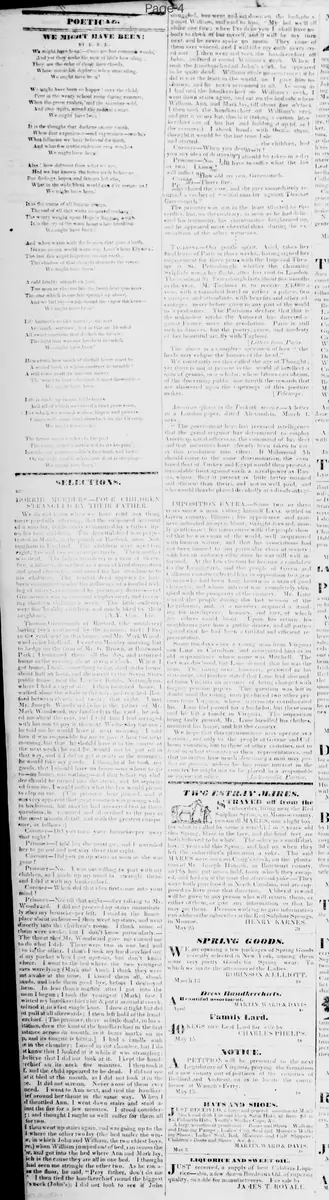
We do not know if we have read any thing more painfully affecting, than the subjoined account of a murder, deliberately committed by a father upon his children. The dreadful spectacle presented in March, at the parish of Bastard, near Nottingham, had four children were slain. They were all twins, eight, ten and twelve years old respectively. Their mother was dead. The father (Thomas Greensmith, the murderer) is about this time fifty-five, a laborer by trade, a man of sound disposition and good character, and to his attachment to his children the tragedy appears to have been committed under the influence of a morbid feeling, caused by pressure of the times, and by poverty. He had been for some time out of employment, and receiving thirteen shillings per week. The little sufferers were his aids hardren, and much liked by the neighbors.
Thomas Greensmith (the murderer) having been charged by the coroner, said: I have in the yard next to my house, and Mr. Mark Woodward is my landlord. On Monday morning last to hedge at the run of Mr. G. Brown, at Eastwood Park: I remained there all the day, and returned home rather worse about seven o'clock. When I got home, I found something to eat, and staid in the house about half an hour, and then went to the Seven Stars public house, for the Leicester Herald. Nottingham, where I had a pot of something—I think rum and water—home. I walked alone the whole of the way, and reached B is ford between nine and ten that night I met Mr. Joseph Wesley (who is the father of Mr. Mark Woodward, my landlord) in the yard: he asked me about the rent, and I told him I had arranged with his son to pay it the Tuesday but one; he told me he would have it next morning: I told him it was impossible for me to see it in the morning, but that he should have it at some source of the next week: he said he would not be put off in that way, and if I didn't get it in the morning, he would take my goods. I thought if he took my goods, that I should have no house—ho where to go to—no home, too, nothing— and that before my children should be turning the streets, and be separated from me. I would suffer what he would please to clap on me. (The prisoner here paused, and it was very apparent that great emotion was struggling in his bosom. But setting the had answered two or three questions, he seemed to curb it, and to the jury in the most unreserved tale, and with the greatest composure, as follows)
Coroner—Did your housekeeper away that night?
Prisoner—I told her she must go; and I intended her to go out and not stay there that night.
Coroner—Did you go upstairs as soon as she was gone?
Prisoner—No. I was not willing to part with my children, so I made up my mind to strangle them. and I did it with my handkerchief.
Coroner—When did the idea first come into your mind?
Prisoner—Not till that night—after talking to Mr. Woodward. I did not proceed upstairs immediate ly after my housekeeper left. I staid in the house place about an hour—I then went up stairs, and went directly into the children's room. I think some of them were awake, but I don't know particularly.— The threat that Mr. Woodward gave me caused me to do what I did. There were two in one bed and two in the other. I think I took my hand serchef on of my pocket when I got upstairs, but don't know where. I went to the bed where the two youngest pues were lying (Mark and Ann): I think they were ot awake at the time. I kissed them all, shook hands, and bade them good bye, before I destroyed hem. In less than a minute after I got into the oom I begun: I took the youngest (Mark) first. I wisted my handkerchie fa bnt à put it around its neck, nd tied it in a fast single knot. I drew it tight but dud ot pull at all afterwards; I then left hold of the hand erchief. (The prisoner, there is little doubt, in his agitation, drew the knot of the handkerchef m the first ustance across its mouth, as it bears marks on its p, and its tongue is bittea.) I had a candle with e in the chamber: I stood in tne chamber. but I do ot know that I looked at it while it was stranglung. belieye that I did not look at it. I kept the hand- erchief on its neck five minutes. I then took it F, and the child appeared to be dead. I did not see at it bled at the mouth, as I did not look it in the ee. It did not scream. Never a one of them ever nced. I went to Ann next. and tied the handker ief around her throat in the same way. When I d throttled Ann, I went down stairs and staid a- inst the fire for a few minutes. I stood consider- g; and thought I might as well suffer for them all for two. I then went up stairs again, and was going up to the I where the other two lay (the bed under the win- w, in which John and William, the two eldest boys, re,) when William jumped out of bed, ran across the br, and got into the bed where Ann and Mark lay, ich is the cause they are all in one bed. I though had seen me strangle the other two. As he ran a- s the floor, he said, "Pray father, don't do me I then tied the handkerchief round the biggest sneck (John's): I did not look to see if John
struggled, but went and sat down on the bed beside a gauust William, and said to him, "My lad, we'll all share one fate: when I've done you I'll shall have no body to think of but myself, and it will be my turn next." and he never spoke no more. They none of them ever winced, and I will take my oath never cried out. I then went and took the handkerchct off John, and fixed it round William's neck. When I took the handkerchuct off John's r ck. he appeared to be quite dead. William made no resistance : if he did it was he least in the world. as I gave him no chance. and he never screamed at all. As soon as I had tied the handkercletf on William's tetk, I went down stairs again, and sat on the bed side where William, Ann, and Mark lay, till about five o'clock I then took the handkerchuct off William's nech and put it in my hat, this is it (taking a cotton byw keroht out of his hat and holding it up to the coroner.) I shook hand, with the three them, thought it would be the last time I shy m started. the children, had Coroner—When you destroyed you ay idea of de stroying should be taken in a dy P'usoner—No. I have to suffer what the law of two. I know me. will mfhiet uflow old are you, Greensmith Coroh. pas closed the r sse and the jury immediately re P'1 "h-Thuty hive. kurne I a voy het of " a ial mar fer against Thomas Greeusmthe" The prisoner was not in the least affected by this werdure. but, on the contrary, as soon as he had delivered his testimony, his countenance brightened up. and he appeared more cheerful than during the examination of the other witnesses
What sub-type of article is it?
What themes does it cover?
What keywords are associated?
What entities or persons were involved?
Where did it happen?
Story Details
Key Persons
Location
Parish Of Bastard, Near Nottingham
Event Date
March
Story Details
Poverty-stricken widower Thomas Greensmith, fearing eviction and separation from his children, strangled his four sons and daughters (twins aged 8, 10, and 12) with a handkerchief in their beds after sending away the housekeeper; he confessed in detail at the coroner's inquest.