Thank you for visiting SNEWPapers!
Sign up free
Virginia Argus
Richmond, Virginia
What is this article about?
The Virginia Argus editorial praises President Madison's January 1810 message recommending defense preparations against Britain and France, criticizing past reliance on negotiation amid impressments, blockades, and seizures, and arguing that military readiness is essential to vindicate U.S. honor and secure future treaties.
Merged-components note: Continuation of Virginia Argus editorial on the President's admonitory message and war preparations.
Clipping
OCR Quality
Full Text
RICHMOND,
TUESDAY, JANUARY 9, 1810.
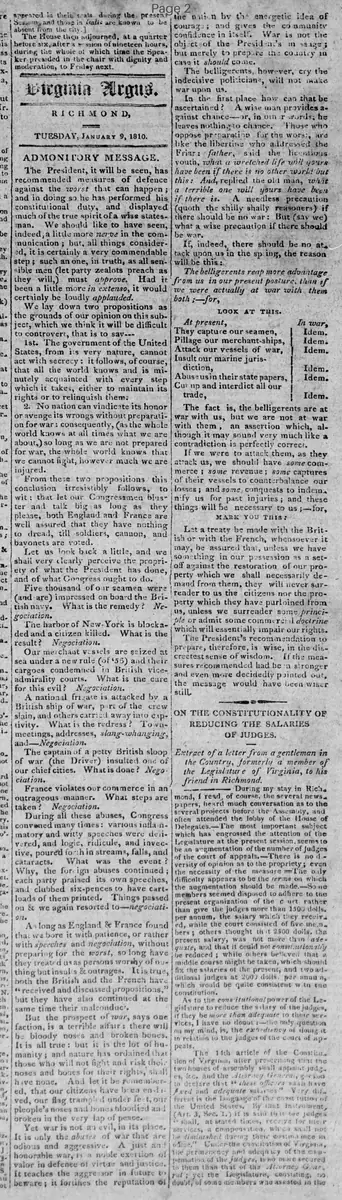
ADMONITORY MESSAGE.
The President, it will be seen, has
recommended measures of defence
against the worst that can happen;
and in doing so he has performed his
constitutional duty, and displayed
much of the true spirit of a wise states-
man. We should like to have seen,
indeed, a little more nerve in the com-
munication; but, all things consider-
ed, it is certainly a very commendable
step; such an one, in truth, as all sen-
sible men (let party zealots preach as
they will,) must approve. Had it
been a little more in extenso, it would
certainly be loudly applauded.
We lay down two propositions as
the grounds of our opinion on this sub-
ject, which we think it will be difficult
to controvert, that is to say--
1st. The government of the United
States, from its very nature, cannot
act with secrecy: it follows, of course,
that all the world knows and is mi-
utely acquainted with every step
which it takes, either to maintain its
rights or to relinquish them:
2. No nation can vindicate its honor
or avenge its wrongs without preparati-
on for war : consequently, (as the whole
world knows at all times what we are
about,) so long as we are not prepared
for war, the whole world knows that
we cannot fight, however much we are
injured.
From these two propositions this
conclusion irresistibly follows, to
wit: that let our Congressmen blus-
ter and talk big as long as they
please, both England and France are
well assured that they have nothing
to dread, till soldiers, cannon, and
bayonets are voted.
Let us look back a little, and we
shall very clearly perceive the propri-
ety of what the President has done,
and of what Congress ought to do.
Five thousand of our seamen were
(and are) impressed on board the Bri-
tish navy.
What is the remedy? Ne-
gotiation.
The harbor of New-York is blocka-
ded and a citizen killed. What is the
result? Negotiation.
Our merchant vessels are seized at
sea under a new rule (of '55) and their
cargoes condemned in British vice-
admiralty courts. What is the cure
for this evil? Negotiation.
A national frigate is attacked by a
British ship of war, part of the crew
slain, and others carried away into cap-
tivity. What is the redress ? Town-
meetings, addresses, slang-whanging,
and--Negotiation.
The captain of a petty British sloop
of war (the Driver) insulted one of
our chief cities. What is done? Nego-
ciation.
France violates our commerce in an
outrageous manner. What steps are
taken? Negotiation.
During all these abuses, Congress
convoned many times: various inflan-
matory and witty speeches were deli-
vered, and logic, ridicule, and invec-
tive, poured forth in streams, falls, and
cataracts. What was the event ?
Why, the foreign abuses continued;
each party praised its own speeches,
and clubbed six-pences to have cart-
loads of them printed. Things passed
on & we again resorted to--negotiati-
on.
As long as England & France found
that we bore it with patience, or rather
with speeches and negotiation, without
preparing for the worst, so long have
they treated us as persons worthy of no-
thing but insults & outrages. It is true,
both the British and the French have
"received and discussed propositions."
but they have also continued at the
same time their ill conduct.
But the prospect of war, says one
faction, is a terrible affair: there will
be bloody noses and broken bones.
It is all true: but it is the lot of hu-
manity; and nature has ordained that
those who will not fight and risk their
noses and bones for their rights, shall
have none. And let it be remem-
bered, that our citizens have been en-
slaved, our flag trampled under feet, our
people's noses and bones bloodied and
broken in the very lap of peace.
Yet war is not an evil, in its place.
It is only the abuses of war that are
odious and aggressive. A just and
honorable war, is a noble exertion of
valor in defence of virtue and justice.
It teaches the aggressor in future to
beware; it fortifies the reputation of
the nation by the energetic idea of
courage; and gives the community
confidence in itself. War is not the
object of the President's message ;
but merely to prepare the country in
case it should come.
The belligerents, however, cry the
indecisive politician, will not make
war upon us.
In the first place how can that be
ascertained? A wise man provides a-
gainst chance--or, in other words; he
leaves nothing to chance. Those who
oppose preparation for the worst, are
like the libertine who addressed the
Friar: -father, said the licentious
youth, what a wretched life will yours
have been if there is no other world but
this: And, replied the old man, what
a terrible one will yours have been
if there is. A needless precaution
(quoth the shilly shally reasoners) if
there should be no war : But (say we)
what a wise precaution if there should
be war.
If, indeed, there should be no at-
tack upon us in the spring, the reason
will be this :
The belligerents reap more advantage
from us in our present posture, than if
we were actually at war with them
both ;-for,
They capture our seamen,
Pillage our merchant-ships,
Attack our vessels of war,
Insult our marine juris-
diction,
Abuse us in their state papers,
Cut up and interdict all our
trade,
In war,
Idem.
Idem.
Idem.
Idem.
Idem.
Idem.
Idem.
The fact is, the belligerents are at
war with us, but we are not at war
with them. an assertion which, al-
though it may sound very much like a
contradiction is perfectly correct.
If we were to attack them, as they
attack us, we should have some com-
merce ; some revenue; some captures
of their vessels to counterbalance our
losses; and some conquests to indem-
nify us for past injuries; and these
things will be necessary to us j-for,
MARK YOU THIS:
Let a treaty be made with the Brit-
ish or with the French, whensoever it
may, be assured that, unless we have
something in our possession as a set-
off against the restoration of our pro-
perty which we shall necessarily de-
mand from them, they will never sur-
render to us the citizens nor the pro-
perty which they have purloined from
us, unless we surrender some princi-
ple or admit some commercial doctrine
which will essentially impair our rights.
The President's recommendation to
prepare, therefore, is wise, in the dis-
creetest sense of wisdom. If the mea-
sures recommended had been stronger
and even more decidedly pointed out,
the message would have been wiser
still.
What sub-type of article is it?
What keywords are associated?
What entities or persons were involved?
Editorial Details
Primary Topic
Support For Presidential Recommendations On Defense Preparations Against Britain And France
Stance / Tone
Supportive Of Military Preparation And Critical Of Negotiation Only Diplomacy
Key Figures
Key Arguments