Thank you for visiting SNEWPapers!
Sign up free
The Kentucky Gazette
Lexington, Fayette County, Kentucky
What is this article about?
Debate in the Kentucky House of Representatives on January 31 regarding a bill to poll the public on calling a constitutional convention. Mr. Breckenridge urges caution to avoid agitating the satisfied populace, while Mr. Taylor and others advocate for allowing the people's voice. The bill passes 35-16.
Merged-components note: Continuation of the same story reporting on the Kentucky Legislature debate, with text flowing directly from one to the other across sequential reading orders.
Clipping
OCR Quality
Full Text
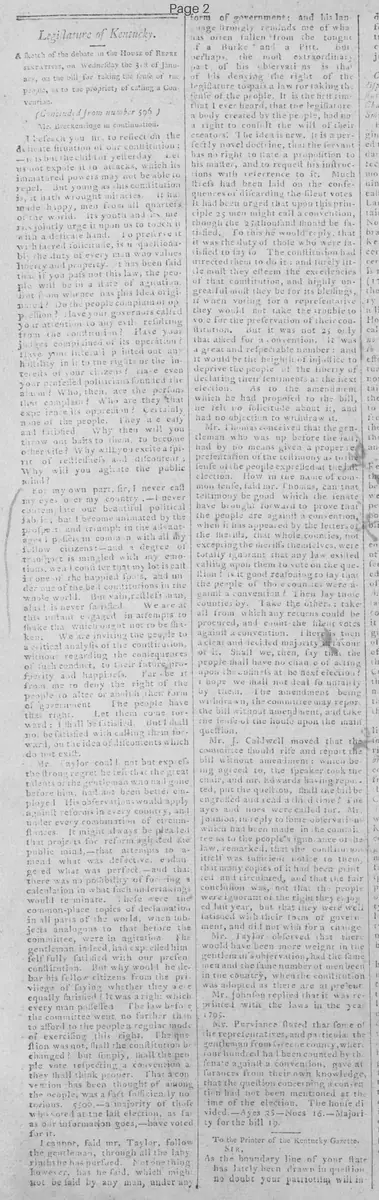
A sketch of the debate in the House of Representatives, on Wednesday the 31st of January, on the bill for taking the sense of the people, as to the propriety of calling a Convention.
(Concluded from number 506)
Mr. Breckenridge in continuation.
I beseech you, sir, to reflect on the delicate situation of our constitution: But the child of yesterday must not expose it to attacks, which its immature powers may not be able to repel. But young as this constitution is, it hath wrought miracles. It has made happy men from all quarters of the world. Its youth and its merits jointly urge it upon us to touch it with a delicate hand. To preserve it with sacred solicitude, is unquestionably the duty of every man who values liberty and property. It has been said that if you pass not this law, the people will be in a state of agitation. But from whence has this idea originated? Do the people complain of oppression? Have your governors called your attention to any evil resulting from the constitution? Have your judges complained of its operation? Have your lawyers pointed out any hostility in it to the rights or the interests of your citizen? Have even your professed politicians found the alarm? Who, then, are the persons that complain? Who are they that experience its oppression? Certainly none of the people. They are easy and satisfied. Why then will you throw out baits to them, to become hostile? Why will you excite a spirit of rebellion and discontent; why will you agitate the public mind?
For my own part, sir, I never cast my eye over my country—I never contemplate our beautiful political fabric, but I become animated by the prospect, and triumph in the advantages possess in common with all my fellow citizens—and a degree of transport is mingled with my emotions, when I consider that my lot is cast in one of the happiest spots, and under one of the best constitutions in the whole world. But vain, restless man, all is never satisfied. We are at this instant engaged in attempts to shake that which ought not to be shaken. We are inviting the people to a critical analysis of the constitution, without regarding the consequences of such conduct, to their future prosperity and happiness. Far be it from me to deny the right of the people to alter or abolish their form of government. The people have that right. Let them come forward: I will be satisfied. But I shall not be satisfied with calling them forward, on the idea of discontents which do not exist.
Mr. Taylor could not but express the strong regret he felt that the great talents of the gentleman who had gone before him, had not been better employed. His observations would apply against reforms in every country, and under every combination of circumstances. It might always be pleaded that projects for reform agitated the public mind—that attempts to amend what was defective endangered what was perfect—and that there was no possibility of foreseeing or calculating in what such undertakings would terminate. These were the common-place topics of declamation in all parts of the world, when subjects analogous to that before the committee, were in agitation. The gentleman indeed, had expressed himself fully satisfied with our present constitution. But why would he debar his fellow citizens from the privilege of saying whether they were equally satisfied? It was a right which every man possessed. The law before the committee went no farther than to afford to the people a regular mode of exercising this right. The question was not, shall the constitution be changed? but simply, shall the people vote respecting a convention as they shall think proper. That a convention has been thought of among the people, was a fact sufficiently notorious. A majority of those who voted at the last election, as far as our information goes, have voted for it.
I cannot, said Mr. Taylor, follow the gentleman, through all the labyrinths he has pursued. Not one thing however, has he said, which might not be said by any man, under any form of government: and his language strongly reminds me of what has often fallen from the tongue of a Burke and a Pitt. But perhaps the most extraordinary part of his observations is that of his denying the right of the legislature to pass a law for taking the sense of the people. It is the first time that I ever heard, that the legislature a body created by the people, had no right to consult the will of their creators: The idea is new. It is a perfectly novel doctrine, that the servant has no right to make a proposition to his master, and to request his instructions with reference to it. Much stress had been laid on the consequences of discarding the silent votes. It had been urged that upon this principle 25 men might call a convention, though the 2000 should be satisfied. To this he would reply, that it was the duty of those who were satisfied to say so. The constitution had directed them to do it: and surely little must they esteem the excellencies of that constitution, and highly ungrateful must they be for its blessings, in whom voting for a representative they would not take the trouble to vote for the preservation of their constitution. But it was not 25 only that asked for a convention. It was a great and respectable number: and it would be the height of injustice to deprive the people of the liberty of declaring their sentiments at the next election. As to the amendment which he had proposed to the bill, he felt no solicitude about it, and had no objection to withdraw it.
Mr. Thomas conceived that the gentleman who was up before the last, had by no means given a proper representation of the testimony as to the sense of the people expressed at the last election. How in the name of common sense, said Mr. Thomas, can that testimony be good which the senate have brought forward to prove that the people are against a convention, when it has appeared by the letters of the clerks, that whole counties, not excepting the sheriffs themselves, were totally ignorant that any law existed calling upon them to vote on the question? Is it good reasoning to say that the people of those counties were against a convention? I then lay those counties by. Take the other: take all from which any returns could be procured, and count the votes against a convention. There is then a clear and decided majority in favour of it. Shall we, then, say that the people shall have no chance of acting upon the question at the next election? I hope we shall not deal so unfairly by them. The amendment being withdrawn, the committee may report the bill without amendment, and take the sense of the house upon the main question.
Mr. J. Caldwell moved that the committee should rise and report the bill without amendment: which being agreed to, the speaker took the chair, and Mr. Edwards having reported, put the question, shall the bill be engrossed and read a third time? and the ayes and noes were called for. Mr. Johnson, in reply to some observations which had been made in the committee as to the people's ignorance of the law, remarked, that the constitution itself was sufficient notice to them that many copies of it had been printed and circulated, and that the fair conclusion was, not that the people were ignorant of the right they enjoyed last year, but that they were well satisfied with their form of government, and did not wish for a change.
Mr. Taylor observed that there would have been more weight in the gentleman's observation, had the same men and the same number of men been in the country, when the constitution was adopted as there are at present.
Mr. Johnson replied that it was renewed with the laws in the year 1795.
Mr. Purviance feared that some of the representatives, and particularly the gentleman from Green county, where four hundred had been counted by the senate against a convention, gave assurances from their own knowledge that the question concerning a convention had not been mentioned at the time of the election. The house divided.—Ayes 35—Noes 16.—Majority for the bill 19.
What sub-type of article is it?
What themes does it cover?
What keywords are associated?
What entities or persons were involved?
Where did it happen?
Story Details
Key Persons
Location
Kentucky House Of Representatives
Event Date
Wednesday The 31st Of January
Story Details
Debate on bill to take public sense on calling a constitutional convention; Breckenridge warns against unnecessary agitation of a satisfied populace; Taylor defends people's right to express will and notes majority support from last election; Thomas argues for fair representation excluding ignorant counties; bill passes without amendment 35-16.