Thank you for visiting SNEWPapers!
Sign up free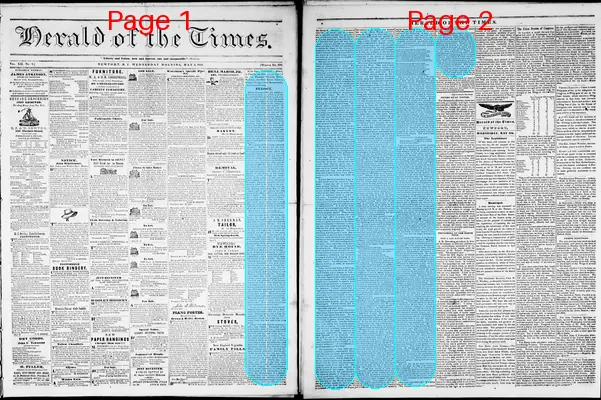
Herald Of The Times
Newport, Newport County, Rhode Island
What is this article about?
Rufus Choate's eulogy at Boston funeral for President William Henry Harrison, who died shortly after inauguration, recounts his fortunate life, Western achievements, military victories like Tippecanoe, land policies, virtues of honesty and benevolence, and the pathos of his untimely death.
Merged-components note: This is a continuation of Rufus Choate's eulogy on President Harrison, split across pages due to independent page parsing.
Clippings

1 of 2
OCR Quality
Full Text
Fellow Citizens:—We are called together by an event, for which, in all the circumstances that attended it, you may scarcely find a parallel in the long series of alternate judgments and blessings, that furnish the matter of the history of the world. Our civil father is dead! In such an hour, when success from his last contest was just attained, when party strifes were subsiding to rest, and the people of America, returning to the generosity of their nature, had united to predict for him the fame of Washington; just then, when warm affections were breathing from so many millions of hearts; just then, when all stood fixed to hear from the eloquence and experience of those lips, the holy, wise and beautiful things that pertain to the institutions of our country; just then, he was stricken from among us;—he has gone to the desolate places, where the kings and counsellors of the earth rest at length together.
How strange is the contrast a moment presents! So strange that the mind vainly strives to appreciate its reality. It is only just now, it seems indeed but yesterday, since some of you saw him stand up,—that firm, wise and kind old man—the snows of three score winters on his head,—but with his eye undimmed and his voice unbroken,—that voice so often heard amid the clamor of the battle-field—and in the presence of a not inadequate representation of all that is honorable and respectable in the land; of the judges, of the clergy, of the foreign ministry, of the strength and intelligence of the country, of men and women, hanging by thousands and tens of thousands, with pride, sympathy and love, on every word of the man of the people's choice;—then and there stand up, and, beneath the radiant flag of his country, portray and assume the vast duties of the office conferred upon him! All is gone! The triumphal march, those voices of hope and joy, that gorgeous standard of the free and brave, that sound as of many waters rising above the cannon's opening roar, with that ceremonial which should mark that day, all is past in a moment, and he is gone. Whither has fled the visionary gleam? Where is it now, the glory and the dream?
Our nation has been called to mourn before, for the good, the wise, the valiant, its founders and benefactors, those who have triumphed in hundreds of victories, in peace and war. It is not now the first time that our people have interrupted their employments, have left the ship half loaded, the contract unfinished, and the plough in the partly broken furrow, and come together to exchange their sympathies on the occasion of public bereavement. But there is something in the circumstances of this bereavement which gives it a pathos—all its own. Others have died when the measure of their glory was full; when the circle of office was all run through; in the bosom of a retirement to which the prayers of their countrymen had attended them; full of years, full of fame the festival of life complete. No duty undischarged, no promise unperformed, no wish ungratified, they went down, like the sun at the close of a bright summer's day into a grave, wider than the sea, a tomb wider than the whole earth. So died Adams, Jefferson, Madison and Monroe; so died Lafayette; Washington so died; their death was noted, but our sorrow was so mitigated, so relieved by the sublimity of the circumstances, the time of their death was so seasonable not only for us but for themselves, that we mourned indeed, but with a pleasant, delicious exultation that time and chance had no more power over them beyond their grave. Hail and farewell, good and faithful servants, for whom it seems there is no more to do! Your own monuments you have yourselves completely built!
To day my friends, we mourn over unfinished labors, over unperfected fame. Although the name of him we have lost shone always brightly, and a long life was spent in the service of his country, we deplore him as we would the enthusiastic youth who had sunk to an early grave.
I know very well that his accession to office was resisted. Thousands of his countrymen—some of you—participated in the resistance, and yet when the strife was over, and the will of the majority was constitutionally proclaimed, when the voice of his country, with that authority at whose sacred call he had so often leapt to arms, had bidden him come forth from his plain old forest home, from his books, from his farm, from the bright Ohio—gliding away like his own life, pure, majestic and serene—from the wife of his bosom, his dear and aged wife not yet, thank God, wholly houseless and homeless, on whose sorrow we will not intrude;—had bidden him come away and ascend to the high places of his country's pride, there to put forth the mild energies, the incorruptible integrity of his character; to calm down the passions of his countrymen; to restrain the intemperance of a majority reeking from recent victory; to protect and reconcile the minority; to execute the laws so that justice might be seasoned with mercy; to reform what was wrong, if wrong there were, to give us back the liberty that we love, and to secure to Labor its daily bread ; and when obedience to that call you saw him go forth to accept that trust, there was no one that bore a true American heart who did not bid the brave and good old man God speed !-not one, who did not fervently desire for him a full and fair opportunity to realize the hopes of his friends, the demands of his country,-and the aspirations of his patriotism; not one who does not mourn, as you mourn to-day, that he has fallen so prematurely for himself, so prematurely for us all.
And yet, my friends, we must not suffer the sharpness of this recent sorrow to make us unreasonable or unjust. We must not defraud him there in his narrow dwelling, of so much as a ray of his already appropriated fame, because he did not live to acquire the exceeding praise we had anticipated for him. It seems rather to be the duty of the occasion, as it certainly was its object, to soothe the violence of our grief by the recollection of the actual life of the departed, as shown to the country and the world.
This is the only way to treat the occasion justly ; thus alone do we gain from it its whole lesson. We do not honor him, we do not benefit ourselves by impatient regrets that he can serve us no longer; but rather by a heartfelt gratitude that he has served us so long. We should rather repeat to ourselves the history of his life, crowded with the events of seventy years, and gather up with fond hands, and pious solicitude, the good, the useful, the grand traits of his character and mind, as that life had brought them out, and engraved them upon our hearts, as with a pen of steel upon the great pyramid fronting the rising sun.
Who needs to be reminded of the story of that life? You all are familiar even with its particulars; with his achievements in the council and the field ; with his family ties; with his primitive habitation on the Ohio; even with the lines of his countenance, no!, as you see, [Here Mr. Choate turned and pointed to the portrait of President Harrison, by Hoyt, which hung over the rostrum, untouched by care, and labor, and time; and yet quick, intelligent, and mild, and all worthy of the glorious fellowship to which you have this day received him. All these are as familiar as household words. How brief and dreamlike seems the interval since the people came together every day, to weave a garland for his living temples ; since the press teemed with his story, and music and song were bearing his name and praises on every wind and to every air, till the nation had them by heart.
It is not therefore necessary to go into any details as to his career or character. I need only call to mind their more general features. In attempting this I would not be understood to intend by any praise I may bestow on him, to reflect on any other men, or on the personal or technical creed of policy of any party. I earnestly pray that I may not be so interpreted. It would be unjust to you who have united to-day without distinction of party for these services of national sorrow. It would be worse. It would be to disregard one of the great lessons of this calamity itself. For does it teach no great lesson? Who can tell that it is not intended that the zeal with which high office is sought, shall be moderated by this picture of the sudden death of a great statesman on the attainment of the summit of ambition; by bringing into such sudden and startling contrast the two great processions. of the inauguration and the funeral. The one marching with the pomp of more than a coronation, to set more than a diadem on his brow; while his bosom was swelling, and his eye kindling with pride, and hope, and affection. The other winding slowly and sadly, like yours to-day, to lay down the cold lips and the prostrate form in the silent grave. Who can say that this great calamity was not intended to soften the asperities of party strife, to arouse a momentary tenderness, and reconcile estranged brethren, by bringing us together around the death-bed of our departed leader. Let the services of this day not weaken, at least, so desirable an impression!
I may confess that when, a week ago, I began to re-read the life of our departed President, and to attempt to form a clear re-judgment of his services, it was with some degree of silent solicitude, lest the circumstances of the recent contest should have combined to bestow upon him, in the general eye, a character above his own, which might now prove to be factitious. I almost feared that it might prove, that our tumultuous desires, our passions and fancies, might have imposed upon us a man not quite worthy to continue the star-bright roll of imperishable names, which is opened by the greatest name on earth, our own great Washington. I almost feared that we had imagined a reputation which a breath might make and take away.
I rejoice that I now know him better! That which I have learned of him makes me love and admire him more. No, my countrymen, you were not deceived; you did wisely to gather around him, from the north to the south, from the farthest East to the setting sun, from the plantation and the prairie, from the workshop and the farm; to commit to his mild and sure virtues, his ample capacities, his enlarged experience, the care of the best interests of our social life. You do well to mourn for him as he passes away. Not one hope but was just, not one expectation but was founded on the history of the past. A vast influence for good has passed forever away!
The two points of view under which I shall particularly contemplate President Harrison are these: first that all his life long he was eminently a fortunate man; and secondly, that he deserved to be so, from the qualities of his mind and heart, from the useful and occasionally brilliant course of his public life. His father's name is engraved indelibly in the memories of his country. He himself was born on the soil and trained in the classical schools of Virginia,--mother of great men, and yet not vain glorious of her jewels! His first experience of battle was on the Miami in 1794, at every part of the field amidst the fire of the age of 21; where he bore through thousand rifles the orders for Wayne, the bravest of the brave, that secured the victory. Here Wayne obtained a conquest, which more even than that of Yorktown determined our national independence. In the next year the young soldier settled in the country which he had aided to liberate; and for forty years of peace and war, in public life and in retirement, in long gradation he grew with the growth and strengthened with the strength of the free and imperial North-west, til at last she presented him to the people of America, completely worthy to fill the foremost place of all the world.
His course was identified with the fortunes of the West. This was, I think, the key to the paramount felicity of his public life. He was her adopted son, and she loved him as her own. It was her children always whom he led to victory. It was from her advancing cabins, from her luxuriant cornfields, and primeval forests that he turned back the fiery tide of Indian war. It was in the administration of her civil affairs that he acquired the capacity and experience that fitted him for the grand trust of his closing life. For half a century, by partaking and reciprocating her boundless hospitalities; by watching in the field so many nights, while her women and children were sleeping in safety, by repelling so many incursions of her savage foe; by assisting to frame the laws for her soil under which she has grown up, and the institutions under which commerce has covered her rivers, before bearing only the light canoe and the newly fallen leaves of autumn; by embodying the perfection of the local character, its self-devotion, large heart, its firmness; he won that love which brought out at the last election her enthusiastic support, which, on this day of grief will carry her fair daughters to smooth the lonely pillow of that aged widow, and would make half a million of swords leap from their scabbards to avenge a word or a look that threatened his memory with insult.
It will be enough to refer to two incidents of his life, either of which would entitle him forever to the grateful honors of his countrymen. The first of these was the victory over the Indian Prophet in 1811, the most desperate in the annals of Indian war. I say nothing of military skill displayed in the action. It was the splendid usefulness of the victory which gave it all its value; which most exhibits the characteristic felicity of the soldier who won it. It seems to be now plain that between 1806 and 1811 the Prophet and his much more remarkable and interesting brother, Tecumseh, had formed the design of enlisting and uniting into a great confederacy the entire aboriginal race. To what extent they had hoped to wage successful war against the States, is not so easy to perceive. Perhaps in the gloomy recesses of their minds which, although not unfurnished with a certain native sublimity of soul, were not without their deep caves of revenge; stung by their traditionary and indisputable wrong, recalling the days of their fabulous glory, and marking how high and for how long the tide of civilization had advanced till it was breaking around their own dwellings ; perhaps, when they listened to the watch-fire song of war, to the dismal roar of the pines, or the solemn fall of the distant river, near which their rugged infancy had played, but from which their old age might be removed; and thought of these things till the dread of the spirits of their fathers aroused the boiling tide of hate and the thirst for vengeance; perhaps Tecumseh, and certainly his more imaginative brother, conceived the plan of restoring the whole country to its original possessors.
Certain it is that they planned a union of the entire tribes from the frontier to the Gulf of Mexico, and that by the year 1811 they had brought it to the verge of consummation. Certain it is also that if the design had been effected, taken in connection with the war with England, it would have environed our whole frontier with a circle of fire: would have turned those gardens of the earth into a dark and bloody wilderness; and the strength which would have been insufficient for permanent re-conquest, might have been insufficient for temporary and terrible devastation. The dark dream of the Indian Hunter at the tomb of his fathers might have been accomplished;—
"But I behold a fearful sign,
To which the white man's eyes are blind:
Their race may vanish hence like mine,
And leave no trace behind,
Save ruins o'er the region spread,
And the white stones above the dead."
Gen. Harrison, as Governor of the North West Territory, detected and defeated this act of duplicity. As I rejoice more than all, now that he has gone to stand for judgment before the father of the Indian and the white man, that the laurels he thus acquired were unstained. His whole life was unstained by a single act of cruelty against those races. Conducting as he did the entire intercourse between the Government and the Indians. he committed no act authorized or unauthorized which violated his faith with the latter : and I rejoice that he so administered that trust, so parentally, so compassionately and so justly urged peace, and so temperately followed up his victory, that to day as the tidings of his death are borne across the ocean forests of the west, the warriors of a hundred races shall mourn with us for their father and for ours.
The other act to which I allude was of a different nature ; the maturing of the system of sales of the public lands, which has contributed so much more than all things else, to the magical but healthful growth of all that great region. In 1799, when he entered Congress, the system which obtained was to confine sales of lands to large tracts of 4000 acres or more. The effect was to place them beyond the reach of the actual emigrant desiring to settle, and in the hands of the capitalists of whom he must buy or hire. It was the first act of the youthful delegate, whose eye took in at a glance the vast interests of the West, to propose a change of policy, by reducing the minimum to 320 acres, just an industrious poor man's farm. This became the basis of the law which has so planted the West. Where, in history, will you find a parallel to this? The law-giver is now in his grave. But go back to the time when, forty years ago, he trembled before the statesmen of that Congress with, his new plan for settling the West, and ask yourselves what that West was then, It now comprises four States, two Territories, and three millions of inhabitants. Let me unroll to you the picture of it as it existed then, as painted by the hand of a master:—
Over all that space, there then stretched one vast wilderness, unbroken, except by four small spots of civilized culture, at Marietta, Cincinnati, Detroit and Vincennes. At those little openings, hardly each a pin's point on the map, the arm of the frontier. man had levelled the forest and let in the sun. These little patches of earth, and themselves almost overshadowed by the over. hanging boughs of that wilderness, which had stood and perpetuated itself, from century to century, ever since the creation, were all that had then been rendered verdant by the hand of man. In an extent of hundreds and thousands of square miles, no other surface of smiling green attested the presence of civilization. The hunter's path crossed mighty rivers, flowing in solitary grandeur, whose sources lay in remote and unknown regions of the wilderness. It struck, upon the north, on a vast inland sea, over which the wintry tempests raged as on the ocean; all around was bare creation. It was fresh, untouched, unbounded. Magnificent wilderness."
And what is it now?" Let us look at the picture of its present condition, as drawn by another artist:—
"Look now abroad-another race has filled
These populous borders-wide the wood recedes,
And towns shoot up, and fertile realms are tilled
The land in full of harvests and green meads;
Streams numberless, that many a fountain feeds,
Shine, disembowered, and give to sun and breeze
Their virgin waters: the full region leads
New colonies forth, that toward the western seas
Spread, like a rapid flame among the autumnal trees.
Here the free spirit of mankind, at length,
Throws its last fetters off'; and who shall place
A limit to the giant's unchained strength.
Or curb his swifteness in the forward race ?
Far, like the comet's way through infinite space
Stretches the long untravelled path of Light
Into the depth of ages; we may trace
Distant, the brightening glory of its flight,
Till the receding rays are lost to human sight."
Such was the west! Such is the west! his home, his pride, and wheresoever his ashes shall lie-his Monument. I have spoken of the felicity, of the fortunate career of Harrison. To complete the circle, you would expect me, of course, to except the history of his recent departure. Is it not a crowning goodness that he died as just now you saw him die,-in the full and fresh fruition that fame, of the extent of which he had just been made so vividly conscious by the scenes of the inauguration. Before one leaf of that transcendent garland had fallen, before he had had one hour's experience, of the difficulty of doing right, of the fickleness of friends, and the harshness of opponents, the selfishness of those who were seeking office and the rancor of those who had left it-the hopes of all our countrymen still resting upon him, the music of that triumphant march still falling upon his ear ; before one light was dim, or one guest departed, the great preparation, we may trust, seasonably made, well might he commit the constitution and country to his successor ;-extend his hand to the urn and draw out the lot appointed to all. Napoleon went back on his death bed to the field of battle; the last thought of the patriot President was on the welfare of his country. The cares of state are over for him
"He sleeps well
nor steel, nor poison,
Malice domestic, foreign levy, nothing
Can touch him farther."
I shall not speak at large of the character of Harrison, and there is no need that I should do so, displayed, as it has been; in every variety of life by the diversified requisitions of forty or fifty years; probed and laid bare as it has been by the tremendous ordeal which every candidate for the Presidency must here pass through; a character too, remarkably accessible and transparent. You know it, the people know it all. What need, here and now, to tell you of the courage, tested midst the flashing fury of midnight warfare; of the military skill that won laurels in all fields, in the face of the iron discipline of one foe, and the stealthy craft of another; of the broad sound sense, the universal discretion, that true Washingtonian trait; of the honesty, no more to be corrupted, no more to be assailed, than the sun in his course of glory-that grand charm by which he won all hearts, on which the universal masses reposed so implicitly, and from which they expected so much ; of that tolerance and justice, which made him forget, after his triumph. which was the party which elected him; of that genuine American feeling, which gave us the assurance of an administration that should recognize no distinction of the opposite sides of the Alleghanies, and of Mason's and Dixon's line : of the true republicanism of his politics-not the republicanism of this man or that, but-of the constitution-promising a government of laws and not of men, promising us a republican government, for which I have sometimes thought his own old house at North Bend, the Doric of the forest, formed no unapt representation; that house, not unvisited by storms and yet not falling-inundated but not destroyed; all within well ordered and administered by a mild parental authority. the home of true affections, strong arms, and high thoughts, nourished by the wisdom of the past, by the contemplation of the grandeur and beauty of nature herself, the forest, the river, and the bright firmament of the stars.
In looking over the history of his life more carefully, to form an estimate of the aggregate of his character, I venture to think. that while through his life he displayed the requisite capacity for the formation and administration of laws, or whatever public duty was required of him, it was the warm, pure and great heart that attracted and retained for him the love of his countrymen. He should be remembered-and we will speak of him to our children as the good President; homely as christian epithet may appear, how much more has it of real significance than the imperial title 'great' so often given to men who have waded through blood to thrones. I need give but two anecdotes to illustrate this trait in his disposition. He pardoned the negro who sought his life, and rescued him, by his own solicitation. when fastened to the stake for military punishment. He recovered heavy damages by a verdict in a case for slander. and then divided the money received, among the children of the slanderer, and the orphan children of some of his old soldiers. Altho he was hospitable beyond the usual hospitality of the west, it was always the remnant of the armies of Harmar and St. Clair that found the warmest welcome at his ever ready board When the ear heard him, it blessed him; when the eye saw him, it gave witness to him; because he delivered the poor that cried. and the fatherless and him that had none to help him. Consider then, that combined benevolence and integrity, worthy the accounts of Grecian and Roman fame. to which he was not ashamed sometimes to turn his attention backwards; behold him tried by the temptation of an office, from which he might have amassed a princely fortune, and with the conscientious honor of a Washington retiring from it poor. and you will feel and see in a moment what it was that impelled towards him the love of a people. The country had been long unprosperous, from causes into which we need not inquire. We were laboring the live-long day, and feeling as we lay down at night, that we were growing poorer and poorer. The people were puzzled with various theories and arguments. They were growing more and more distrustful with all mere great talent. There grew up a wide and irrepressible craving in the public heart. for an honest man from among themselves, to preside over their affairs, and help them backward to the glories of their father's days, Then it was that they turned to him. Be this the lesson of his life. Be this his eulogy. That not for descent from an exalted line; not for his military victories: not for his dexterity in the partizanship of professional politics, was he chosen to relieve and reform the land; but because he was a good and just man, fearing God and loving his country.
And now that he has been called to go hence, and leave the high trust which had been committed to him, how impressive is that sublime and shadowy orientalism which he is said to have repeated a few days before his death, which seemed to predict the awful lesson, which has now been given, from the month which has passed to the months which are to come—
"Watchman, what of the night? Watchman, what of the night?"
"The watchman said, the morning cometh and also the night: if ye will inquire, inquire ye, return, come."
Happy if this dreary eclipse in so splendid a morning, should inspire such inquiries in all our statesmen, should change the ambition of public men, should admonish them that all the ends they aim at should be their country's and their God's. Happy if it should sink deep and lie long in the heart of the great mass of the people, on whom directly this affliction is to fall, repressing, if it may be, the mean selfishness of worldly life teaching sympathy by this seasonable and indulged sorrow, and carrying all our thoughts forward to that tribunal at which not rulers only, but nations themselves must one day stand. There are times and seasons, in which it may be true of a nation as well as of a man. that it is good to be afflicted. Who knows how much the fall of a hero, the event of a war, a triumphant victory, the tears of a nation in mighty grief, may contribute to that mysterious and varied public discipline, by which at last a living soul is breathed into that nation's giant limbs.
We stand on this spot where the heart of an American must throb with pride and joy And yet, perhaps you have embellished the glories of even this place, by hanging these emblems of mourning to its pillars, by this dim religious light, you have added to the memories of its ancestral glories.
What sub-type of article is it?
What themes does it cover?
What keywords are associated?
What entities or persons were involved?
Where did it happen?
Story Details
Key Persons
Location
Boston
Event Date
Tuesday, The 20th Inst.
Story Details
Rufus Choate delivers a eulogy praising Harrison's life, military victories, public service, character, and sudden death shortly after inauguration, emphasizing his goodness, fortune, and the nation's loss.