Thank you for visiting SNEWPapers!
Sign up free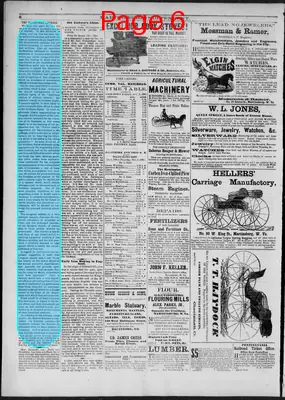
Story
March 12, 1881
Martinsburg Independent
Martinsburg, Berkeley County, West Virginia
What is this article about?
Commentary on President Garfield's inaugural address, highlighting his positions on education for freedmen, the Mormon problem in Utah, civil service reform, the Isthmus canal, financial theories, and a call for unity in peace.
Clipping

OCR Quality
98%
Excellent
Full Text
THE INAUGURAL ADDRESS.
We have not space for the full text of President Garfield's inaugural address. It was delivered on Friday, and ere this has been read by millions of citizens, and made the text of comments deeply tinged with the preconceived opinions and prejudices prevailing in various circles and sections. Like all important declarations addressed to immense audiences it contains some avowals which may excite antagonistic feelings, but bearing in mind that he was elected as the candidate of the Republican party and is generally expected to uphold the distinctive ideas and principles of that organization, the President has combined a full recognition of that obligation with an avoidance of unnecessary offense to his partisan antagonists. On the issue most likely to awaken hostilities, which is that relating to the alleged infringements of the political rights of the "American citizens of African descent," the practical remedy he proposes might, if properly applied, be more likely to prove acceptable than odious to some of the Southern States. In brief, he advocates liberal appropriations by Congress, for the support of the common schools intended for the education of the freedmen, as this seems clearly to be the meaning of his declaration that the "Nation itself is responsible for the extension of the suffrage, and is under special obligations to aid in removing the illiteracy which it has added to the voting population." As most, if not all, of the Southern States habitually make appropriations for supporting freedmen's schools, and as the industrial and financial difficulties under which the South has been laboring generally either render these appropriations insufficient for the complete accomplishment of the contemplated end, or necessitate a rate of taxation which is considered very onerous, the scheme for partly educating the freedmen at the expense of the entire country might be carried out in a manner which would extend welcome relief to the entire body of Southern taxpayers. One of the most plausible objections to this proposition is that it would have a tendency to promote centralization, and it must remain for the future to decide whether this theoretical consideration will be allowed to outweigh the proposed practical advantages.
The inaugural address, in a very emphatic manner, discusses the continued prevalence of polygamy in Utah, and the prolonged exercise, by the Mormon church, of powers akin to those usually wielded by government. The country is nearer now, than at any former period, to reaching a practical solution of the Mormon problem, and the new president is evidently disposed to take special efforts to hasten the accomplishment of that end.
In regard to civil service the important suggestion is made that Congress should pass a law "to fix the tenure of the minor officers of the several executive departments, and prescribe the grounds upon which removals shall be made during the terms for which incumbents have been appointed." Such a measure would have a very important effect in preventing tens of thousands of employes of the government from being subjected to uncertainties and quakings whenever a change occurs in the heads of the department with which they are connected. There would be at least some sort of a fixed point in regard to the minor offices, and their incumbents are quite as well entitled to such protection as is proposed as the holders of more important positions.
In reference to the Isthmus canal project, the Monroe doctrine is reaffirmed. On financial questions the President indorses the theories he advocated while he was a member of Congress. And on general subjects this forcible sentiment is expressed: "Let all our people, leaving behind them the battle-fields of dead issues, move forward, and in the strength of liberty and the restored Union win the grander victories of peace."
We have not space for the full text of President Garfield's inaugural address. It was delivered on Friday, and ere this has been read by millions of citizens, and made the text of comments deeply tinged with the preconceived opinions and prejudices prevailing in various circles and sections. Like all important declarations addressed to immense audiences it contains some avowals which may excite antagonistic feelings, but bearing in mind that he was elected as the candidate of the Republican party and is generally expected to uphold the distinctive ideas and principles of that organization, the President has combined a full recognition of that obligation with an avoidance of unnecessary offense to his partisan antagonists. On the issue most likely to awaken hostilities, which is that relating to the alleged infringements of the political rights of the "American citizens of African descent," the practical remedy he proposes might, if properly applied, be more likely to prove acceptable than odious to some of the Southern States. In brief, he advocates liberal appropriations by Congress, for the support of the common schools intended for the education of the freedmen, as this seems clearly to be the meaning of his declaration that the "Nation itself is responsible for the extension of the suffrage, and is under special obligations to aid in removing the illiteracy which it has added to the voting population." As most, if not all, of the Southern States habitually make appropriations for supporting freedmen's schools, and as the industrial and financial difficulties under which the South has been laboring generally either render these appropriations insufficient for the complete accomplishment of the contemplated end, or necessitate a rate of taxation which is considered very onerous, the scheme for partly educating the freedmen at the expense of the entire country might be carried out in a manner which would extend welcome relief to the entire body of Southern taxpayers. One of the most plausible objections to this proposition is that it would have a tendency to promote centralization, and it must remain for the future to decide whether this theoretical consideration will be allowed to outweigh the proposed practical advantages.
The inaugural address, in a very emphatic manner, discusses the continued prevalence of polygamy in Utah, and the prolonged exercise, by the Mormon church, of powers akin to those usually wielded by government. The country is nearer now, than at any former period, to reaching a practical solution of the Mormon problem, and the new president is evidently disposed to take special efforts to hasten the accomplishment of that end.
In regard to civil service the important suggestion is made that Congress should pass a law "to fix the tenure of the minor officers of the several executive departments, and prescribe the grounds upon which removals shall be made during the terms for which incumbents have been appointed." Such a measure would have a very important effect in preventing tens of thousands of employes of the government from being subjected to uncertainties and quakings whenever a change occurs in the heads of the department with which they are connected. There would be at least some sort of a fixed point in regard to the minor offices, and their incumbents are quite as well entitled to such protection as is proposed as the holders of more important positions.
In reference to the Isthmus canal project, the Monroe doctrine is reaffirmed. On financial questions the President indorses the theories he advocated while he was a member of Congress. And on general subjects this forcible sentiment is expressed: "Let all our people, leaving behind them the battle-fields of dead issues, move forward, and in the strength of liberty and the restored Union win the grander victories of peace."
What sub-type of article is it?
Historical Event
What themes does it cover?
Justice
Moral Virtue
What keywords are associated?
Garfield Inaugural
Freedmen Education
Mormon Problem
Civil Service Reform
Monroe Doctrine
National Unity
What entities or persons were involved?
President Garfield
Where did it happen?
Utah
Story Details
Key Persons
President Garfield
Location
Utah
Event Date
Delivered On Friday
Story Details
Analysis of Garfield's inaugural address covering education for freedmen via federal aid to Southern schools, addressing polygamy and Mormon church powers in Utah, civil service tenure reform, reaffirmation of Monroe doctrine for Isthmus canal, endorsement of prior financial views, and a call for national unity in peace.