Thank you for visiting SNEWPapers!
Sign up free
Story
September 13, 1920
The Evening Herald
Klamath Falls, Klamath County, Oregon
What is this article about?
Historical account of lace manufacturing in Ypres and Flanders starting in 1665, its revival post-war, and past popularity in England and France with royal involvement.
Clipping
OCR Quality
95%
Excellent
Full Text
HAD TO HAVE AN ARGUMENT
Since 1665 Ypres Has Been "Celebrated for the Excellence of Its Manufactures."
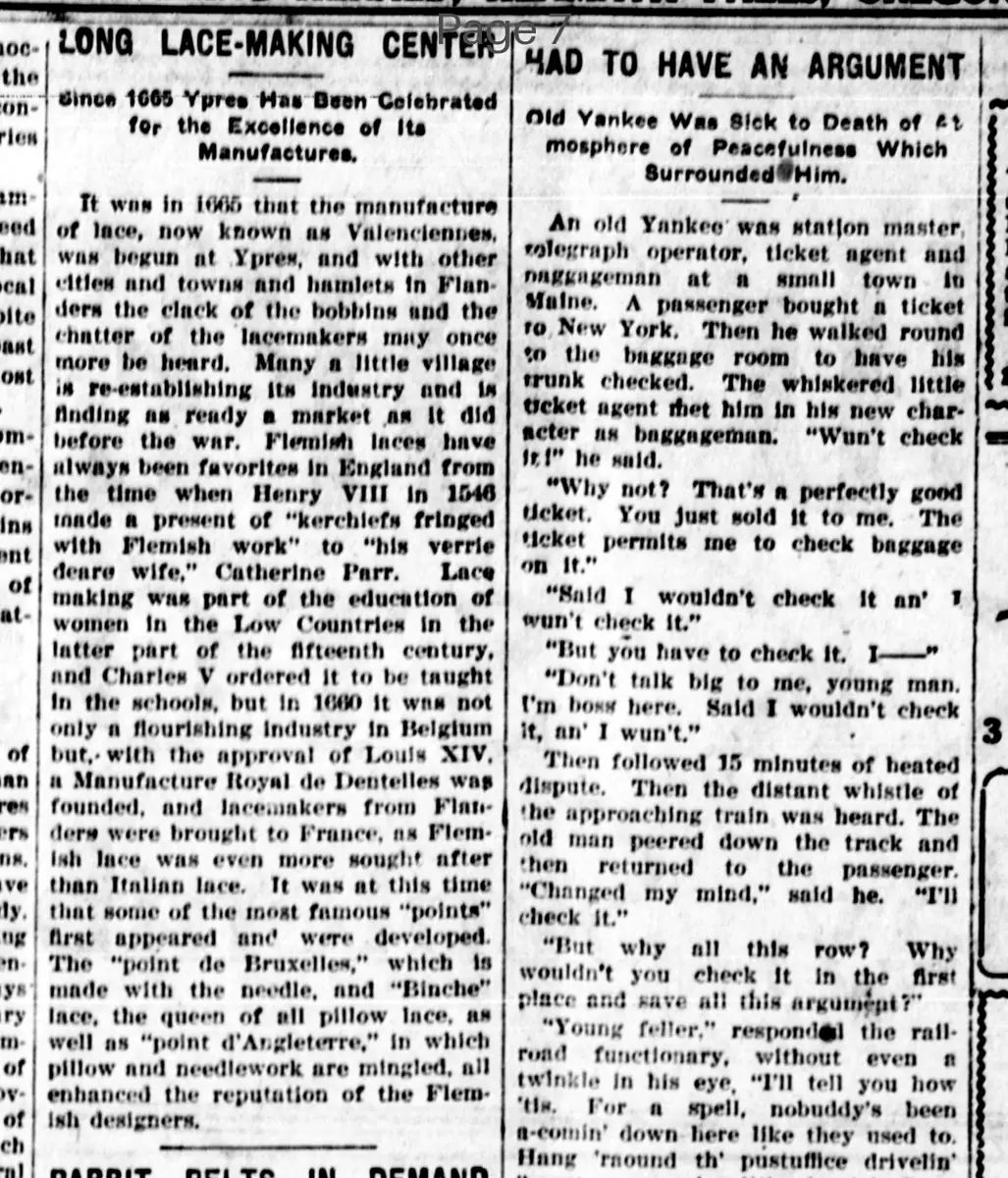
It was in 1665 that the manufacture of lace, now known as Valenciennes, was begun at Ypres, and with other cities and towns and hamlets in Flanders the clack of the bobbins and the chatter of the lacemakers may once more be heard. Many a little village is re-establishing its industry and is finding a ready market as it did before the war. Flemish laces have always been favorites in England from the time when Henry VIII in 1540 made a present of "kerchiefs fringed with Flemish work" to his "verrie deare wife," Catherine Parr. Lace making was part of the education of women in the Low Countries in the latter part of the seventeenth century, and Charles V ordered it to be taught in the schools, but in 1660 it was not only a flourishing industry in Belgium but, with the approval of Louis XIV, a Manufacture Royale de Dentelles was founded, and lacemakers from Flanders were brought to France, as Flemish lace was even more sought after than Italian lace. It was at this time that some of the most famous "points" first appeared and were developed. The "point de Bruxelles," which is made with the needle, and "Binche" lace, the queen of all pillow lace, as well as "point d'Angleterre," in which pillow and needlework are mingled, all enhanced the reputation of the Flemish designers.
Since 1665 Ypres Has Been "Celebrated for the Excellence of Its Manufactures."
It was in 1665 that the manufacture of lace, now known as Valenciennes, was begun at Ypres, and with other cities and towns and hamlets in Flanders the clack of the bobbins and the chatter of the lacemakers may once more be heard. Many a little village is re-establishing its industry and is finding a ready market as it did before the war. Flemish laces have always been favorites in England from the time when Henry VIII in 1540 made a present of "kerchiefs fringed with Flemish work" to his "verrie deare wife," Catherine Parr. Lace making was part of the education of women in the Low Countries in the latter part of the seventeenth century, and Charles V ordered it to be taught in the schools, but in 1660 it was not only a flourishing industry in Belgium but, with the approval of Louis XIV, a Manufacture Royale de Dentelles was founded, and lacemakers from Flanders were brought to France, as Flemish lace was even more sought after than Italian lace. It was at this time that some of the most famous "points" first appeared and were developed. The "point de Bruxelles," which is made with the needle, and "Binche" lace, the queen of all pillow lace, as well as "point d'Angleterre," in which pillow and needlework are mingled, all enhanced the reputation of the Flemish designers.
What sub-type of article is it?
Historical Event
What themes does it cover?
Triumph
Recovery
What keywords are associated?
Lace Making
Ypres
Flanders
Valenciennes Lace
Flemish Lace
Historical Industry
What entities or persons were involved?
Henry Viii
Catherine Parr
Charles V
Louis Xiv
Where did it happen?
Ypres, Flanders
Story Details
Key Persons
Henry Viii
Catherine Parr
Charles V
Louis Xiv
Location
Ypres, Flanders
Event Date
1665
Story Details
The manufacture of Valenciennes lace began in Ypres in 1665 and is being revived in Flanders after the war, with historical popularity in England and France, including royal endorsements and developments of famous lace types.