Thank you for visiting SNEWPapers!
Sign up free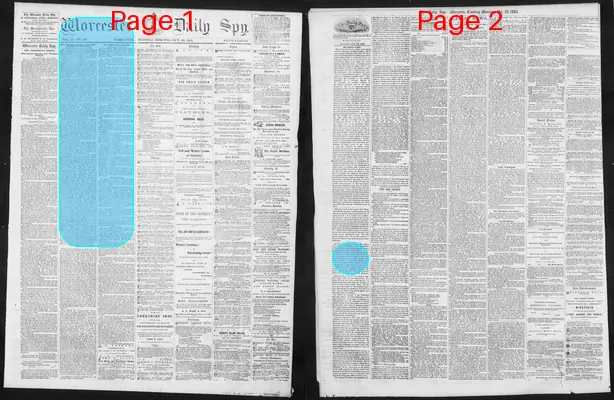
Worcester Daily Spy
Worcester, Worcester County, Massachusetts
What is this article about?
Rev. Dr. John B. Kerfoot writes to defend the Episcopal convention's vote to table resolutions on national loyalty and slavery abolition, insisting church bodies should avoid political matters to prevent division, while affirming his and others' strong patriotism and joy in the Union's victory and emancipation. (248 characters)
Merged-components note: The short note on page 2 provides context and discussion for the full Kerfoot letter on page 1, making them a single logical unit.
Clippings
1 of 2
OCR Quality
Full Text
WORCESTER
The Protestant Episcopal Convention—New England News Summary.
Mr. Binney's Resolutions.
BOSTON AND VICINITY
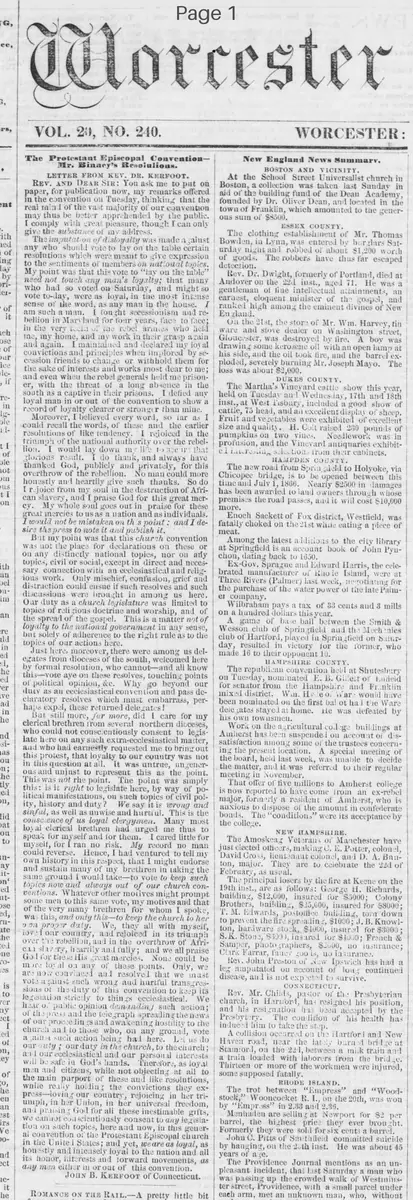
LETTER FROM REV. DR. KERFOOT.
REV. AND DEAR SIR: You ask me to put on paper, for publication now, my remarks offered in the convention on Tuesday, thinking that the real mind of the vast majority of our convention may thus be better apprehended by the public.
I comply with great pleasure, though I can only give the substance of my address.
"The imputation of disloyalty was made against any who should vote to lay on the table certain resolutions which were meant to give expression to the sentiments of members on national topics.
My point was that this vote to "lay on the table" need not touch any man's loyalty; that many who had so voted on Saturday, and might so vote to-day, were as loyal, in the true most intense sense of the word, as any man in the house. I am such a man, (on the accession of secessionism and rebellion in Maryland for four years, face to face; in the very teeth of the rebel arms who held my house, and my work in their grasp again and again,) I maintained and declared my loyal convictions and principles when implored by secession friends to change or withhold them for the sake of interests and works most dear to me; and even when the rebel generals held me prisoner, with the threat of a long absence in the south as a captive in their prisons. I defied any loyal man in or out of the convention to show a record of loyalty clearer or stronger than mine.
Moreover, I believed every word, so far as I could recall the words, of these and the earlier resolutions of like tendency. I rejoiced in the triumph of the national authority over the rebels; I would lay down my life to secure that result, I do think, and always have thanked God, publicly and privately, "for this overthrow of the rebellion. No man could more honestly and heartily give such thanks. So do I rejoice from my soul in the destruction of African slavery, and I praise God for this great mercy. My whole soul goes out in praise for these great mercies to us as a nation and as individuals.
I would not be mistaken on this point; and I desire the press to note it and publish it.
But my point was that this church convention was not the place for declarations on these or on any distinctly national topics, nor on any topics, civil or social, except in direct and necessary connection with an ecclesiastical and religious work. Only mischief, confusion, grief and distraction could ensue if such resolves and such discussions were brought in among us here.
Our duty as a church legislature was limited to topics of religious doctrine and worship, and of the spread of the gospel. This is a matter not of loyalty to the national government in any sense, but solely of adherence to the right rule as to the topics of our actions here.
Just here, moreover, there were among us delegates from dioceses of the south, welcomed here by formal resolution, who cannot—and all know this—vote aye on these resolves, touching points of political opinion, &c. Why go beyond our duty as an ecclesiastical convention and pass declaratory resolves which must embarrass, perhaps expel, these returned delegates!
But still more, for more, did I care for my clerical brethren from several northern dioceses, who could not conscientiously consent to legislate here on any such extra-ecclesiastical matter, and who had earnestly requested me to bring out this protest, that loyalty to our country was not in this question at all. It was untrue, ungenerous and unjust to represent this as the point.
This was not the point. The point was simply this: is it right to legislate here, by way of political manifestations, on such topics of civil polity, history and duty? We say it is wrong and sinful, as well as unwise and hurtful. This is the conscience of us loyal clergymen. Many most loyal clerical brethren had urged me thus to speak for myself and for them. I cared little for myself, for I ran no risk. My record no man could reverse. Hence, I had ventured to tell my own history in this respect, that I might endorse and sustain many of my brethren in taking the same ground I would take—to vote to keep such topics now and always out of our church conventions. Whatever other motives might prompt some men to this same vote, my motives and that of the very many brethren for whom I spoke, was this, and only this—to keep the church to her own proper duty. We, they all with myself, love our country, and rejoiced in its triumph over the rebellion, and in the overthrow of African slavery, heartily and fully; and we all praise God for these His great mercies. None could be more loyal on any of these points. Only, we are now convinced and resolved that we must vote against such wrong and hurtful transgressions of the duty of this convention to keep its legislation strictly to things ecclesiastical. We hear of public opinion demanding such action; of the press and the telegraph spreading the news of our proceedings and awakening hostility to the church and to those who, on any ground, vote against such action being had here. Let us do our duty; our duty in the church, to the church; and our ecclesiastical and our personal interests will be safe in God's hands. Therefore, as loyal men and citizens, while not objecting at all to the main purport of these and like resolutions, while really holding the convictions they express—loving our country, rejoicing in her triumph, in her Union, in her universal freedom, and praising God for all these inestimable gifts, we cannot conscientiously consent to any legislation on such topics, here and now, in this general convention of the Protestant Episcopal church in the United States; and yet, we are as loyal, as honestly and intensely loyal to the nation and all its honor, interests and forward movements, as any men either in or out of this convention.
John B. Kerfoot of Connecticut.
Dr. Kerfoot's Letter.
We comply with a request to publish the letter of Rev. Dr. Kerfoot of Hartford, who voted with the majority against the resolutions of Mr. Horace Binney, Jr., in the general convention of the Episcopal church. The action of the convention in this regard elicited very general criticism, in reply to which, and in defence of the motives of the majority, this letter was written. It was the fact that the body to which he belonged did not consider the emancipation of four million slaves an event worthy of christian recognition which excited the surprise and criticism of which he is sensitive. The public does not concern itself with motives where errors of opinion are so boldly displayed.
What sub-type of article is it?
What themes does it cover?
What keywords are associated?
What entities or persons were involved?
Letter to Editor Details
Author
John B. Kerfoot Of Connecticut
Recipient
Rev. And Dear Sir
Main Argument
the protestant episcopal church convention should not address political topics like national loyalty or the overthrow of slavery, even if members support them, to maintain focus on ecclesiastical matters; voting to table such resolutions does not indicate disloyalty.
Notable Details