Thank you for visiting SNEWPapers!
Sign up free
Foreign News
January 24, 1953
The Detroit Tribune
Detroit, Wayne County, Michigan
What is this article about?
Sir Oliver Franks, retiring British Ambassador to the US, delivers a radio farewell address reflecting on key joint events like the Berlin Airlift, Marshall Plan, Atlantic Pact, and Korean War resistance, highlighting shared aims for peace and liberty.
Clipping
OCR Quality
95%
Excellent
Full Text
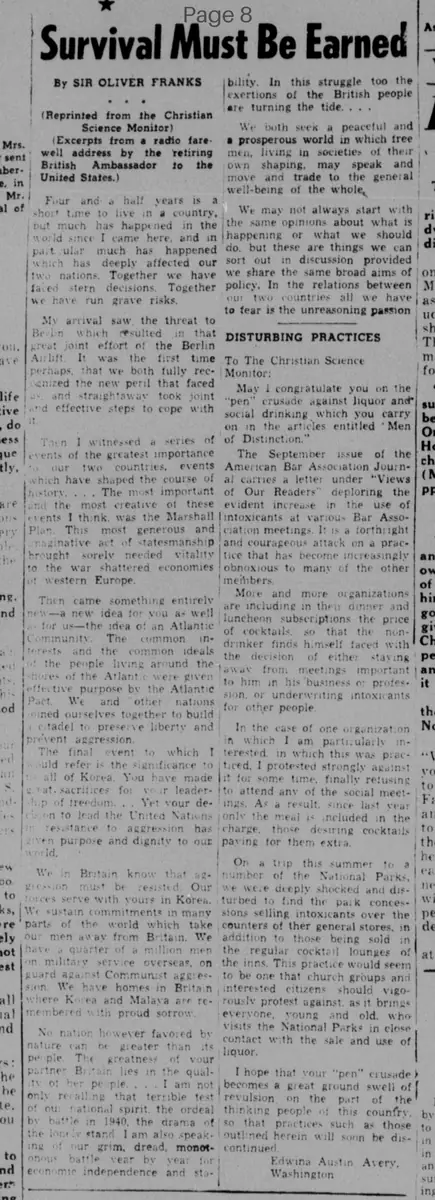
Survival Must Be Earned
By SIR OLIVER FRANKS
(Reprinted from the Christian Science Monitor)
(Excerpts from a radio farewell address by the retiring British Ambassador to the United States.)
Four and a half years is a short time to live in a country, but much has happened in the world since I came here, and in particular much has happened which has deeply affected our two nations. Together we have faced stern decisions. Together we have run grave risks.
My arrival saw the threat to Berlin which resulted in that great joint effort of the Berlin Airlift. It was the first time perhaps, that we both fully recognized the new peril that faced us and straightaway took joint and effective steps to cope with it.
Then I witnessed a series of events of the greatest importance to our two countries, events which have shaped the course of history... The most important and the most creative of these events I think, was the Marshall Plan. This most generous and imaginative act of statesmanship brought sorely needed vitality to the war shattered economies of western Europe.
Then came something entirely new—a new idea for you as well for us—the idea of an Atlantic Community. The common interests and the common ideals the people living around the shores of the Atlantic were given effective purpose by the Atlantic Pact. We and other nations joined ourselves together to build a citadel to preserve liberty and prevent aggression.
The final event to which I would refer is the significance to all of Korea. You have made great sacrifices for your leadership of freedom. Yet your decision to lead the United Nations in resistance to aggression has given purpose and dignity to our world.
We in Britain know that aggression must be resisted. Our forces serve with yours in Korea. We sustain commitments in many parts of the world which take our men away from Britain. We have a quarter of a million men on military service overseas, on guard against Communist aggression. We have homes in Britain where Korea and Malaya are remembered with proud sorrow.
No nation however favored by nature can be greater than its people. The greatness of your partner Britain lies in the quality of her people... I am not only referring to that terrible test of our national spirit the ordeal by battle in 1940, the drama of the lonely stand. I am also speaking of our grim, dread, monotonous battle year by year for economic independence and stability. In this struggle too the exertions of the British people are turning the tide...
We both seek a peaceful and prosperous world in which free men, living in societies of their own shaping, may speak and move and trade to the general well-being of the whole.
We may not always start with the same opinions about what is happening or what we should do, but these are things we can sort out in discussion provided we share the same broad aims of policy. In the relations between our two countries all we have to fear is the unreasoning passion.
By SIR OLIVER FRANKS
(Reprinted from the Christian Science Monitor)
(Excerpts from a radio farewell address by the retiring British Ambassador to the United States.)
Four and a half years is a short time to live in a country, but much has happened in the world since I came here, and in particular much has happened which has deeply affected our two nations. Together we have faced stern decisions. Together we have run grave risks.
My arrival saw the threat to Berlin which resulted in that great joint effort of the Berlin Airlift. It was the first time perhaps, that we both fully recognized the new peril that faced us and straightaway took joint and effective steps to cope with it.
Then I witnessed a series of events of the greatest importance to our two countries, events which have shaped the course of history... The most important and the most creative of these events I think, was the Marshall Plan. This most generous and imaginative act of statesmanship brought sorely needed vitality to the war shattered economies of western Europe.
Then came something entirely new—a new idea for you as well for us—the idea of an Atlantic Community. The common interests and the common ideals the people living around the shores of the Atlantic were given effective purpose by the Atlantic Pact. We and other nations joined ourselves together to build a citadel to preserve liberty and prevent aggression.
The final event to which I would refer is the significance to all of Korea. You have made great sacrifices for your leadership of freedom. Yet your decision to lead the United Nations in resistance to aggression has given purpose and dignity to our world.
We in Britain know that aggression must be resisted. Our forces serve with yours in Korea. We sustain commitments in many parts of the world which take our men away from Britain. We have a quarter of a million men on military service overseas, on guard against Communist aggression. We have homes in Britain where Korea and Malaya are remembered with proud sorrow.
No nation however favored by nature can be greater than its people. The greatness of your partner Britain lies in the quality of her people... I am not only referring to that terrible test of our national spirit the ordeal by battle in 1940, the drama of the lonely stand. I am also speaking of our grim, dread, monotonous battle year by year for economic independence and stability. In this struggle too the exertions of the British people are turning the tide...
We both seek a peaceful and prosperous world in which free men, living in societies of their own shaping, may speak and move and trade to the general well-being of the whole.
We may not always start with the same opinions about what is happening or what we should do, but these are things we can sort out in discussion provided we share the same broad aims of policy. In the relations between our two countries all we have to fear is the unreasoning passion.
What sub-type of article is it?
Diplomatic
What keywords are associated?
Berlin Airlift
Marshall Plan
Atlantic Pact
Korea Resistance
Us Uk Relations
British Ambassador Farewell
What entities or persons were involved?
Sir Oliver Franks
Where did it happen?
United States
Foreign News Details
Primary Location
United States
Key Persons
Sir Oliver Franks
Event Details
Excerpts from a radio farewell address by the retiring British Ambassador to the United States, reflecting on joint US-UK efforts including the Berlin Airlift, Marshall Plan, Atlantic Pact, and resistance in Korea; emphasizes shared commitments against aggression and the quality of the British people.