Thank you for visiting SNEWPapers!
Sign up free
Story
December 26, 1873
Chicago Daily Tribune
Chicago, Cook County, Illinois
What is this article about?
Biographical profiles from the New York Herald of Newton Booth, Republican US Senator-elect from California for a six-year term starting March 1875, and Democrat John S. Hager, filling an unexpired term, detailing their rises in politics, careers, and stances.
Clipping
OCR Quality
95%
Excellent
Full Text
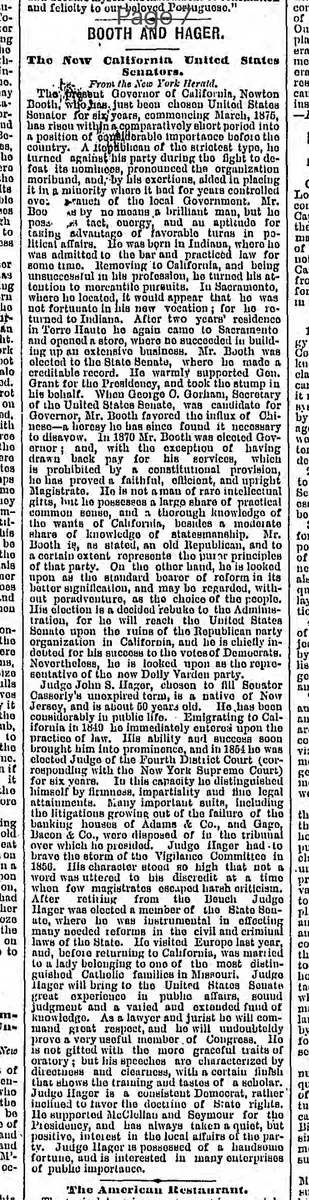
BOOTH AND HAGER.
The New California United States Senators.
From the New York Herald.
The present Governor of California, Newton Booth, who has just been chosen United States Senator for six years, commencing March, 1875, has risen within a comparatively short period into a position of considerable importance before the country. A Republican of the strictest type, he turned against his party during the fight to defeat its nominees, pronounced the organization moribund, and, by his exertions, aided in placing it in a minority where it had for years controlled every branch of the local Government. Mr. Booth is by no means a brilliant man, but he possesses tact, energy, and an aptitude for taking advantage of favorable turns in political affairs. He was born in Indiana, where he was admitted to the bar and practiced law for some time. Removing to California, and being unsuccessful in his profession, he turned his attention to mercantile pursuits. In Sacramento, where he located, it would appear that he was not fortunate in his new vocation; for he returned to Indiana. After two years' residence in Terre Haute he again came to Sacramento and opened a store, where he succeeded in building up an extensive business. Mr. Booth was elected to the State Senate, where he made a creditable record. He warmly supported Gen. Grant for the Presidency, and took the stump in his behalf. When George O. Gorham, Secretary of the United States Senate, was candidate for Governor, Mr. Booth favored the influx of Chinese—a heresy he has since found it necessary to disavow. In 1871 Mr. Booth was elected Governor; and, with the exception of having drawn back pay for his services, which is prohibited by a constitutional provision, he has proved a faithful, efficient, and upright Magistrate. He is not a man of rare intellectual gifts, but he possesses a large share of practical common sense, and a thorough knowledge of the wants of California, besides a moderate share of knowledge of statesmanship. Mr. Booth is, as stated, an old Republican, and to a certain extent represents the ultra principles of that party. On the other hand, he is looked upon as the standard bearer of reform in its better signification, and may be regarded, without peradventure, as the choice of the people. His election is a decided rebuke to the Administration, for he will reach the United States Senate upon the ruins of the Republican party organization in California, and he is chiefly indebted for his success to the votes of Democrats. Nevertheless, he is looked upon as the representative of the new Dolly Varden party.
Judge John S. Hager, chosen to fill Senator Casserly's unexpired term, is a native of New Jersey, and is about 50 years old. He has been considerably in public life. Emigrating to California in 1852 he immediately entered upon the practice of law. His ability and success soon brought him into prominence, and in 1855 he was elected Judge of the Fourth District Court (corresponding with the New York Supreme Court) for six years. In this capacity he distinguished himself by firmness, impartiality and true legal attainments. Many important suits, including the litigations growing out of the failure of the banking houses of Adams & Co., and Gage, Bacon & Co., were disposed of in the tribunal over which he presided. Judge Hager had to brave the storm of the Vigilance Committee in 1856. His character stood so high that not a word was uttered to his discredit at a time when few magistrates escaped harsh criticism. After retiring from the Bench Judge Hager was elected a member of the State Senate, where he was instrumental in effecting many needed reforms in the civil and criminal laws of the State. He visited Europe last year, and, before returning to California, was married to a lady belonging to one of the most distinguished Catholic families in Missouri. Judge Hager will bring to the United States Senate great experience in public affairs, sound judgment and a varied and extended fund of knowledge. As a lawyer and jurist he will command great respect, and he will undoubtedly prove a very useful member of Congress. He is not gifted with the more graceful traits of oratory; but his speeches are characterized by directness and clearness, with a certain finish that shows the training and tastes of a scholar. Judge Hager is a consistent Democrat, rather inclined to favor the doctrine of State rights. He supported McClellan and Seymour for the Presidency, and has always taken a quiet, but positive, interest in the local affairs of the party. Judge Hager is possessed of a handsome fortune, and is interested in many enterprises of public importance.
The New California United States Senators.
From the New York Herald.
The present Governor of California, Newton Booth, who has just been chosen United States Senator for six years, commencing March, 1875, has risen within a comparatively short period into a position of considerable importance before the country. A Republican of the strictest type, he turned against his party during the fight to defeat its nominees, pronounced the organization moribund, and, by his exertions, aided in placing it in a minority where it had for years controlled every branch of the local Government. Mr. Booth is by no means a brilliant man, but he possesses tact, energy, and an aptitude for taking advantage of favorable turns in political affairs. He was born in Indiana, where he was admitted to the bar and practiced law for some time. Removing to California, and being unsuccessful in his profession, he turned his attention to mercantile pursuits. In Sacramento, where he located, it would appear that he was not fortunate in his new vocation; for he returned to Indiana. After two years' residence in Terre Haute he again came to Sacramento and opened a store, where he succeeded in building up an extensive business. Mr. Booth was elected to the State Senate, where he made a creditable record. He warmly supported Gen. Grant for the Presidency, and took the stump in his behalf. When George O. Gorham, Secretary of the United States Senate, was candidate for Governor, Mr. Booth favored the influx of Chinese—a heresy he has since found it necessary to disavow. In 1871 Mr. Booth was elected Governor; and, with the exception of having drawn back pay for his services, which is prohibited by a constitutional provision, he has proved a faithful, efficient, and upright Magistrate. He is not a man of rare intellectual gifts, but he possesses a large share of practical common sense, and a thorough knowledge of the wants of California, besides a moderate share of knowledge of statesmanship. Mr. Booth is, as stated, an old Republican, and to a certain extent represents the ultra principles of that party. On the other hand, he is looked upon as the standard bearer of reform in its better signification, and may be regarded, without peradventure, as the choice of the people. His election is a decided rebuke to the Administration, for he will reach the United States Senate upon the ruins of the Republican party organization in California, and he is chiefly indebted for his success to the votes of Democrats. Nevertheless, he is looked upon as the representative of the new Dolly Varden party.
Judge John S. Hager, chosen to fill Senator Casserly's unexpired term, is a native of New Jersey, and is about 50 years old. He has been considerably in public life. Emigrating to California in 1852 he immediately entered upon the practice of law. His ability and success soon brought him into prominence, and in 1855 he was elected Judge of the Fourth District Court (corresponding with the New York Supreme Court) for six years. In this capacity he distinguished himself by firmness, impartiality and true legal attainments. Many important suits, including the litigations growing out of the failure of the banking houses of Adams & Co., and Gage, Bacon & Co., were disposed of in the tribunal over which he presided. Judge Hager had to brave the storm of the Vigilance Committee in 1856. His character stood so high that not a word was uttered to his discredit at a time when few magistrates escaped harsh criticism. After retiring from the Bench Judge Hager was elected a member of the State Senate, where he was instrumental in effecting many needed reforms in the civil and criminal laws of the State. He visited Europe last year, and, before returning to California, was married to a lady belonging to one of the most distinguished Catholic families in Missouri. Judge Hager will bring to the United States Senate great experience in public affairs, sound judgment and a varied and extended fund of knowledge. As a lawyer and jurist he will command great respect, and he will undoubtedly prove a very useful member of Congress. He is not gifted with the more graceful traits of oratory; but his speeches are characterized by directness and clearness, with a certain finish that shows the training and tastes of a scholar. Judge Hager is a consistent Democrat, rather inclined to favor the doctrine of State rights. He supported McClellan and Seymour for the Presidency, and has always taken a quiet, but positive, interest in the local affairs of the party. Judge Hager is possessed of a handsome fortune, and is interested in many enterprises of public importance.
What sub-type of article is it?
Biography
Historical Event
What themes does it cover?
Fortune Reversal
Triumph
What keywords are associated?
Us Senators
California Politics
Newton Booth
John Hager
Republican Reform
Democratic Jurist
What entities or persons were involved?
Newton Booth
John S. Hager
Where did it happen?
California
Story Details
Key Persons
Newton Booth
John S. Hager
Location
California
Event Date
Commencing March, 1875
Story Details
Biographical accounts of Newton Booth, elected US Senator for six years starting March 1875, and John S. Hager, chosen to fill an unexpired term, covering their backgrounds, political careers, and achievements.