Thank you for visiting SNEWPapers!
Sign up free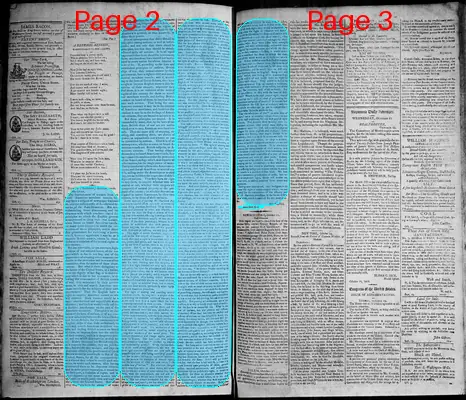
Alexandria Daily Advertiser
Alexandria, Virginia
What is this article about?
A letter to Mr. Gray defends the British right to search American merchant vessels and impress British seamen, arguing it aligns with international law and does not violate U.S. neutral rights. It critiques opposing views and references historical precedents and legal authorities, promising further discussion on American protections. Signed Sulpicius, Baltimore, Oct. 6, 1803.
Merged-components note: Merged continuation of the letter to the editor on impressment of seamen across pages, relabeled from editorial to letter_to_editor, and included the dateline as it relates to the letter's origin.
Clippings
1 of 2
OCR Quality
Full Text
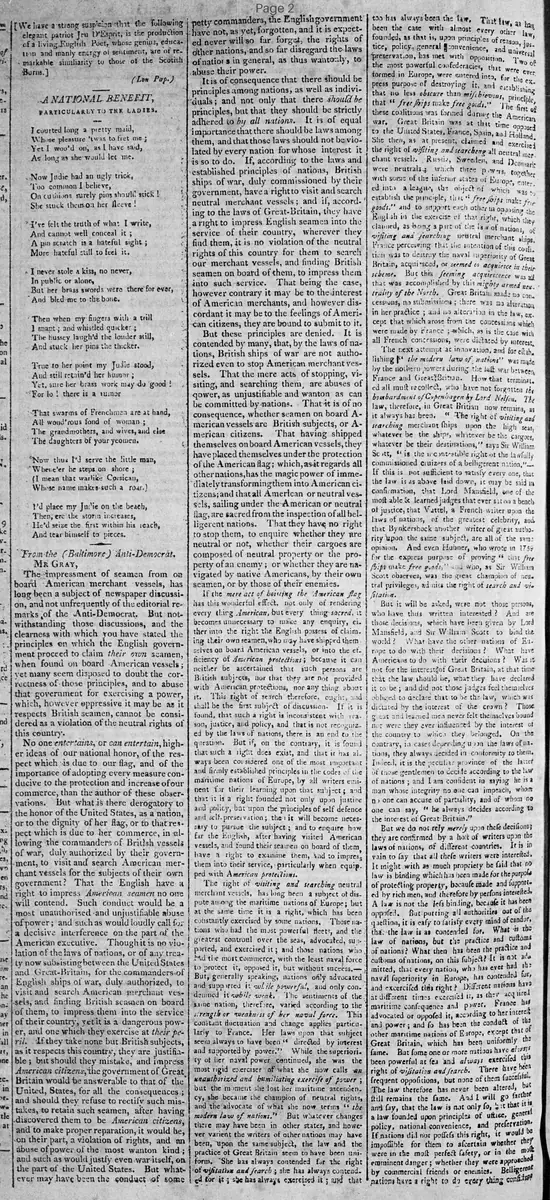
The impressment of seamen from onboard American merchant vessels, has long been a subject of newspaper discussion, and not unfrequently of the editorial remarks of the Anti-Democrat. But notwithstanding those discussions, and the clearness with which you have stated the principles on which the English government proceed to claim their own seamen, when found on board American vessels; yet many seem disposed to doubt the correctness of those principles, and to abuse that government for exercising a power, which, however oppressive it may be as it respects British seamen, cannot be considered as a violation of the neutral rights of this country.
No one entertains, or can entertain, higher ideas of our national honor, of the respect which is due to our flag, and of the importance of adopting every measure conducive to the protection and increase of our commerce, than the author of these observations.
But what is there derogatory to the honor of the United States, as a nation, or to the dignity of her flag, or to that respect which is due to her commerce, in allowing the commanders of British vessels of war, duly authorized by their government, to visit and search American merchant vessels for the subjects of their own government? That the English have a right to impress American seamen no one will contend. Such conduct would be a most unauthorised and unjustifiable abuse of power; and such as would loudly call for a decisive interference on the part of the American executive. Though it is no violation of the laws of nations, or of any treaty now subsisting between the United States and Great-Britain, for the commanders of English ships of war, duly authorized, to visit and search American merchant vessels, and finding British seamen on board of them, to impress them into the service of their country, yet it is a dangerous power, and one which they exercise at their peril. If they take none but British subjects, as it respects this country, they are justifiable; but should they mistake, and impress American citizens, the government of Great Britain would be answerable to that of the United States, for all the consequences; and should they refuse to rectify such mistakes, to retain such seamen, after having discovered them to be American citizens, and to make proper reparation, it would be, on their part, a violation of rights, and an abuse of power of the most wanton kind; and such as would justify even war itself, on the part of the United States. But whatever may have been the conduct of some petty commanders, the English government have not, as yet, forgotten, and it is expected never will so far forget, the rights of other nations, and so far disregard the laws of nations in general, as thus wantonly, to abuse their power.
It is of consequence that there should be principles among nations, as well as individuals; and not only that there should be principles, but that they should be strictly adhered to by all nations. It is of equal importance that there should be laws among them, and that those laws should not be violated by every nation for whose interest it is so to do. If, according to the laws and established principles of nations, British ships of war, duly commissioned by their government, have a right to visit and search neutral merchant vessels; and if, according to the laws of Great-Britain, they have a right to impress English seamen into the service of their country, wherever they find them, it is no violation of the neutral rights of this country for them to search our merchant vessels, and finding British seamen on board of them, to impress them into such service. That being the case, however contrary it may be to the interest of American merchants, and however discordant it may be to the feelings of American citizens, they are bound to submit to it.
But these principles are denied. It is contended by many, that, by the laws of nations, British ships of war are not authorized even to stop American merchant vessels. That the mere acts of stopping, visiting, and searching them, are abuses of power, as unjustifiable and wanton as can be committed by nations. That it is of no consequence, whether seamen on board American vessels are British subjects, or American citizens. That having shipped themselves on board American vessels, they have placed themselves under the protection of the American flag; which, as it regards all other nations, has the magic power of immediately transforming them into American citizens; and that all American or neutral vessels, sailing under the American or neutral flag, are sacred from the inspection of all belligerent nations. That they have no right to stop them, to enquire whether they are neutral or not, whether their cargoes are composed of neutral property or the property of an enemy; or whether they are navigated by native Americans, by their own seamen, or by those of their enemies.
If the mere act of hoisting the American flag has this wonderful effect, not only of rendering every thing American, but every thing sacred, it becomes unnecessary to make any enquiry, either into the right the English possess of claiming their own seamen, who may have shipped themselves on board American vessels, or into the efficacy of American protections; because it can neither be ascertained that such persons are British subjects, nor that they are not provided with American protections, nor any thing about it. This right of search therefore, ought, and shall be the first subject of discussion. If it is found, that such a right is inconsistent with reason, justice, and policy, and that it is not recognized by the laws of nations, there is an end to the question. But if, on the contrary, it is found that such a right does exist, and that it has always been considered one of the most important and firmly established principles in the codes of the maritime nations of Europe, by all writers eminent for their learning upon that subject: and that it is a right founded not only upon justice and policy, but upon the principles of self defence and self-preservation; then it will become necessary to pursue the subject ; and to enquire how far the English, after having visited American vessels, and found their seamen on board of them, have a right to examine them, and to impress them into their service, particularly when equipped with American protections.
The right of visiting and searching neutral merchant vessels, has long been a subject of dispute among the maritime nations of Europe; but at the same time it is a right, which has been constantly exercised by some nations. Those nations who had the most powerful fleets, and the greatest control over the seas, advocated, supported, and exercised it; and those nations who had the most commerce, with the least naval force to protect it, opposed it, but without success. But, generally speaking, nations only advocated and supported it while powerful, and only condemned it while weak. The sentiments of the same nation, therefore, varied according to the strength or weakness of her naval force. This constant fluctuation and change applies particularly to France. Her laws upon that subject seem always to have been "directed by interest and supported by power." While the superiority of her naval power continued, she was the most rigid exerciser of what she now calls an unauthorized and humiliating exercise of power ; but the moment she lost her maritime ascendancy, she became the champion of neutral rights, and the advocate of what she now terms "the modern law of nations." But whatever changes there may have been in other states, and however variant the writers of other nations may have been, upon the same subject, the law and the practice of Great Britain seem to have been uniform. She has always contended for the right of visitation and search; she has always contended for it ; she has always exercised it ; and that too has always been the law. That law, as has been the case with almost every other law founded, as that is, upon principles of reason, justice, policy, general convenience, and universal preservation, has met with opposition. Two of the most powerful confederacies that were ever formed in Europe were entered into for the purpose of destroying it and establishing that no less obscure than mischievous, principle, that "free ships make free goods."
The first of these coalitions was formed during the American war. Great Britain was at that time opposed to the United States, France, Spain, and Holland. She then, as at present, claimed and exercised the right of visiting and searching all neutral merchant vessels. Russia, Sweden, and Denmark were neutrals, which three powers, together with some of the inferior states of Europe, entered into a league, the object of which was to establish the principle, that "free ships make free goods." and to support each other in opposing the English in the exercise of that right, which they claimed, as being a part of the law of nations, of visiting and searching neutral merchant ships. France perceiving that the intention of this coalition was to destroy the naval superiority of Great Britain, acquiesced, or seemed to acquiesce in their scheme. But this seeming acquiescence was all that was accomplished by this mighty armed neutrality of the North. Great Britain made no concessions, no submissions ; there was no alteration in her practice ; and no alteration in the law, except that which arose from the concessions which were made by France ; which, as is the case with all French concessions, were dictated by interest.
The next attempt at innovation, and for establishing ["the modern law of nations"] was made by the northern powers during the last war between France and Great Britain. How that terminated all must recollect, who have not forgotten the bombardment of Copenhagen by Lord Nelson. The law, therefore, in Great Britain now remains, as it always has been. "The right of visiting and searching merchant ships upon the high seas, whatever be the ships, whatever be the cargoes, whatever be their destinations," says Sir William Scott, "is the incontestible right of the lawfully commissioned cruizers of a belligerent nation."
If this is not sufficient to satisfy every one, that the law is as above laid down, it may be said in confirmation, that Lord Mansfield, one of the most able & learned judges that ever sat on a bench of justice, that Vattel, a French writer upon the laws of nations, of the greatest celebrity, and that Bynkershock another writer of great authority upon the same subject, are all of the same opinion. And even Hubner, who wrote in 1759 for the express purpose of proving "that free ships make free goods," and who, as Sir William Scott observes, was the great champion of neutral privileges, admits the right of search and visitation.
But it will be asked, were not those persons, who have thus written interested? And are those decisions, which have been given by Lord Mansfield, and Sir William Scott to bind the world? What have the other nations of Europe to do with their decisions ? What have Americans to do with their decisions? Was it not for the interest of Great Britain, at that time that the law should be, what they have declared it to be ; and did not those judges feel themselves obliged to declare that to be the law, which was dictated by the interest of the crown? Those great and learned men never felt themselves bound nor were they ever influenced by the interest of the country to which they belonged. On the contrary, in cases depending upon the laws of nations, they always decided in conformity to them. Indeed, it is the peculiar province of the latter of those gentlemen to decide according to the law of nations ; and I am confident in saying he is a man whose integrity no one can impeach, whom no one can accuse of partiality, and of whom no one can say, "he always decides according to the interest of Great Britain."
But we do not rely merely upon these decisions; they are confirmed by a host of writers upon the laws of nations, of different countries. It is in vain to say that all these writers were interested. It might with as much propriety be said that no law is binding which has been made for the purpose of protecting property, because made and supported by rich men, and therefore by persons interested. A law is not the less binding, because it has been opposed. But putting all authorities out of the question, and say, that the law is not only so, but that it still remains the same.
And I will go farther If nations did not possess this right, it would be policy, national convenience, and preservation, impossible for them to ascertain whether they were in the most perfect safety, or in the most eminent danger; whether they were approached by commercial friends or enemies. Belligerent nations have a right to do every thing consistent with the laws of nations. with the law of nations to weaken each other, to conquer each other, and to destroy each other. But of all the rights they would be deprived by the right of visitation it would be impossible for them to ascertain who were their enemies, and who their friends; what enemies; what ships were laden with enemy's goods, were neutral and what belonged to their own; what ships were navigated by neutral seamen, and which by them; what with neutral and which were their enemies. In such case it would make it necessary for them to attack the commerce of the whole world. If that doctrine was established Bonaparte the whole world make no attack on French soldiers, and he would have no difficulty the United States all their vessels, fill them which would have only to charter from the citizens of In transporting them to England. Being on hard mutual wrecks, and sailing under a neutral flag, English vessels of war would have no right to interfere with them. They would be bound to charge, the mariners. and all on board. But not only of the neutrality of the vessels, but of the consider the neutral flag, as conclusive evidence, how inconsistent is this with the laws of self-defence? Which is the most perfect right, that of independence and pride of another? Is not the law of self defence the first law of nations; and one with which no other can be put in competition? This is what Sulpicius contends for. True the advocates of the "modern law of nations," seek to consider independence, as not only the most important, but the most perfect right in nature. Not content with making man independent of man, they would even destroy his dependence upon his God, and make him depend solely upon his own passion and feelings. Independence is a feeling, that ought always to be cherished; but only as it is consistent with the nature of man and things, as they now exist. A state of perfect independence never yet existed in society, or among nations. It is absolutely necessary for the existence of civil society, and the harmony of nations, that both individuals and nations should make a sacrifice of a part of their independence and some of their pride. Indeed, it ought not to be called a sacrifice. It is only changing air for subsistence; or that which is of no value, for that which is absolutely necessary. The suffering belligerent nations to visit & search our vessels is a sacrifice of that kind. We lose only a momentary gratification of pride, but we gain an important right, which will enable us, in our turn, to defend ourselves from abuse and aggression.
Having now ascertained, that belligerents do possess the right of visitation and search, we are prepared for the examination of the efficacy and force of American protections in the hands of British seamen, which is reserved for the next numbers.
SULPICIUS.
Baltimore, Oct. 6, 1803.
What sub-type of article is it?
What themes does it cover?
What keywords are associated?
What entities or persons were involved?
Letter to Editor Details
Author
Sulpicius
Recipient
Mr Gray
Main Argument
british ships of war have the right under international law to search american merchant vessels and impress british seamen found aboard, without violating u.s. neutral rights, though impressing americans would be unjustifiable and warrant response; this practice is defended against opposing views emphasizing the american flag's protection.
Notable Details