Thank you for visiting SNEWPapers!
Sign up free
Story
October 13, 1820
Richmond Enquirer
Richmond, Richmond County, Virginia
What is this article about?
In Paris, Frenchman M. Brunet, who obtained English denization letters, sues General Crewe for debt in French court. Court rules denization does not change nationality, allowing the suit and favoring Brunet.
Clipping
OCR Quality
95%
Excellent
Full Text
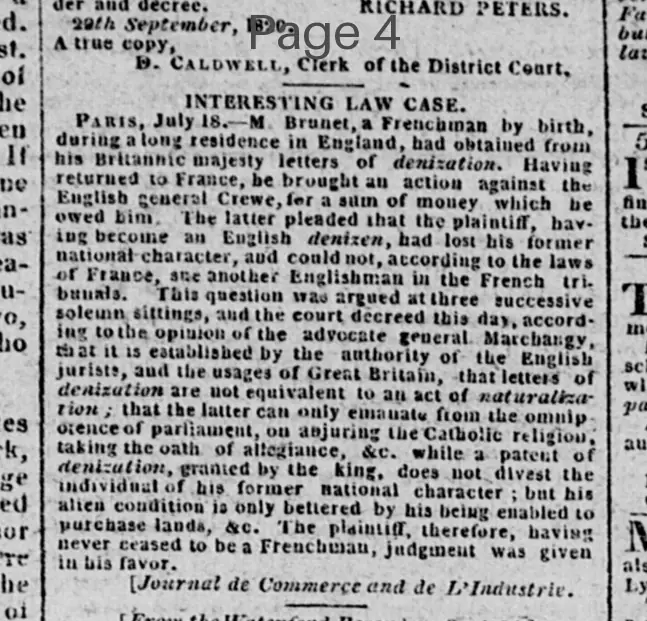
INTERESTING LAW CASE.
Paris, July 18. M. Brunet, a Frenchman by birth, during a long residence in England, had obtained from his Britannic majesty letters of denization. Having returned to France, he brought an action against the English general Crewe, for a sum of money which he owed him. The latter pleaded that the plaintiff, having become an English denizen, had lost his former national character, and could not, according to the laws of France, sue another Englishman in the French tribunals. This question was argued at three successive solemn sittings, and the court decreed this day, according to the opinion of the advocate general Marchangy, that it is established by the authority of the English jurists, and the usages of Great Britain, that letters of denization are not equivalent to an act of naturalization; that the latter can only emanate from the omnipotence of parliament, on abjuring the Catholic religion, taking the oath of allegiance, &c. while a patent of denization, granted by the king, does not divest the individual of his former national character; but his alien condition is only bettered by his being enabled to purchase lands, &c. The plaintiff, therefore, having never ceased to be a Frenchman, judgment was given in his favor.
Paris, July 18. M. Brunet, a Frenchman by birth, during a long residence in England, had obtained from his Britannic majesty letters of denization. Having returned to France, he brought an action against the English general Crewe, for a sum of money which he owed him. The latter pleaded that the plaintiff, having become an English denizen, had lost his former national character, and could not, according to the laws of France, sue another Englishman in the French tribunals. This question was argued at three successive solemn sittings, and the court decreed this day, according to the opinion of the advocate general Marchangy, that it is established by the authority of the English jurists, and the usages of Great Britain, that letters of denization are not equivalent to an act of naturalization; that the latter can only emanate from the omnipotence of parliament, on abjuring the Catholic religion, taking the oath of allegiance, &c. while a patent of denization, granted by the king, does not divest the individual of his former national character; but his alien condition is only bettered by his being enabled to purchase lands, &c. The plaintiff, therefore, having never ceased to be a Frenchman, judgment was given in his favor.
What sub-type of article is it?
Historical Event
Curiosity
What themes does it cover?
Justice
What keywords are associated?
Law Case
Denization
Nationality
French Court
English Law
What entities or persons were involved?
M. Brunet
English General Crewe
Advocate General Marchangy
Where did it happen?
Paris
Story Details
Key Persons
M. Brunet
English General Crewe
Advocate General Marchangy
Location
Paris
Event Date
July 18
Story Details
M. Brunet sues General Crewe in French court for debt; court rules denization does not alter French nationality, allowing the suit and granting judgment to Brunet.