Thank you for visiting SNEWPapers!
Sign up free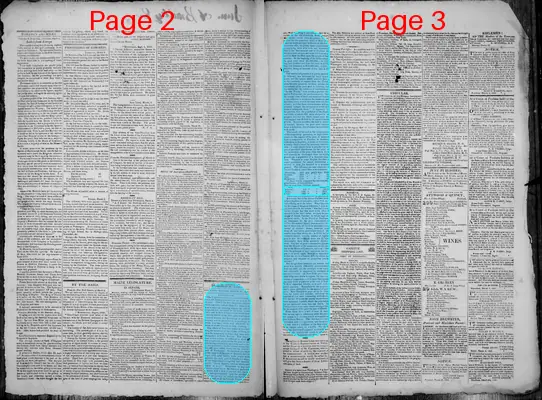
Editorial
March 12, 1821
The Portland Gazette
Portland, Cumberland County, Maine
What is this article about?
Editorial warns of rising pauperism in US and Britain due to compulsory poor laws, cites historical examples from England and Scotland showing voluntary systems work better, and urges Maine Legislature to reform support for the poor wisely.
Merged-components note: Editorial on pauperism and poor laws, including embedded tables as examples, continued across pages.
Clippings
1 of 2
OCR Quality
65%
Fair
Full Text
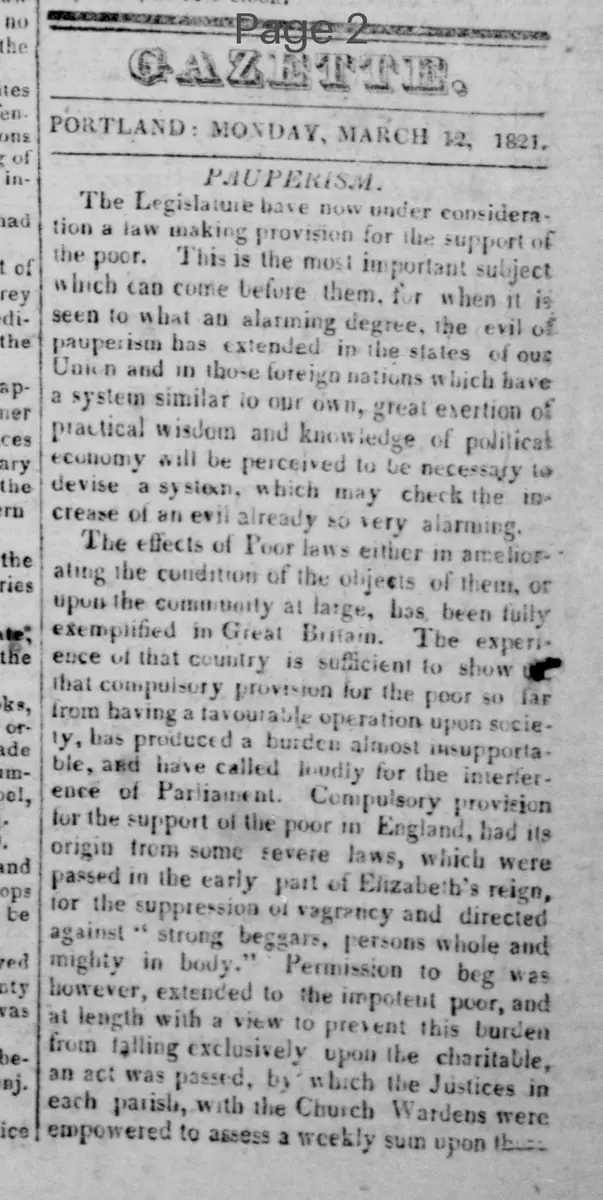
GAZETTE.
PORTLAND: MONDAY, MARCH 12, 1821.
PAUPERISM.
The Legislature have now under consideration a law making provision for the support of the poor. This is the most important subject which can come before them. for when it is seen to what an alarming degree, the evil of pauperism has extended in the states of our Union and in those foreign nations which have a system similar to our own, great exertion of practical wisdom and knowledge of political economy will be perceived to be necessary to devise a system, which may check the increase of an evil already so very alarming.
The effects of Poor laws either ameliorating the condition of the objects of them, or upon the community at large, has been fully exemplified in Great Britain. The experience of that country is sufficient to show that compulsory provision for the poor so far from having a favourable operation upon society, has produced a burden almost insupportable, and have called loudly for the interference of Parliament. Compulsory provision for the support of the poor in England, had its origin from some severe laws, which were passed in the early part of Elizabeth's reign, for the suppression of vagrancy and directed against "strong beggars, persons whole and mighty in body." Permission to beg was however, extended to the impotent poor, and at length with a view to prevent this burden from falling exclusively upon the charitable. an act was passed, by which the Justices in each parish, with the Church Wardens were empowered to assess a weekly sum upon the:
who were or willing to contribute. And by a statute of the 43d Elizabeth, those persons are further vested with the power, 1st. to provide for the gratuitous relief of those who could not work and 2nd. to find work for those who were able, by giving them employment, or supplying them with tools and materials. This is the fundamental law of England on this important subject, and some few facts may serve to show its effect upon the people of that country. In the beginning of the 18th century the poor rates were 1,000,000l; in 1793 they had doubled and from that time to 1820, they had advanced to 10,000,000l, or $44,400,000, being an increase of fivefold in 27 years.
The number of paupers it is pretty generally believed, are increased by legal assessments, and the system which prevails there; for this certainty of support from the Parish, when his own resources fail him, relaxes the excitements of the poor man to industry, and thus multiplies the instances of wretchedness. In one Parish, from which a petition was sent to Parliament; the petitioners state, 'that the annual value of lands and mines and houses is not sufficient to maintain the numerous and increasing poor, even if the same were set free of rent: and that these circumstances will inevitably compel the occupiers of mines and lands to relinquish them.' 'It appeared by the petition, that the population of the Parish was 1900, of whom 620 were chargeable as paupers, and that the whole annual rates for their support was 1605 3s. 7d, equal to about $7130.' In some parishes, the land is actually vacated, because the poor rates form so large a deduction, that it cannot be cultivated with profit.
That much of this evil is the consequence of the compulsory provision, or legal assessments for the support of the poor, is manifest from a comparison of Parishes in Scotland, with those in England; in many of the former, a yearly fund is raised by voluntary contribution; to each church there is attached an organ of parochial distribution for the relief of the necessities of the poor, from which there will annually be discharged from ten to fifty pounds, on a population of a thousand members. Whereas in some English Parishes of equal population, the annual distribution amounts to from five hundred to a thousand pounds. The following are some examples of Scotch Parishes, where there is no assessment.
To these may be compared the following English Parishes in Leicestershire. Barrow-upon-Soar, 1143 pop. expendi. These sums are expended on the poor only.
It is a fact that in the former Parishes there is less complaint of indigence, and as little actual suffering as in the latter. What then can be the cause of this great difference? must we not look for it in the system? But that it may not be thought that this result is the effect of situation in the same realm, we have the example of Scotch Parishes in which legal assessment exists. In the Parish of Dunblane, an assessment for the poor commenced in 1775-the number of poor then exceeded 50: but of these only 19 could be prevailed on to accept of aliment: shame, however, soon wore off, and before assessments ceased, the number was often above 40: in 1800, the assessment ceased, and the number of regular poor is now 10:-though there are 50 who occasionally share in the quarterly distributions. One fact of great consequence appears from the Report of the committee on the subject to the House of Commons, and it is, 'that after the principle of legal assessment has begun to be acted upon, there is no expedient within the reach of human skill, by which the progress and increase of pauperism can be arrested.'
But though these instances are remote, and occur in a country differently circumstanced from our own; yet the principle is the same, and unhappily is supported by examples in our own country. In New-York great exertions have been made to oppose the rapid increase of pauperism; --it is stated that nearly one tenth of the population of the city of New York is supported wholly, or in part, at the public expense. Massachusetts has paid annually about $100,000 for the support of paupers. New-Hampshire pays about the same sum, by towns and counties, including the expense of law suits concerning settlements. For the last 20 years the yearly expenditures have increased fourfold, while the population has not increased more than one fourth. In Portland there is annually raised and expended for the support of the poor the sum of $4000.
From these facts it will at once be seen, that we are rapidly advancing under the present system to a situation almost as hopeless as that of Great Britain. That this then is a subject which calls for legislation, and for remedy, and that it is a subject of the first importance cannot admit of a doubt. We hope therefore that it will be passed upon with that wisdom and deliberation which it deserves, and which the legislature can bestow upon it.
PORTLAND: MONDAY, MARCH 12, 1821.
PAUPERISM.
The Legislature have now under consideration a law making provision for the support of the poor. This is the most important subject which can come before them. for when it is seen to what an alarming degree, the evil of pauperism has extended in the states of our Union and in those foreign nations which have a system similar to our own, great exertion of practical wisdom and knowledge of political economy will be perceived to be necessary to devise a system, which may check the increase of an evil already so very alarming.
The effects of Poor laws either ameliorating the condition of the objects of them, or upon the community at large, has been fully exemplified in Great Britain. The experience of that country is sufficient to show that compulsory provision for the poor so far from having a favourable operation upon society, has produced a burden almost insupportable, and have called loudly for the interference of Parliament. Compulsory provision for the support of the poor in England, had its origin from some severe laws, which were passed in the early part of Elizabeth's reign, for the suppression of vagrancy and directed against "strong beggars, persons whole and mighty in body." Permission to beg was however, extended to the impotent poor, and at length with a view to prevent this burden from falling exclusively upon the charitable. an act was passed, by which the Justices in each parish, with the Church Wardens were empowered to assess a weekly sum upon the:
| Traserburg, | 2271 | pop. | yearly fund, | £100 |
| Lonmay, | 1627 | “ | “ | 25 |
| Jura, | 1157 | “ | “ | 6 |
| Redgorton, | 2216 | “ | “ | 29 |
who were or willing to contribute. And by a statute of the 43d Elizabeth, those persons are further vested with the power, 1st. to provide for the gratuitous relief of those who could not work and 2nd. to find work for those who were able, by giving them employment, or supplying them with tools and materials. This is the fundamental law of England on this important subject, and some few facts may serve to show its effect upon the people of that country. In the beginning of the 18th century the poor rates were 1,000,000l; in 1793 they had doubled and from that time to 1820, they had advanced to 10,000,000l, or $44,400,000, being an increase of fivefold in 27 years.
The number of paupers it is pretty generally believed, are increased by legal assessments, and the system which prevails there; for this certainty of support from the Parish, when his own resources fail him, relaxes the excitements of the poor man to industry, and thus multiplies the instances of wretchedness. In one Parish, from which a petition was sent to Parliament; the petitioners state, 'that the annual value of lands and mines and houses is not sufficient to maintain the numerous and increasing poor, even if the same were set free of rent: and that these circumstances will inevitably compel the occupiers of mines and lands to relinquish them.' 'It appeared by the petition, that the population of the Parish was 1900, of whom 620 were chargeable as paupers, and that the whole annual rates for their support was 1605 3s. 7d, equal to about $7130.' In some parishes, the land is actually vacated, because the poor rates form so large a deduction, that it cannot be cultivated with profit.
That much of this evil is the consequence of the compulsory provision, or legal assessments for the support of the poor, is manifest from a comparison of Parishes in Scotland, with those in England; in many of the former, a yearly fund is raised by voluntary contribution; to each church there is attached an organ of parochial distribution for the relief of the necessities of the poor, from which there will annually be discharged from ten to fifty pounds, on a population of a thousand members. Whereas in some English Parishes of equal population, the annual distribution amounts to from five hundred to a thousand pounds. The following are some examples of Scotch Parishes, where there is no assessment.
To these may be compared the following English Parishes in Leicestershire. Barrow-upon-Soar, 1143 pop. expendi. These sums are expended on the poor only.
It is a fact that in the former Parishes there is less complaint of indigence, and as little actual suffering as in the latter. What then can be the cause of this great difference? must we not look for it in the system? But that it may not be thought that this result is the effect of situation in the same realm, we have the example of Scotch Parishes in which legal assessment exists. In the Parish of Dunblane, an assessment for the poor commenced in 1775-the number of poor then exceeded 50: but of these only 19 could be prevailed on to accept of aliment: shame, however, soon wore off, and before assessments ceased, the number was often above 40: in 1800, the assessment ceased, and the number of regular poor is now 10:-though there are 50 who occasionally share in the quarterly distributions. One fact of great consequence appears from the Report of the committee on the subject to the House of Commons, and it is, 'that after the principle of legal assessment has begun to be acted upon, there is no expedient within the reach of human skill, by which the progress and increase of pauperism can be arrested.'
But though these instances are remote, and occur in a country differently circumstanced from our own; yet the principle is the same, and unhappily is supported by examples in our own country. In New-York great exertions have been made to oppose the rapid increase of pauperism; --it is stated that nearly one tenth of the population of the city of New York is supported wholly, or in part, at the public expense. Massachusetts has paid annually about $100,000 for the support of paupers. New-Hampshire pays about the same sum, by towns and counties, including the expense of law suits concerning settlements. For the last 20 years the yearly expenditures have increased fourfold, while the population has not increased more than one fourth. In Portland there is annually raised and expended for the support of the poor the sum of $4000.
From these facts it will at once be seen, that we are rapidly advancing under the present system to a situation almost as hopeless as that of Great Britain. That this then is a subject which calls for legislation, and for remedy, and that it is a subject of the first importance cannot admit of a doubt. We hope therefore that it will be passed upon with that wisdom and deliberation which it deserves, and which the legislature can bestow upon it.
| ture, | £1868,17 |
| Belgrave, | £03,7 |
| Lileby, | 1764 |
| Blaby, | 1391,5 |
What sub-type of article is it?
Social Reform
Economic Policy
Legal Reform
What keywords are associated?
Pauperism
Poor Laws
Compulsory Provision
Voluntary Contributions
England
Scotland
United States
What entities or persons were involved?
Legislature
Parliament
Elizabeth
New York
Massachusetts
New Hampshire
Portland
Editorial Details
Primary Topic
Reform Of Poor Laws To Address Pauperism
Stance / Tone
Critical Of Compulsory Poor Support, Advocates Voluntary Systems
Key Figures
Legislature
Parliament
Elizabeth
New York
Massachusetts
New Hampshire
Portland
Key Arguments
Compulsory Poor Laws Originated In Elizabeth's Reign And Have Led To Unsustainable Burdens In England
Poor Rates In England Increased From 1,000,000l In Early 18th Century To 10,000,000l By 1820
Legal Assessments Relax Incentives For Industry Among The Poor, Multiplying Pauperism
Voluntary Contributions In Scottish Parishes Result In Lower Expenditures And Less Indigence Than In English Parishes
In Dunblane, Scotland, Pauperism Increased With Assessments But Decreased After They Ceased
Once Legal Assessment Begins, Pauperism Cannot Be Arrested
In Us, Pauper Support Costs Are Rising Rapidly, E.G., $4000 Annually In Portland