Thank you for visiting SNEWPapers!
Sign up free
Story
December 5, 1817
The Rhode Island American, And General Advertiser
Providence, Providence County, Rhode Island
What is this article about?
Commentary on the opening of the US Congress session with the President's Message, featuring satirical advice from Vermont editor Mr. Fessenden on new members' conduct and speechifying.
Clipping
OCR Quality
95%
Excellent
Full Text
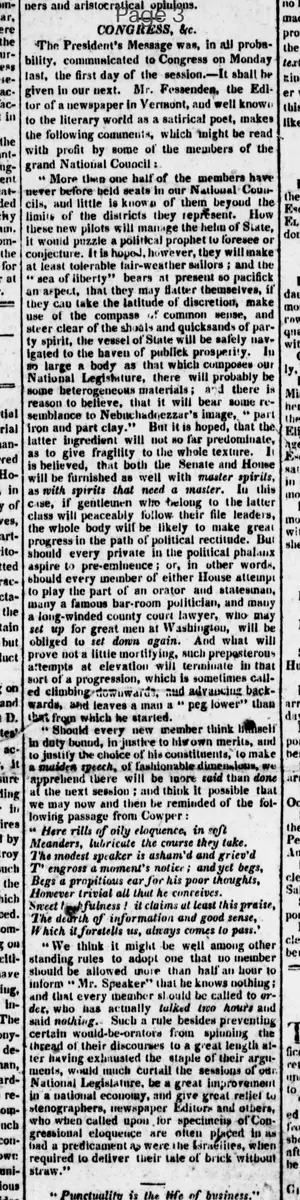
CONGRESS, &c.
The President's Message was, in all probability, communicated to Congress on Monday last, the first day of the session.—It shall be given in our next. Mr. Fessenden, the Editor of a newspaper in Vermont, and well known to the literary world as a satirical poet, makes the following comments, which might be read with profit by some of the members of the grand National Council:
"More than one half of the members have never before held seats in our National Councils, and little is known of them beyond the limits of the districts they represent. How these new pilots will manage the helm of State, it would puzzle a political prophet to foresee or conjecture. It is hoped, however, they will make at least tolerable fair-weather sailors; and the "sea of liberty" bears at present so pacific an aspect, that they may flatter themselves, if they can take the latitude of discretion, make use of the compass common sense, and steer clear of the shoals and quicksands of party spirit, the vessel of State will be safely navigated to the haven of publick prosperity. In so large a body as that which composes our National Legislature, there will probably be some heterogeneous materials; and there is reason to believe, that it will bear some resemblance to Nebuchadnezzar's image, "part iron and part clay." But it is hoped, that the latter ingredient will not so far predominate, as to give fragility to the whole texture. It is believed, that both the Senate and House will be furnished as well with master spirits, as with spirits that need a master. In this case, if gentlemen who belong to the latter class will peaceably follow their file leaders, the whole body will be likely to make great progress in the path of political rectitude. But should every private in the political phalanx aspire to pre-eminence; or, in other words, should every member of either House attempt to play the part of an orator and statesman, many a famous bar-room politician, and many a long-winded county court lawyer, who may set up for great men at Washington, will be obliged to set down again. And what will prove not a little mortifying, such preposterous attempts at elevation will terminate in that sort of a progression, which is sometimes called climbing downwards, and advancing backwards, and leaves a man a "peg lower" than that from which he started.
"Should every new member think himself in duty bound, in justice to his own merits, and to justify the choice of his constituents, to make a maiden speech, of fashionable dimensions, we apprehend there will be more said than done at the next session; and think it possible that we may now and then be reminded of the following passage from Cowper:
"Here rills of oily eloquence, in soft
Meanders, lubricate the course they take.
The modest speaker is asham'd and griev'd
To engross a moment's notice; and yet begs,
Begs a propitious ear for his poor thoughts,
However trivial all that he conceives.
Sweet fondness! it claims at least this praise,
The dearth of information and good sense,
Which it foretells us, always comes to pass."
"We think it might be well among other standing rules to adopt one that no member should be allowed more than half an hour to inform "Mr. Speaker" that he knows nothing; and that every member should be called to order, who has actually talked two hours and said nothing.—Such a rule besides preventing certain would-be-orators from spinning the thread of their discourses to a great length after having exhausted the staple of their arguments, would much curtail the sessions of our National Legislature, be a great improvement in a national economy, and give greater relief to stenographers, newspaper Editors and others, who when called upon for specimens of Congressional eloquence are often placed in as bad a predicament as were the Israelites, when required to deliver their tale of brick without straw."
The President's Message was, in all probability, communicated to Congress on Monday last, the first day of the session.—It shall be given in our next. Mr. Fessenden, the Editor of a newspaper in Vermont, and well known to the literary world as a satirical poet, makes the following comments, which might be read with profit by some of the members of the grand National Council:
"More than one half of the members have never before held seats in our National Councils, and little is known of them beyond the limits of the districts they represent. How these new pilots will manage the helm of State, it would puzzle a political prophet to foresee or conjecture. It is hoped, however, they will make at least tolerable fair-weather sailors; and the "sea of liberty" bears at present so pacific an aspect, that they may flatter themselves, if they can take the latitude of discretion, make use of the compass common sense, and steer clear of the shoals and quicksands of party spirit, the vessel of State will be safely navigated to the haven of publick prosperity. In so large a body as that which composes our National Legislature, there will probably be some heterogeneous materials; and there is reason to believe, that it will bear some resemblance to Nebuchadnezzar's image, "part iron and part clay." But it is hoped, that the latter ingredient will not so far predominate, as to give fragility to the whole texture. It is believed, that both the Senate and House will be furnished as well with master spirits, as with spirits that need a master. In this case, if gentlemen who belong to the latter class will peaceably follow their file leaders, the whole body will be likely to make great progress in the path of political rectitude. But should every private in the political phalanx aspire to pre-eminence; or, in other words, should every member of either House attempt to play the part of an orator and statesman, many a famous bar-room politician, and many a long-winded county court lawyer, who may set up for great men at Washington, will be obliged to set down again. And what will prove not a little mortifying, such preposterous attempts at elevation will terminate in that sort of a progression, which is sometimes called climbing downwards, and advancing backwards, and leaves a man a "peg lower" than that from which he started.
"Should every new member think himself in duty bound, in justice to his own merits, and to justify the choice of his constituents, to make a maiden speech, of fashionable dimensions, we apprehend there will be more said than done at the next session; and think it possible that we may now and then be reminded of the following passage from Cowper:
"Here rills of oily eloquence, in soft
Meanders, lubricate the course they take.
The modest speaker is asham'd and griev'd
To engross a moment's notice; and yet begs,
Begs a propitious ear for his poor thoughts,
However trivial all that he conceives.
Sweet fondness! it claims at least this praise,
The dearth of information and good sense,
Which it foretells us, always comes to pass."
"We think it might be well among other standing rules to adopt one that no member should be allowed more than half an hour to inform "Mr. Speaker" that he knows nothing; and that every member should be called to order, who has actually talked two hours and said nothing.—Such a rule besides preventing certain would-be-orators from spinning the thread of their discourses to a great length after having exhausted the staple of their arguments, would much curtail the sessions of our National Legislature, be a great improvement in a national economy, and give greater relief to stenographers, newspaper Editors and others, who when called upon for specimens of Congressional eloquence are often placed in as bad a predicament as were the Israelites, when required to deliver their tale of brick without straw."
What sub-type of article is it?
Historical Event
Curiosity
What themes does it cover?
Social Manners
Moral Virtue
What keywords are associated?
Congress Session
New Members
Satirical Comments
Political Advice
National Legislature
What entities or persons were involved?
Mr. Fessenden
Where did it happen?
Washington
Story Details
Key Persons
Mr. Fessenden
Location
Washington
Event Date
Monday Last, The First Day Of The Session
Story Details
The President's Message was communicated to Congress on Monday last. Mr. Fessenden, a Vermont newspaper editor and satirical poet, comments satirically on the new members of Congress, advising them to use discretion, common sense, avoid party spirit, follow leaders if needed, and limit speeches to prevent wasting time.