Thank you for visiting SNEWPapers!
Sign up free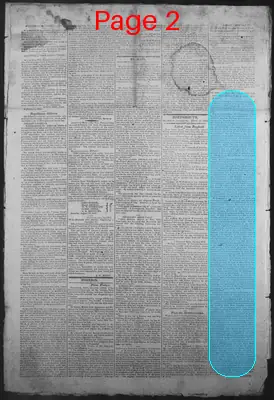
The New Hampshire Gazette
Portsmouth, Rockingham County, New Hampshire
What is this article about?
A response to 'Remarks on Common Sense' defending the repeal of Sabbath laws without harming public schools or morality, advocating mild persuasive measures over punitive ones to suppress vice, and refuting claims that public opinion countenances crimes like theft and debauchery in the town.
Clipping

OCR Quality
Full Text
Sir—Not wishing to monopolize too much of the printers' premises, or to intrude on the patience of the public, I closed my last communication without finishing what I had to say in reply to your remarks. I will now resume the subject.
The laws to enforce the observance of the first-day of the week, you represent to "have uniformly stood on the same ground, and been supported by the same policy as our school laws, and that if they fall, these will fall also." That they stand on the same ground inasmuch as they are both laws of the state, there is no dispute: but, that the fall of the one is necessarily connected with the fall or decline of the other, is not conceded. Nor do I perceive that the establishment of our public schools can derive any more injury from a repeal of the Sabbath act, than the progress of science and literature in Europe, from a total destruction of the Spanish Inquisition. Again, "we have uniformly observed that persons who resist the salutary institutions of society, are usually punished in a way calculated most deeply to afflict them. Their children learn to spurn parental authority, and by sinking in profligacy make their parents hearts to bleed."
Now, this is a mere dogmatic assertion; you have given no instances of this, and if you had it would have proved nothing; other instances might be given among those who are supporters of these "salutary institutions," that is, societies for the suppression of vice] and what would all this amount to? It would prove that some who do, and some who do not resist "salutary institutions," either from the naturally vicious dispositions of their children, or from their incapacity to govern, were very unfortunately and unhappily situated, which would be a subject of deep regret to all good men; whether this should be considered a punishment for disapproving Sunday laws, is a question I shall not undertake to discuss, but it appears that such punishments, like the rains from heaven, descend equally upon the just and upon the unjust.
With regard to the list of vices which you enumerate in your remarks," and which you say are so prevalent, the correction of them is a subject which deserves, the serious consideration of every good citizen; they are vices which always exist in a greater or less degree, in all populous towns. and it is the disposition as well as the duty of every man of feeling and sentiment, not only to discountenance, but to use all feasible methods to suppress them, and to endeavour to turn the deluded followers of such practices, to more honorable pursuits. And although I have never yet heard of any official acts of the "society" to prevent profane swearing, excessive drunkenness, gambling, "debauchery." &c. yet if they ever meet with opposition in an attempt of this nature, (unless they use very improper measures) the state of public opinion must be entirely different from what has hitherto come under my observation.— and your insinuation, that "not only these vices, but even theft, shop lifting, and crimes of the blackest character are countenanced by public opinion," I do think is grossly libelous on the general character of this town. it is moreover. an unfair reflection on those from whom you receive your support, and it certainly devolves on you, by the laws of civility and hospitality, publicly to withdraw, and apologize for the expression. To my observation, whenever any attempt at theft or shop lifting has been made, the arm of the magistrate has immediately been stretched out to seize on the offenders, and the exertions of the citizens have at once been roused to bring the perpetrators to justice and to punishment. I have never heard that any of the official services of the "society" have been offered on such occasions; had it been the case, I have no reason to think that they would have been rejected, or their exertions discountenanced; nor did I ever know in this place, the arm of the magistrate in the suppression of real vices, to be "paralized by public opinion."
A voluntary association of individuals to restrain the prevalence of vice by using mild, enticing, and persuasive measures to induce our deluded and inconsiderate youth to abandon their vicious, unhealthful, and unprofitable habits, pointing to them the ill consequences naturally resulting from their irregular course of conduct, and exhibiting to their view, the rewards and comforts attendant on a virtuous and exemplary life, which are honor, dignity, and respectability of character, and above all, peace of mind, and consequent innate happiness, would unquestionably produce more converts to morality and true religion, than a society for the exercise of the penal code. It is undoubtedly expedient, that laws for the punishment of venial offences should exist, & that recourse should be had to them in extreme cases; but, the arraignment of a youth before a public tribunal for idle and dissolute habits, though he should be convicted thereof and suffer exemplary punishment, would afford but little prospect of reclaiming him from such practices; on the contrary, it has more frequently a tendency to harden him in iniquity, as disgrace and ignominy will have fixed their mark upon him, the fear of the loss of reputation will have vanished. and shame, will have become a stranger to his breast; whereas, if milder and less rigorous, though more efficient measures were adopted, he might become a valuable member of society. But it may be said that although the victim may be lost to society, his condign punishment may operate as an example to prevent the like offences in others; I answer that this is a dear way of furnishing examples, and is a mode of correcting vices, which I am far from believing expedient, neither do I believe the present state of society to be such, as to "require sacrifices of his nature.
AN OBSERVER
What sub-type of article is it?
What themes does it cover?
What keywords are associated?
What entities or persons were involved?
Letter to Editor Details
Author
An Observer
Recipient
The Author Of "Remarks On Common Sense," In A Late Gazette
Main Argument
repealing sabbath laws will not necessarily harm public schools or lead to moral decay; milder, persuasive measures are more effective for suppressing vice than punitive societies or laws, which can harden offenders; public opinion does not countenance crimes like theft or debauchery, and the original remarks libel the town's character.
Notable Details