Thank you for visiting SNEWPapers!
Sign up free
Republican Herald
Providence, Providence County, Rhode Island
What is this article about?
Abstract of U.S. Congress proceedings from January 16-18, 1832, covering Senate and House debates on tariff resolutions, appropriations bills for internal improvements and military roads, public lands, imprisonment for debt, and apportionment, with emphasis on tariff compromise discussions.
Merged-components note: These two components form a continuous report on United States Congress proceedings from January 16-18, 1832.
Clipping
OCR Quality
Full Text
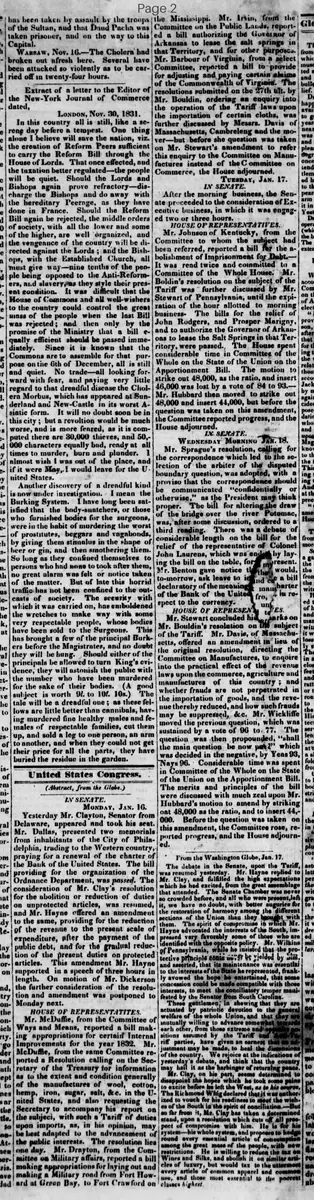
(Abstract, from the Globe.)
IN SENATE.
Monday, Jan. 16.
Yesterday Mr. Clayton, Senator from Delaware, appeared and took his seat.
Mr. Dallas, presented two memorials from inhabitants of the City of Philadelphia, trading to the Western country, praying for a renewal of the charter of the Bank of the United States. The bill providing for the organization of the Ordnance Department, was passed. The consideration of Mr. Clay's resolution for the abolition or reduction of duties on unprotected articles, was resumed, and Mr. Hayne offered an amendment to the same, providing for the reduction of the revenue to the present scale of expenditure, after the payment of the public debt, and for the gradual reduction of the present duties on protected articles. This amendment Mr. Hayne supported in a speech of three hours in length. On motion of Mr. Dickerson the further consideration of the resolution and amendment was postponed to Monday next.
HOUSE OF REPRESENTATIVES.
Mr. McDuffie, from the Committee of Ways and Means, reported a bill making appropriations for certain Internal Improvements for the year 1832. Mr. McDuffie, from the same Committee reported a Resolution calling on the Secretary of the Treasury for information as to the extent and condition generally of the manufactures of wool, cotton, hemp, iron, sugar, salt, &c. in the United States, and also requesting the Secretary to accompany his report on the subject, with such a Tariff of duties upon imports, as, in his opinion, may be best adapted to the advancement of the public interests. The resolution lies one day. Mr. Drayton, from the Committee on Military affairs, reported a bill making appropriations for laying out and making a Military road from Fort Howard at Green Bay, to Fort Crawford on the Mississippi.
Mr. Irvin, from the Committee on the Public Lands, reported a bill authorizing the Governor of Arkansas to lease the salt springs in that Territory, and for other purposes.
Mr. Barbour of Virginia, from a select Committee, reported a bill to provide for adjusting and paying certain claims of the Commonwealth of Virginia. The resolutions submitted on the 27th ult. by Mr. Bouldin, ordering an enquiry into the operation of the Tariff Laws upon the importation of certain cloths, was further discussed by Messrs. Davis of Massachusetts, Cambreleng and the mover—but before the question was taken on Mr. Stewart's amendment to refer this enquiry to the Committee on Manufactures instead of the Committee on Commerce, the House adjourned.
Tuesday, Jan. 17.
IN SENATE.
After the morning business, the Senate proceeded to the consideration of Executive business, in which it was engaged two or three hours.
HOUSE OF REPRESENTATIVES.
Mr. Johnson of Kentucky, from the Committee to whom the subject had been referred, reported a bill for the abolition of Imprisonment for Debt.—It was read twice and committed to a Committee of the Whole House. Mr. Bouldin's resolution on the subject of the Tariff was further discussed by Mr. Stewart of Pennsylvania, until the expiration of the hour allotted to morning business— The bills for the relief of John Rodgers, and Prosper Marigny, and to authorize the Governor of Arkansas to lease the Salt Springs in that Territory, were passed. The House spent considerable time in Committee of the Whole on the State of the Union on the Apportionment Bill. The motion to strike out 48,000, as the ratio, and insert 46,000 was lost by a vote of 84 to 93.—Mr. Hubbard then moved to strike out 48,000 and insert 44,000, but before the question was taken on this amendment, the Committee reported progress, and the House adjourned.
IN SENATE.
Wednesday Morning Jan. 18.
Mr. Sprague's resolution, calling for the correspondence which led to the selection of the arbiter of the disputed boundary question, was adopted, with a proviso that the correspondence should be communicated "confidentially or otherwise," as the President may think proper. The bill for altering the draw of the bridge over the river Potomac, was, after some discussion, ordered to a third reading.
There was a debate of considerable length on the bill for the relief of the representative of Colonel John Laurens, which was ended by laying the bill on the table, or present.
Mr. Benton gave notice to-morrow, ask leave to introduce and call up a bill declaratory of the meaning of the Bank of the United States, in respect to the currency.
HOUSE OF REPRESENTATIVES.
Mr. Stewart concluded his remarks on Mr. Bouldin's resolution on the subject of the Tariff. Mr. Davis, of Massachusetts, offered an amendment in lieu of the original resolution, directing the Committee on Manufactures, to enquire into the practical effect of the revenue laws upon the commerce, agriculture and manufactures of this country ; and whether frauds are not perpetrated in the importation of goods, and the revenue thereby reduced, and how such frauds may be suppressed, &c. Mr. Wickliffe moved the previous question, which was sustained by a vote of 96 to 77. The question was then propounded, "shall the main question be now put?" which was decided in the negative, by Yeas 93, Nays 96. Considerable time was spent in Committee of the Whole on the State of the Union on the Apportionment Bill. The merits and principles of the bill were discussed with much zeal upon Mr. Hubbard's motion to amend by striking out 48,000 as the ratio, and to insert 44,000. Before the question was taken on this amendment, the Committee rose, reported progress, and the House adjourned.
From the Washington Globe, Jan. 17.
The debate in the Senate, upon the Tariff, was resumed yesterday. Mr. Hayne replied to Mr. Clay, and fulfilled the high expectations which he had excited, from the great assemblage that attended. The Senate Chamber was never so crowded before, and all who were present, left it, we have no doubt, with better auguries for the restoration of harmony among the different sections of the Union than they brought with them. The spirit of compromise in which Mr. Hayne advocated the interests of the South, impressed very favorably some of those who are identified with the opposite policy. Mr. Wilkins of Pennsylvania, while he insisted that the protective principle could never be yielded by him, and asserted, that its maintenance was essential to the interests of the State he represented, frankly avowed the hope he entertained, that some concession could be made compatible with those interests, to meet the conciliatory temper manifested by the Senator from South Carolina.
These gentlemen, in shewing that they are actuated by patriotic devotion to the general welfare of the whole Union, and that they are mutually willing to advance somewhat toward each other, from those extreme and positions assumed by the Tariff and Anti-Tariff parties, have given an earnest that an adjustment may be made, to heal the dissension of the country.
We rejoice at the indications of yesterday's debate, and think that the country may hail it as the harbinger of returning peace.
Mr. Clay, on his part, seems determined to disappoint the hopes which he took some pains to excite before he left the West, as to his course,
The Richmond Whig declared that it was authorized to vouch for his readiness to meet the wishes of the South in the spirit of conciliation. But so far from it, Mr. Clay has taken a determined stand, upon a resolution which cuts off all prospect of compromise with him. He is for his system—his whole system, and proposes to hedge round every essential article of consumption among the great mass of the people, with new restrictions. He is willing to reduce the tax on wines and Silks, and abolish it on similar articles of luxury, but would tax to the uttermost every article of common apparel and common use, and those most essential to the poorest classes highest.
What sub-type of article is it?
What keywords are associated?
What entities or persons were involved?
Where did it happen?
Domestic News Details
Primary Location
Washington
Event Date
January 16 18, 1832
Key Persons
Outcome
various bills reported, passed, or postponed; tariff debates continued with discussions on compromise; apportionment bill amendments debated but not resolved.
Event Details
Proceedings in the U.S. Senate and House of Representatives included reports on bills for internal improvements, military roads, public lands leases, imprisonment for debt abolition, Virginia claims, and tariff inquiries; debates on tariff resolutions and amendments by Hayne and others; executive business; boundary correspondence resolution; bridge alteration bill; Laurens relief bill tabled; bank currency bill notice; apportionment ratio amendments lost or pending.