Thank you for visiting SNEWPapers!
Sign up free
Editorial
October 23, 1837
Alexandria Gazette
Alexandria, Alexandria County, District Of Columbia
What is this article about?
Editorial lists acts from the extra session of the 25th Congress called by President Van Buren, then critiques the session for prioritizing government needs over public relief, covering currency issues, appropriations, Indian hostilities, and partisan policies, with sarcastic tone against the administration.
Clipping
OCR Quality
95%
Excellent
Full Text
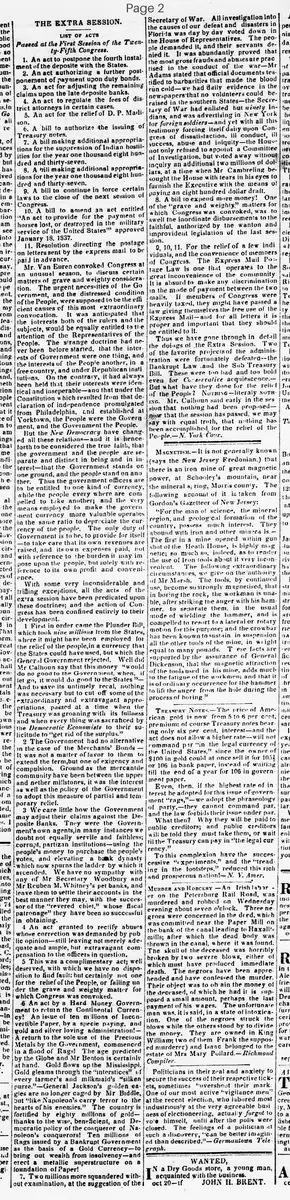
THE EXTRA SESSION.
LIST OF ACTS
Passed at the First Session of the Twenty-Fifth Congress.
1. An act to postpone the fourth installment of the deposite with the States.
2. An act authorizing a further postponement of payment upon duty bonds.
3. An act for adjusting the remaining claims upon the late deposite banks.
4. An act to regulate the fees of district attorneys in certain cases.
5. An act for the relief of D. P. Madison.
6. A bill to authorize the issuing of Treasury notes.
7. A bill making additional appropriations for the suppression of Indian hostilities for the year one thousand eight hundred and thirty-seven.
8. A bill making additional appropriations for the year one thousand eight hundred and thirty-seven.
9. A bill to continue in force certain laws to the close of the next session of Congress.
10. A bill to amend an act entitled "An act to provide for the payment of horses lost, or destroyed in the military service of the United States" approved January 18, 1837.
11. Resolution directing the postage on letters sent by the express mail to be paid in advance.
Mr. Van Buren convoked Congress at an unusual season, to discuss certain matters of grave and weighty consideration. The urgent necessities of the Government, and the distressed condition of the People, were supposed to be the efficient causes of this most extraordinary convocation. It was anticipated that the interests both of the rulers and the subjects, would be equally entitled to the attention of the Representatives of the People. The strange doctrine had never been before started, that the interests of Government were one thing, and the interests of the People another, in a free country, and under Republican institutions. On the contrary, it had always been held that their interests were identical and inseparable-and that under the Constitution which resulted from that declaration of independence promulgated from Philadelphia, and established at Yorktown, the People were the Government, and the Government the People. But the New Democracy have changed all these relations-and it is henceforth to be considered the true faith, that the government and the people are separate and distinct in being and in interest-that the Government stands on one ground, and the people stand on another. Thus the government officers are to be entitled to one kind of currency, while the people every where are compelled to take another; and the very means employed to make the government currency more valuable operates in the same ratio to depreciate the currency of the people. The only duty of Government is to be, to provide for itself-to take care that its own revenues are raised, and its own expenses paid, not with reference to the burden it may impose upon the people, but solely with reference to its own profit and convenience.
With some very inconsiderable and trifling exceptions, all the acts of the extra session have been predicated upon these doctrines; and the action of Congress has been confined entirely to their development.
First in order came the Plunder Bill which took nine millions from the States, where it might have been employed for the relief of the people, in a currency that the States could have used, but which the General Government rejected. Well did Mr Calhoun say that this money "would do no good to the Government, when, if let go, it would do good to the States." And to save its untimely recall, nothing was necessary but to cut off some of the extraordinary and extravagant appropriations, passed at a time when the Treasury was groaning with its fullness and when every thing was sacrificed by the Democratic Economists to their solicitude to "get rid of the surplus."
The Government had no alternative in the case of the Merchants' Bonds-It was not a matter of favor to them to extend the term, but one of exigency and compulsion. Ground as the mercantile community have been between the upper and nether millstones, it was the interest as well as the policy of the Government to adopt this measure of partial and temporary relief.
We care little how the Government may adjust their claims against the Deposit Banks. They were the Government's own agents, in many instances we doubt not equally servile and faithless; corrupt, partizan institutions-using the people's money to purchase the people's votes, and elevating a bank dynasty which now spurns the ladder by which it ascended. We have no sympathy with any of Mr Secretary Woodbury and Mr Reuben M. Whitney's pet banks, and leave them to settle their accounts in the best manner they may, with the successor of the "revered chief," whose fiscal "patronage" they have been so successful in obtaining.
An act granted to rectify abuses whose correction was demanded by public opinion--still leaving not merely adequate and ample, but extravagant compensation to the officers in question.
This was a complimentary act: well deserved, with which we have no disposition to find fault: but certainly not one for the relief of the People, or falling under the grave and weighty matter for which Congress was convoked.
An act by a Hard Money Government to return the Continental Currency! An issue of ten millions of Inconvertible Paper, by a specie paying, and gold and silver loving administration!-A return to the sole use of the Precious Metals by the Government, commenced in a flood of Rags! The age predicted by the Globe and Mr Benton is certainly at hand. Gold flows up the Mississippi. Gold gleams through the "interstices" every farmer's and milkmaid's "silken purse."-General Jackson's golden eagles are no longer caged by Mr Biddle, but "like Napoleon's carry terror to the hearts of his enemies." The country is fortified by eighty millions of gold-thanks to the wise, beneficent, and Democratic policy of the conqueror of Napoleon's conquerors! Ten millions of Rags issued by a Bankrupt Government as the basis of a Gold Currency-to bring out wealth from insolvency-and erect a metallic superstructure on a foundation of Paper!
Two millions more squandered without examination, at the suggestion of the Secretary of War. All investigation into the causes of our defeat and disasters in Florida was day by day voted down in the House of Representatives. The people demanded it, and their servants denied it. It was abundantly proved that the most gross frauds and abuses are practised in the conduct of the war-Mr Adams stated that official documents testified to barbarities that made the blood run cold-we had daily evidence in the newspapers that no volunteers could be raised in the southern States-the Secretary of War was enlisting but ninety Indians, and was advertising in New York for foreign soldiers-and yet with all this testimony forcing itself daily upon Congress of dissatisfaction, ill conduct, ill success, abuse and iniquity-the House not only refused to appoint a Committee of Investigation, but voted away without inquiry an additional two millions of dollars, at a time when Mr Cambreleng besought the House with tears in his eyes to furnish the Executive with the means of paying an eight hundred dollar draft.
A bill to expend more money! One of the "grave and weighty" matters for which Congress was convoked, was to swell the inordinate disbursements to the faithful, authorized by the wanton and improvident legislation of the last session.
9, 10, 11. For the relief of a few individuals, and the convenience of members of Congress. The Express Mail Postage Law is one that operates to the great inconvenience of the community It is absurd to make any discrimination in the mode of payment between the two mails. If members of Congress were heavily taxed, they might have passed a law giving themselves the free use of the Express Mail-and for all letters it is proper and important that they should be entitled to it.
Thus we have gone through in detail the doings of the Extra Session. Two of the favorite projects of the administration were fortunately defeated--the Bankrupt Law and the Sub Treasury Bill. These were too bad and too bold even for Conservative acquiescence. But what have they done for the relief of the People? Nothing-literally NOTHING. Mr. Calhoun said early in the session that nothing had been proposed-and that the session has passed, we may say with equal truth, that nothing has been accomplished for the relief of the People.-N. York Cour.
LIST OF ACTS
Passed at the First Session of the Twenty-Fifth Congress.
1. An act to postpone the fourth installment of the deposite with the States.
2. An act authorizing a further postponement of payment upon duty bonds.
3. An act for adjusting the remaining claims upon the late deposite banks.
4. An act to regulate the fees of district attorneys in certain cases.
5. An act for the relief of D. P. Madison.
6. A bill to authorize the issuing of Treasury notes.
7. A bill making additional appropriations for the suppression of Indian hostilities for the year one thousand eight hundred and thirty-seven.
8. A bill making additional appropriations for the year one thousand eight hundred and thirty-seven.
9. A bill to continue in force certain laws to the close of the next session of Congress.
10. A bill to amend an act entitled "An act to provide for the payment of horses lost, or destroyed in the military service of the United States" approved January 18, 1837.
11. Resolution directing the postage on letters sent by the express mail to be paid in advance.
Mr. Van Buren convoked Congress at an unusual season, to discuss certain matters of grave and weighty consideration. The urgent necessities of the Government, and the distressed condition of the People, were supposed to be the efficient causes of this most extraordinary convocation. It was anticipated that the interests both of the rulers and the subjects, would be equally entitled to the attention of the Representatives of the People. The strange doctrine had never been before started, that the interests of Government were one thing, and the interests of the People another, in a free country, and under Republican institutions. On the contrary, it had always been held that their interests were identical and inseparable-and that under the Constitution which resulted from that declaration of independence promulgated from Philadelphia, and established at Yorktown, the People were the Government, and the Government the People. But the New Democracy have changed all these relations-and it is henceforth to be considered the true faith, that the government and the people are separate and distinct in being and in interest-that the Government stands on one ground, and the people stand on another. Thus the government officers are to be entitled to one kind of currency, while the people every where are compelled to take another; and the very means employed to make the government currency more valuable operates in the same ratio to depreciate the currency of the people. The only duty of Government is to be, to provide for itself-to take care that its own revenues are raised, and its own expenses paid, not with reference to the burden it may impose upon the people, but solely with reference to its own profit and convenience.
With some very inconsiderable and trifling exceptions, all the acts of the extra session have been predicated upon these doctrines; and the action of Congress has been confined entirely to their development.
First in order came the Plunder Bill which took nine millions from the States, where it might have been employed for the relief of the people, in a currency that the States could have used, but which the General Government rejected. Well did Mr Calhoun say that this money "would do no good to the Government, when, if let go, it would do good to the States." And to save its untimely recall, nothing was necessary but to cut off some of the extraordinary and extravagant appropriations, passed at a time when the Treasury was groaning with its fullness and when every thing was sacrificed by the Democratic Economists to their solicitude to "get rid of the surplus."
The Government had no alternative in the case of the Merchants' Bonds-It was not a matter of favor to them to extend the term, but one of exigency and compulsion. Ground as the mercantile community have been between the upper and nether millstones, it was the interest as well as the policy of the Government to adopt this measure of partial and temporary relief.
We care little how the Government may adjust their claims against the Deposit Banks. They were the Government's own agents, in many instances we doubt not equally servile and faithless; corrupt, partizan institutions-using the people's money to purchase the people's votes, and elevating a bank dynasty which now spurns the ladder by which it ascended. We have no sympathy with any of Mr Secretary Woodbury and Mr Reuben M. Whitney's pet banks, and leave them to settle their accounts in the best manner they may, with the successor of the "revered chief," whose fiscal "patronage" they have been so successful in obtaining.
An act granted to rectify abuses whose correction was demanded by public opinion--still leaving not merely adequate and ample, but extravagant compensation to the officers in question.
This was a complimentary act: well deserved, with which we have no disposition to find fault: but certainly not one for the relief of the People, or falling under the grave and weighty matter for which Congress was convoked.
An act by a Hard Money Government to return the Continental Currency! An issue of ten millions of Inconvertible Paper, by a specie paying, and gold and silver loving administration!-A return to the sole use of the Precious Metals by the Government, commenced in a flood of Rags! The age predicted by the Globe and Mr Benton is certainly at hand. Gold flows up the Mississippi. Gold gleams through the "interstices" every farmer's and milkmaid's "silken purse."-General Jackson's golden eagles are no longer caged by Mr Biddle, but "like Napoleon's carry terror to the hearts of his enemies." The country is fortified by eighty millions of gold-thanks to the wise, beneficent, and Democratic policy of the conqueror of Napoleon's conquerors! Ten millions of Rags issued by a Bankrupt Government as the basis of a Gold Currency-to bring out wealth from insolvency-and erect a metallic superstructure on a foundation of Paper!
Two millions more squandered without examination, at the suggestion of the Secretary of War. All investigation into the causes of our defeat and disasters in Florida was day by day voted down in the House of Representatives. The people demanded it, and their servants denied it. It was abundantly proved that the most gross frauds and abuses are practised in the conduct of the war-Mr Adams stated that official documents testified to barbarities that made the blood run cold-we had daily evidence in the newspapers that no volunteers could be raised in the southern States-the Secretary of War was enlisting but ninety Indians, and was advertising in New York for foreign soldiers-and yet with all this testimony forcing itself daily upon Congress of dissatisfaction, ill conduct, ill success, abuse and iniquity-the House not only refused to appoint a Committee of Investigation, but voted away without inquiry an additional two millions of dollars, at a time when Mr Cambreleng besought the House with tears in his eyes to furnish the Executive with the means of paying an eight hundred dollar draft.
A bill to expend more money! One of the "grave and weighty" matters for which Congress was convoked, was to swell the inordinate disbursements to the faithful, authorized by the wanton and improvident legislation of the last session.
9, 10, 11. For the relief of a few individuals, and the convenience of members of Congress. The Express Mail Postage Law is one that operates to the great inconvenience of the community It is absurd to make any discrimination in the mode of payment between the two mails. If members of Congress were heavily taxed, they might have passed a law giving themselves the free use of the Express Mail-and for all letters it is proper and important that they should be entitled to it.
Thus we have gone through in detail the doings of the Extra Session. Two of the favorite projects of the administration were fortunately defeated--the Bankrupt Law and the Sub Treasury Bill. These were too bad and too bold even for Conservative acquiescence. But what have they done for the relief of the People? Nothing-literally NOTHING. Mr. Calhoun said early in the session that nothing had been proposed-and that the session has passed, we may say with equal truth, that nothing has been accomplished for the relief of the People.-N. York Cour.
What sub-type of article is it?
Partisan Politics
Economic Policy
Military Affairs
What keywords are associated?
Extra Session
Van Buren Congress
Economic Policy
Indian Hostilities
Treasury Notes
Partisan Critique
Public Relief
What entities or persons were involved?
Mr. Van Buren
Mr Calhoun
General Jackson
Mr Secretary Woodbury
Mr Reuben M. Whitney
Mr Benton
Mr Adams
Mr Cambreleng
N. York Cour.
Editorial Details
Primary Topic
Critique Of Van Buren's Extra Congressional Session For Neglecting Public Relief
Stance / Tone
Strongly Critical And Sarcastic Against The Administration
Key Figures
Mr. Van Buren
Mr Calhoun
General Jackson
Mr Secretary Woodbury
Mr Reuben M. Whitney
Mr Benton
Mr Adams
Mr Cambreleng
N. York Cour.
Key Arguments
Government Interests Separated From People's Under New Democracy
Extra Session Acts Focused Solely On Government Convenience
Plunder Bill Recalled Funds Needed By States For Relief
Treasury Notes Issued Contradict Hard Money Policy
Additional Appropriations For Indian Wars Without Investigation
No Measures For Public Economic Relief
Defeated Bankrupt Law And Sub Treasury Bill
Session Accomplished Nothing For The People