Thank you for visiting SNEWPapers!
Sign up free
The New Hampshire Gazette
Portsmouth, Rockingham County, New Hampshire
What is this article about?
Update from London on November 11 reports no further Chartist hostile actions in Monmouthshire; many have returned to work and business resumes in Newport and Monmouth. Analysis highlights the secretive, formidable conspiracy involving mining population, poor leadership by Frost preventing disaster, and broader political unrest among working classes influenced by Chartism and religious rhetoric.
Clipping
OCR Quality
Full Text
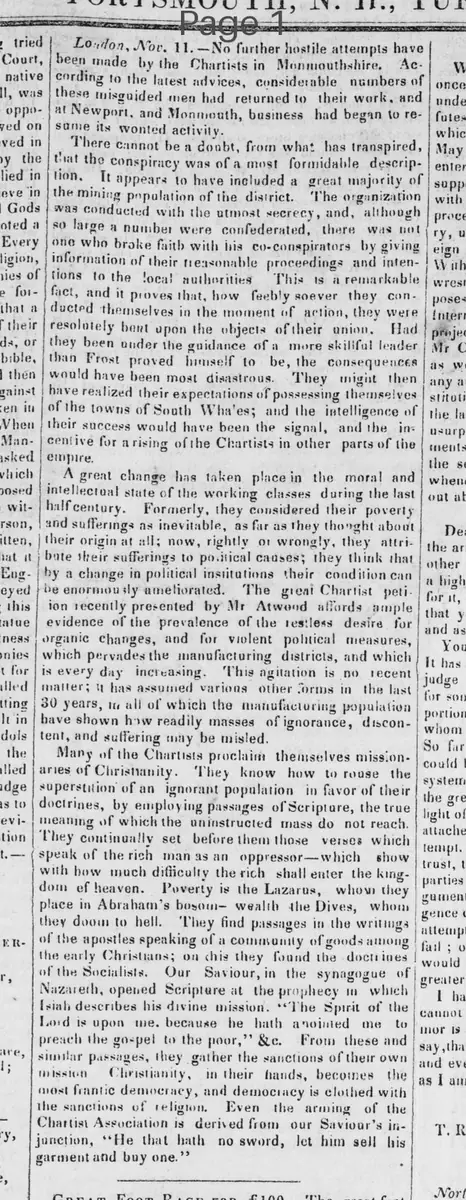
There cannot be a doubt, from what has transpired, that the conspiracy was of a most formidable description. It appears to have included a great majority of the mining population of the district. The organization was conducted with the utmost secrecy, and, although so large a number were confederated, there was not one who broke faith with his co-conspirators by giving information of their treasonable proceedings and intentions to the local authorities. This is a remarkable fact, and it proves that, how feebly soever they conducted themselves in the moment of action, they were resolutely bent upon the objects of their union. Had they been under the guidance of a more skillful leader than Frost proved himself to be, the consequences would have been most disastrous. They might then have realized their expectations of possessing themselves of the towns of South Wales; and the intelligence of their success would have been the signal, and the incentive for a rising of the Chartists in other parts of the empire.
A great change has taken place in the moral and intellectual state of the working classes during the last half century. Formerly, they considered their poverty and sufferings as inevitable, as far as they thought about their origin at all; now, rightly or wrongly, they attribute their sufferings to political causes; they think that by a change in political institutions their condition can be enormously ameliorated. The great Chartist petition recently presented by Mr Atwood affords ample evidence of the prevalence of the restless desire for organic changes, and for violent political measures, which pervades the manufacturing districts, and which is every day increasing. This agitation is no recent matter; it has assumed various other forms in the last 30 years, to all of which the manufacturing population have shown how readily masses of ignorance, discontent, and suffering may be misled.
Many of the Chartists proclaim themselves missionaries of Christianity. They know how to rouse the superstition of an ignorant population in favor of their doctrines, by employing passages of Scripture, the true meaning of which the uninstructed mass do not reach. They continually set before them those verses which speak of the rich man as an oppressor—which show with how much difficulty the rich shall enter the kingdom of heaven. Poverty is the Lazarus, whom they place in Abraham's bosom—wealth the Dives, whom they doom to hell. They find passages in the writings of the apostles speaking of a community of goods among the early Christians; on this they found the doctrines of the Socialists. Our Saviour, in the synagogue of Nazareth, opened Scripture at the prophecy in which Isaiah describes his divine mission. "The Spirit of the Lord is upon me, because he hath anointed me to preach the gospel to the poor," &c. From these and similar passages, they gather the sanctions of their own mission. Christianity, in their hands, becomes the most frantic democracy, and democracy is clothed with the sanctions of religion. Even the arming of the Chartist Association is derived from our Saviour's injunction, "He that hath no sword, let him sell his garment and buy one."
What sub-type of article is it?
What keywords are associated?
What entities or persons were involved?
Where did it happen?
Foreign News Details
Primary Location
Monmouthshire
Event Date
Nov. 11
Key Persons
Outcome
no further hostile attempts; considerable numbers returned to work; business resuming its wonted activity at newport and monmouth
Event Details
No further hostile attempts by Chartists in Monmouthshire; latest advices indicate many misguided men returned to work, business resuming in Newport and Monmouth. Conspiracy was formidable, involving majority of mining population, conducted with utmost secrecy, no betrayals. Resolute but feebly executed under Frost's leadership; better guidance could have led to possession of South Wales towns and wider risings. Broader changes in working classes' views on poverty as political; Chartist petition by Mr Atwood shows desire for organic changes and violent measures in manufacturing districts. Agitation ongoing for 30 years. Chartists use Christian scriptures to promote doctrines, portraying poverty positively and wealth negatively, justifying socialism and arming.