Thank you for visiting SNEWPapers!
Sign up free
Editorial
June 14, 1803
Alexandria Advertiser And Commercial Intelligencer
Alexandria, Virginia
What is this article about?
Continuation of an editorial critiquing Doctor Barker's letter praising Thomas Jefferson. The author admires Barker's sincere intentions but argues his delusion stems from Jefferson's charming demeanor masking dangerous deist and demagogic principles, citing associations with Paine, Illuminati, and infidels.
Clipping
OCR Quality
95%
Excellent
Full Text
From the CHARLESTON COURIER
Observations on Doctor Barker's Letter
CONTINUED
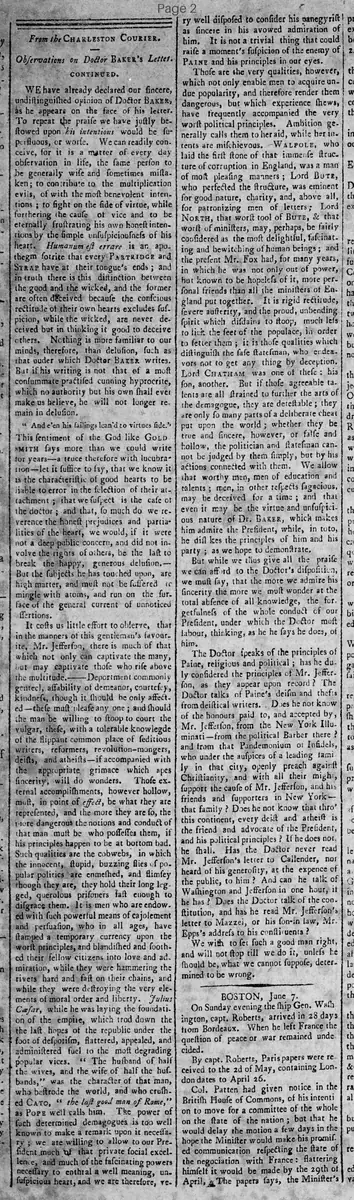
WE have already declared our sincere undistinguished opinion of Doctor Baker. as he appears on the face of his letter. To repeat the praise we have justly bestowed upon his intentions would be superfluous, or worse. We can readily conceive, for it is a matter of every day observation in life, the same person to be generally wise and sometimes mistaken: to contribute to the multiplication of evils, of which the most benevolent intentions : to fight on the side of virtue, while furthering the cause of vice and to be eternally frustrating his own honest intentions by the simple unsuspiciousness of his heart. Humanum est errare is an apothegm so trite that every Partridge and Strap have at their tongue's ends ; and in truth there is this distinction between the good and the wicked, and the former are often deceived because the conscious rectitude of their own hearts excludes suspicion, while the wicked, are never deceived but in thinking it good to deceive others. Nothing is more familiar to our minds, therefore, than delusion, such as that under which Doctor Baker writes. But if his writing is not that of a most consummate practiced cunning hypocrite, which no authority but his own shall ever make us believe, he will not longer remain in delusion.
" And e'en his failings lean'd to virtue's side."
This sentiment of the God like Goldsmith says more than we could write for years--a truce therefore with lucubration let it suffice to say, that we know it is the characteristic of good hearts to be liable to error in the selection of their attachments ; that we suspect is the case of the doctor : and that, so much do we reverence the honest prejudices and partialities of the heart, we would, if it were not a deep public concern, and did not involve the rights of others, be the last to break the happy, generous delusion.-
But the subjects he has touched upon, are high matter, and must not be trifled (c mingle with atoms, and run on the surface of the general current of unnoticed assertions.
It costs us little effort to observe, that in the manners of this gentleman's favorite, Mr. Jefferson. there is much of that which not only can captivate the many, but may captivate those who rise above the multitude. --Deportment commonly genteel, affability of demeanor, courtesy, kindness, though it should be only affected these must please any one ; and should the man be willing to stoop to court the vulgar, these, with a tolerable knowledge of the flippant common place of seditious writers, reformers, revolution-mongers, deists, and atheists-if accompanied with the appropriate grimace which apes sincerity, will do wonders. Those external accomplishments, however hollow, must, in point of effect, be what they are represented, and the more they are so, the more dangerous the notions and conduct of that man must be who possesses them, if his principles happen to be at bottom bad. Such qualities are the cobwebs, in which the innocent, stupid, buzzing flies of popular politics are enmeshed, and flimsy though they are, they hold their long legged, querulous prisoners fast enough to disgrace them. It is men who are endowed with such powerful means of cajolement and persuasion, who in all ages, have stamped a temporary currency upon the worst principles, and blandished and soothed their fellow citizens into love and admiration, while they were hammering the rivets hard and fast on their chains, and while they were destroying the very elements of moral order and liberty. Julius Caesar, while he was laying the foundation of the empire, which trod down the last hopes of the republic under the foot of despotism, flattered, appealed, and administered fuel to the most degrading popular vices. " The husband of half the wives, and the wife of half the husbands," was the character of that man, who bestrode the world, and who crushed Cato, " the last good man of Rome," as Pope well calls him, The, power of such determined demagogues is too well known to make a remark upon it necessary ; we are willing to allow to our President much of that private social excellence, and much of the fascinating powers necessary to enthral a well meaning, unsuspicious heart, and we are therefore, very well disposed to consider his panegyrist as sincere in his avowed admiration of him. It is not a trivial thing that could raise a moment's suspicion of the enemy of Paine and his principles in our eyes. Those are the very qualities, however, which not only enable men to acquire undue popularity, and therefore render them dangerous, but which experience shews, have frequently accompanied the very worst political principles. Ambition generally calls them to her aid, while her intentions are mischievous. -Walpole, who laid the first stone of that immense structure of corruption in England, was a man of most pleasing manners; Lord Bute, who perfected the structure, was eminent for good nature, charity, and, above all, for patronizing men of letters; Lord North, that worst tool of Bute; & that worst of ministers, may, perhaps, be fairly considered as the most delightful, fascinating and bewitching of human beings; and the present Mr. Fox had, for many years, in which he was not only out of power, but known to be hopeless of it, more personal friends than all the ministers of England put together. It is rigid rectitude, severe austerity, and the proud, unbending spirit which disdains to stoop, much less to lick the feet of the populace, in order to fetter them ; it is those qualities which distinguish the true statesman, who endeavors not to get any thing by deception. Lord Chatham was one of these : his son, another. But if those agreeable talents are all trained to further the arts of the demagogue, they are detestable; they are only so many parts of a deliberate cheat put upon the world; whether they be true and sincere, however, or false and hollow, the politician and statesman cannot be judged by them simply, but by his actions connected with them. We allow that worthy men, men of education and talents ; men, in other respects sagacious, may be deceived for a time ; and that even it may be the virtue and unsuspicious nature of Dr. Baker, which makes him admire the President, while, in toto, he dislikes the principles of him and his party ; as we hope to demonstrate. But while we thus give all the praise we can afford to the Doctor's disposition, we must say, that the more we admire his sincerity the more we must wonder at the total absence of all knowledge, the forgetfulness of the whole conduct of our President, under which the Doctor must labour, thinking, as he says he does, of him. The Doctor speaks of the principles of Paine, religious and political ; has he duly considered the principles of Mr. Jefferson, as they appear upon record? The Doctor talks of Paine's deism and thefts from deistical writers. Does he not know of the honours paid to, and accepted by, Mr. Jefferson, from the New York Illuminati--from the political Barber there ? and from that Pandemonium of Infidels, who under the auspices of a leading family in that city, openly preach against Christianity, and with all their might, support the cause of Mr. Jefferson, and his friends and supporters in New York-- that family ? Does he not know that thro' this continent, every deist and atheist is the friend and advocate of the President, and his political principles ? If he does not. he shall. Has the Doctor never read Mr. Jefferson's letter to Callender, nor heard of his generosity, at the expense of the public, to him ? And can he talk of Washington and Jefferson in one hour, if he has ? Does the Doctor talk of the constitution, and has he read Mr. Jefferson's letter to Mazzei, or his son-in law, Mr. Eppes's address to his constituents ? We wish to set such a good man right, and will not stop till we do it, unless he should be, what we cannot suppose, determined to be wrong.
Observations on Doctor Barker's Letter
CONTINUED
WE have already declared our sincere undistinguished opinion of Doctor Baker. as he appears on the face of his letter. To repeat the praise we have justly bestowed upon his intentions would be superfluous, or worse. We can readily conceive, for it is a matter of every day observation in life, the same person to be generally wise and sometimes mistaken: to contribute to the multiplication of evils, of which the most benevolent intentions : to fight on the side of virtue, while furthering the cause of vice and to be eternally frustrating his own honest intentions by the simple unsuspiciousness of his heart. Humanum est errare is an apothegm so trite that every Partridge and Strap have at their tongue's ends ; and in truth there is this distinction between the good and the wicked, and the former are often deceived because the conscious rectitude of their own hearts excludes suspicion, while the wicked, are never deceived but in thinking it good to deceive others. Nothing is more familiar to our minds, therefore, than delusion, such as that under which Doctor Baker writes. But if his writing is not that of a most consummate practiced cunning hypocrite, which no authority but his own shall ever make us believe, he will not longer remain in delusion.
" And e'en his failings lean'd to virtue's side."
This sentiment of the God like Goldsmith says more than we could write for years--a truce therefore with lucubration let it suffice to say, that we know it is the characteristic of good hearts to be liable to error in the selection of their attachments ; that we suspect is the case of the doctor : and that, so much do we reverence the honest prejudices and partialities of the heart, we would, if it were not a deep public concern, and did not involve the rights of others, be the last to break the happy, generous delusion.-
But the subjects he has touched upon, are high matter, and must not be trifled (c mingle with atoms, and run on the surface of the general current of unnoticed assertions.
It costs us little effort to observe, that in the manners of this gentleman's favorite, Mr. Jefferson. there is much of that which not only can captivate the many, but may captivate those who rise above the multitude. --Deportment commonly genteel, affability of demeanor, courtesy, kindness, though it should be only affected these must please any one ; and should the man be willing to stoop to court the vulgar, these, with a tolerable knowledge of the flippant common place of seditious writers, reformers, revolution-mongers, deists, and atheists-if accompanied with the appropriate grimace which apes sincerity, will do wonders. Those external accomplishments, however hollow, must, in point of effect, be what they are represented, and the more they are so, the more dangerous the notions and conduct of that man must be who possesses them, if his principles happen to be at bottom bad. Such qualities are the cobwebs, in which the innocent, stupid, buzzing flies of popular politics are enmeshed, and flimsy though they are, they hold their long legged, querulous prisoners fast enough to disgrace them. It is men who are endowed with such powerful means of cajolement and persuasion, who in all ages, have stamped a temporary currency upon the worst principles, and blandished and soothed their fellow citizens into love and admiration, while they were hammering the rivets hard and fast on their chains, and while they were destroying the very elements of moral order and liberty. Julius Caesar, while he was laying the foundation of the empire, which trod down the last hopes of the republic under the foot of despotism, flattered, appealed, and administered fuel to the most degrading popular vices. " The husband of half the wives, and the wife of half the husbands," was the character of that man, who bestrode the world, and who crushed Cato, " the last good man of Rome," as Pope well calls him, The, power of such determined demagogues is too well known to make a remark upon it necessary ; we are willing to allow to our President much of that private social excellence, and much of the fascinating powers necessary to enthral a well meaning, unsuspicious heart, and we are therefore, very well disposed to consider his panegyrist as sincere in his avowed admiration of him. It is not a trivial thing that could raise a moment's suspicion of the enemy of Paine and his principles in our eyes. Those are the very qualities, however, which not only enable men to acquire undue popularity, and therefore render them dangerous, but which experience shews, have frequently accompanied the very worst political principles. Ambition generally calls them to her aid, while her intentions are mischievous. -Walpole, who laid the first stone of that immense structure of corruption in England, was a man of most pleasing manners; Lord Bute, who perfected the structure, was eminent for good nature, charity, and, above all, for patronizing men of letters; Lord North, that worst tool of Bute; & that worst of ministers, may, perhaps, be fairly considered as the most delightful, fascinating and bewitching of human beings; and the present Mr. Fox had, for many years, in which he was not only out of power, but known to be hopeless of it, more personal friends than all the ministers of England put together. It is rigid rectitude, severe austerity, and the proud, unbending spirit which disdains to stoop, much less to lick the feet of the populace, in order to fetter them ; it is those qualities which distinguish the true statesman, who endeavors not to get any thing by deception. Lord Chatham was one of these : his son, another. But if those agreeable talents are all trained to further the arts of the demagogue, they are detestable; they are only so many parts of a deliberate cheat put upon the world; whether they be true and sincere, however, or false and hollow, the politician and statesman cannot be judged by them simply, but by his actions connected with them. We allow that worthy men, men of education and talents ; men, in other respects sagacious, may be deceived for a time ; and that even it may be the virtue and unsuspicious nature of Dr. Baker, which makes him admire the President, while, in toto, he dislikes the principles of him and his party ; as we hope to demonstrate. But while we thus give all the praise we can afford to the Doctor's disposition, we must say, that the more we admire his sincerity the more we must wonder at the total absence of all knowledge, the forgetfulness of the whole conduct of our President, under which the Doctor must labour, thinking, as he says he does, of him. The Doctor speaks of the principles of Paine, religious and political ; has he duly considered the principles of Mr. Jefferson, as they appear upon record? The Doctor talks of Paine's deism and thefts from deistical writers. Does he not know of the honours paid to, and accepted by, Mr. Jefferson, from the New York Illuminati--from the political Barber there ? and from that Pandemonium of Infidels, who under the auspices of a leading family in that city, openly preach against Christianity, and with all their might, support the cause of Mr. Jefferson, and his friends and supporters in New York-- that family ? Does he not know that thro' this continent, every deist and atheist is the friend and advocate of the President, and his political principles ? If he does not. he shall. Has the Doctor never read Mr. Jefferson's letter to Callender, nor heard of his generosity, at the expense of the public, to him ? And can he talk of Washington and Jefferson in one hour, if he has ? Does the Doctor talk of the constitution, and has he read Mr. Jefferson's letter to Mazzei, or his son-in law, Mr. Eppes's address to his constituents ? We wish to set such a good man right, and will not stop till we do it, unless he should be, what we cannot suppose, determined to be wrong.
What sub-type of article is it?
Partisan Politics
Moral Or Religious
What keywords are associated?
Jefferson Criticism
Deism
Political Principles
Demagogues
Illuminati
Thomas Paine
Moral Delusion
Charismatic Leaders
What entities or persons were involved?
Doctor Barker
Mr. Jefferson
Thomas Paine
George Washington
Julius Caesar
Cato
Lord Chatham
Walpole
Lord Bute
Lord North
Mr. Fox
Callender
Mazzei
Mr. Eppes
New York Illuminati
Editorial Details
Primary Topic
Critique Of Doctor Barker's Admiration For Thomas Jefferson
Stance / Tone
Critical Of Jefferson's Principles And Associations, Sympathetic To Barker's Intentions
Key Figures
Doctor Barker
Mr. Jefferson
Thomas Paine
George Washington
Julius Caesar
Cato
Lord Chatham
Walpole
Lord Bute
Lord North
Mr. Fox
Callender
Mazzei
Mr. Eppes
New York Illuminati
Key Arguments
Good Intentions Can Lead To Errors In Judgment Due To Unsuspicious Hearts.
Jefferson's Charming Manners Mask Potentially Dangerous Deist And Demagogic Principles.
Historical Demagogues Like Caesar Used Charisma To Undermine Liberty.
Jefferson Accepted Honors From Infidels And Illuminati.
Deists And Atheists Support Jefferson's Political Principles.
Jefferson's Letters And Actions Contradict Claims Of Virtue, E.G., To Callender And Mazzei.
True Statesmen Exhibit Rigid Rectitude, Not Popular Appeal.