Thank you for visiting SNEWPapers!
Sign up free
Editorial
June 13, 1843
Indiana State Sentinel
Indianapolis, Marion County, Indiana
What is this article about?
An editorial criticizes the Whig party's interconnected economic schemes: a national bank, high protective tariff, and federal assumption of state debts. It argues these measures would benefit manufacturers and bankers at the expense of laborers and consumers, predicting public opposition.
Clipping
OCR Quality
95%
Excellent
Full Text
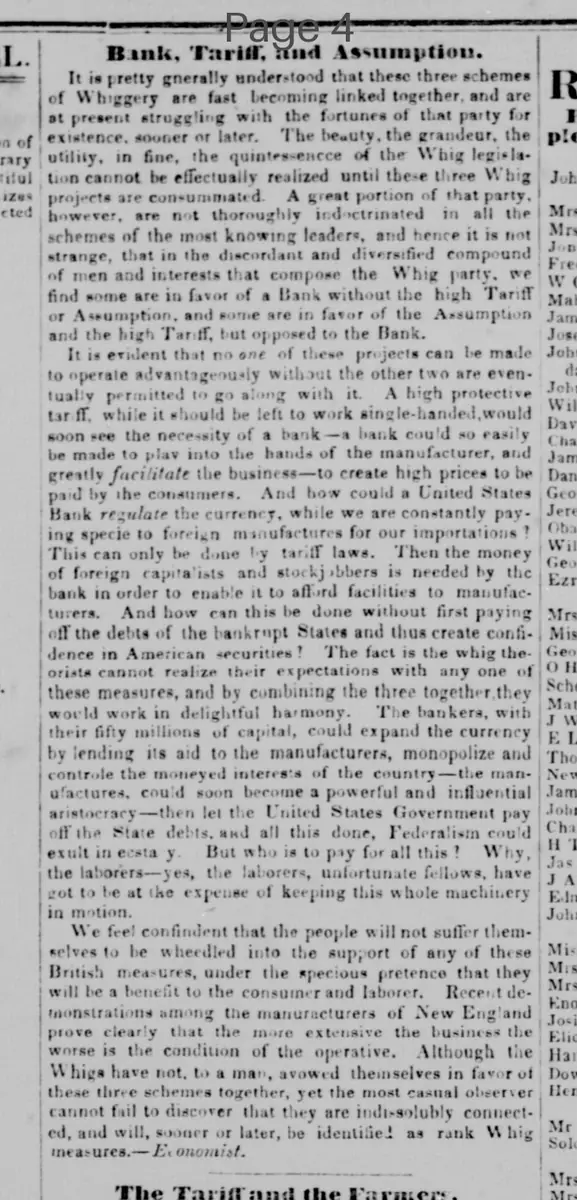
Bank, Tariff, and Assumption.
It is pretty generally understood that these three schemes of Whiggery are fast becoming linked together, and are at present struggling with the fortunes of that party for existence, sooner or later. The beauty, the grandeur, the utility, in fine, the quintessence of the Whig legislation cannot be effectually realized until these three Whig projects are consummated. A great portion of that party, however, are not thoroughly indoctrinated in all the schemes of the most knowing leaders, and hence it is not strange, that in the discordant and diversified compound of men and interests that compose the Whig party, we find some are in favor of a Bank without the high Tariff or Assumption, and some are in favor of the Assumption and the high Tariff, but opposed to the Bank.
It is evident that no one of these projects can be made to operate advantageously without the other two are eventually permitted to go along with it. A high protective tariff, while it should be left to work single-handed, would soon see the necessity of a bank—a bank could so easily be made to play into the hands of the manufacturer, and greatly facilitate the business—to create high prices to be paid by the consumers. And how could a United States Bank regulate the currency, while we are constantly paying specie to foreign manufacturers for our importations? This can only be done by tariff laws. Then the money of foreign capitalists and stockjobbers is needed by the bank in order to enable it to afford facilities to manufacturers. And how can this be done without first paying off the debts of the bankrupt States and thus create confidence in American securities! The fact is the whig theorists cannot realize their expectations with any one of these measures, and by combining the three together they would work in delightful harmony. The bankers, with their fifty millions of capital, could expand the currency by lending its aid to the manufacturers, monopolize and control the moneyed interests of the country—the manufacturers, could soon become a powerful and influential aristocracy—then let the United States Government pay off the State debts, and all this done, Federalism could exult in ecstasy. But who is to pay for all this? Why, the laborers—yes, the laborers, unfortunate fellows, have got to be at the expense of keeping this whole machinery in motion.
We feel confident that the people will not suffer themselves to be wheedled into the support of any of these British measures, under the specious pretence that they will be a benefit to the consumer and laborer. Recent demonstrations among the manufacturers of New England prove clearly that the more extensive the business the worse is the condition of the operative. Although the Whigs have not, to a man, avowed themselves in favor of these three schemes together, yet the most casual observer cannot fail to discover that they are indissolubly connected, and will, sooner or later, be identified as rank Whig measures.—Economist.
It is pretty generally understood that these three schemes of Whiggery are fast becoming linked together, and are at present struggling with the fortunes of that party for existence, sooner or later. The beauty, the grandeur, the utility, in fine, the quintessence of the Whig legislation cannot be effectually realized until these three Whig projects are consummated. A great portion of that party, however, are not thoroughly indoctrinated in all the schemes of the most knowing leaders, and hence it is not strange, that in the discordant and diversified compound of men and interests that compose the Whig party, we find some are in favor of a Bank without the high Tariff or Assumption, and some are in favor of the Assumption and the high Tariff, but opposed to the Bank.
It is evident that no one of these projects can be made to operate advantageously without the other two are eventually permitted to go along with it. A high protective tariff, while it should be left to work single-handed, would soon see the necessity of a bank—a bank could so easily be made to play into the hands of the manufacturer, and greatly facilitate the business—to create high prices to be paid by the consumers. And how could a United States Bank regulate the currency, while we are constantly paying specie to foreign manufacturers for our importations? This can only be done by tariff laws. Then the money of foreign capitalists and stockjobbers is needed by the bank in order to enable it to afford facilities to manufacturers. And how can this be done without first paying off the debts of the bankrupt States and thus create confidence in American securities! The fact is the whig theorists cannot realize their expectations with any one of these measures, and by combining the three together they would work in delightful harmony. The bankers, with their fifty millions of capital, could expand the currency by lending its aid to the manufacturers, monopolize and control the moneyed interests of the country—the manufacturers, could soon become a powerful and influential aristocracy—then let the United States Government pay off the State debts, and all this done, Federalism could exult in ecstasy. But who is to pay for all this? Why, the laborers—yes, the laborers, unfortunate fellows, have got to be at the expense of keeping this whole machinery in motion.
We feel confident that the people will not suffer themselves to be wheedled into the support of any of these British measures, under the specious pretence that they will be a benefit to the consumer and laborer. Recent demonstrations among the manufacturers of New England prove clearly that the more extensive the business the worse is the condition of the operative. Although the Whigs have not, to a man, avowed themselves in favor of these three schemes together, yet the most casual observer cannot fail to discover that they are indissolubly connected, and will, sooner or later, be identified as rank Whig measures.—Economist.
What sub-type of article is it?
Economic Policy
Partisan Politics
Taxation
What keywords are associated?
Whig Schemes
National Bank
Protective Tariff
State Debt Assumption
Economic Criticism
Labor Exploitation
Manufacturing Interests
What entities or persons were involved?
Whig Party
Bankers
Manufacturers
United States Government
Laborers
New England Manufacturers
Editorial Details
Primary Topic
Interconnected Whig Schemes Of Bank, Tariff, And Assumption Of State Debts
Stance / Tone
Strongly Critical Of Whig Economic Policies
Key Figures
Whig Party
Bankers
Manufacturers
United States Government
Laborers
New England Manufacturers
Key Arguments
The Three Whig Schemes Are Linked And Necessary For Each Other To Succeed.
A High Tariff Requires A Bank To Facilitate Manufacturing And High Prices For Consumers.
A Bank Needs Tariff Laws To Regulate Currency Amid Foreign Imports.
Assumption Of State Debts Creates Confidence In Securities For Foreign Investment.
These Measures Benefit Bankers And Manufacturers, Creating An Aristocracy At Laborers' Expense.
People Will Reject These 'British Measures' As They Harm Consumers And Laborers.
Evidence From New England Shows Expanded Manufacturing Worsens Operatives' Conditions.