Thank you for visiting SNEWPapers!
Sign up free
Story
May 10, 1805
The Enquirer
Richmond, Henrico County, Virginia
What is this article about?
Discussion of the arrest of Don Jose Cabrera, a secretary of the Spanish legation, ordered by Governor M'Kean at the request of Marquis d'Yrujo, raising questions of diplomatic immunity under the laws of nations and U.S. law, sparking political debate in Pennsylvania.
Clipping
OCR Quality
95%
Excellent
Full Text
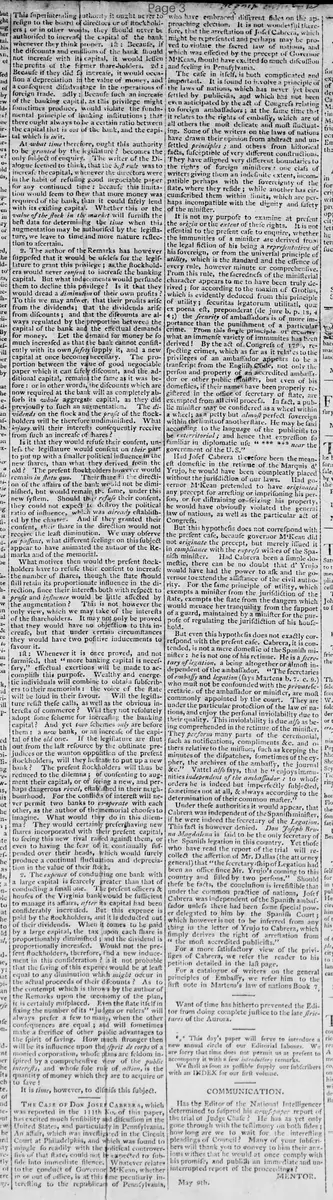
The Case of Don Jose Cabrera, which was reported in the 11th No. of this paper, has excited much sensibility and discussion in the United States, and particularly in Pennsylvania. An affair. which was investigated in the Circuit Court at Philadelphia, and which was found to mingle so readily with the political controversies of that state, could not be expected to subside into immediate silence. Whatever relates to the conduct of Governor M'Kean, whether in or out of office, is at this time peculiarly interesting to the republicans of Pennsylvania, who have embraced different sides on the approaching election. It is not wonderful therefore, that the arrestation of Jose Cabrera, which might be represented and perhaps may be proved to violate the sacred law of nations, and which was effected by the precept of Governor M'Kean, should have excited so much discussion and feeling in Pennsylvania.
The case in itself, is both complicated and important. It is found to involve a principle of the laws of nations, which has never yet been settled by publicists, and which has not been even anticipated by the act of Congress relating to foreign ambassadors; at the same time that it relates to the rights of embassy, which are of all others the most delicate and most fluctuating. Some of the writers on the laws of nations have drawn their opinion from abstract and unsettled principles ; and others from historical facts, susceptible of very different constructions. They have assigned very different boundaries to the rights of foreign ministers : one class of writers giving them an indefinite extent, incompatible perhaps with the sovereignty of the state, where they reside; while another has circumscribed them within limits, which are perhaps incompatible with the dignity and safety of the minister.
It is not my purpose to examine at present the origin or the extent of these rights. It is not essential to the present case to enquire, whether the immunities of a minister are derived from the legal fiction of his being a representative of his sovereign, or from the universal principle of utility, which is the standard and the defence of every rule, however minute or comprehensive. From this rule, the sacredness of the ministerial character appears to me to have been truly derived; for according to the maxim of Grotius, which is evidently deduced from this principle of utility; securitas legatorum utilitati, qux ex poena est, preponderat (de jure b. p. 18, 4 4 ;) the security of ambassadors is of more importance than the punishment of a particular crime. From this single principle or security what an immense variety of immunities has been derived! By the act of Congress of 1790, respecting crimes, which as far as it relates to the privileges of an ambassador appears to be a transcript from the English Code, not only the person and property of an accredited ambassador or other public minister, but even of his domestics, if their names have been properly registered in the office of secretary of state, are exempted from all civil process. In fact, a public minister may be considered as a wheel within a wheel; as a petty but almost perfect sovereign within the limits of another state. He may be said according to the language of the publicists to be exterritorial; and hence that expression so familiar in diplomatic use " *** *** near the government of the U.S."
Had Jose Cabrera therefore been the meanest domestic in the retinue of the Marquis d' Yrujo, he would have been compleatly placed without the jurisdiction of our laws. Had governor M'Kean pretended to have originated any precept for arresting or imprisoning his person, or for distraining or-seizing his property, he would have obviously violated the general law of nations, as well as the particular act of Congress.
But this hypothesis does not correspond with the present case, because governor M'Kean did not originate the precept, but merely issued it in compliance with the express wishes of the Spanish minister. Had Cabrera been a simple domestic, there can be no doubt that d' Yrujo would have had the power to ask and the governor to extend the assistance of the civil authority. For the same principle of utility, which exempts a minister from the jurisdiction of the state, exempts the state from the dangers which would menace her tranquility from the support of a guard, maintained by a minister for the purpose of regulating the jurisdiction of his household.
But even this hypothesis does not exactly correspond with the present case. Cabrera, it is contended, is not a mere domestic of the Spanish minister : he is not one of his retinue. He is a secretary of legation, a being altogether or almost independent of the ambassador. "The secretaries of embassy and legation (says Martens b. T. c. 9.) who must not be confounded with the private secretaries of the ambassador or minister, are most commonly appointed by the court. They are under the particular protection of the law of nations, and enjoy the personal inviolability due to their quality. This inviolability is due also as being comprehended in the retinue of the minister. They perform many parts of the ceremonial, such as notifications, compliments &c. and others relative to the mission, such as keeping the minutes of the dispatches, sometimes of the cypher, the archives of the embassy, the journal &c." Vattel also says, that he "enjoys immunities independent of the ambassador : to whose orders he is indeed but imperfectly subjected, sometimes not at all, & always according to the determination of their common master."
Under these authorities it would appear, that Cabrera was independent of the Spanish minister, if he were indeed the secretary of the Legation. This fact is however denied. Don Joseph Bruna Magdalena is said to be the only secretary of the Spanish legation in this country. Yet those who have read the report of the trial will recollect the assertion of Mr. Dallas (the attorney general) that "the secretaryship of Legation had been an office since Mr. Yrujo's coming to this country and filled by two persons." Should these be facts, the conclusion is irresistible that under the common practice of nations, Jose Cabrera was independent of the Spanish ambassador unless there had been some special power delegated to him by the Spanish Court; which however is not to be inferred from any thing in the letter of Yrujo to Cabrera, which simply derives the right of arrestation from "the most accredited publicists."
For a more satisfactory view of the privileges of Cabrera, we refer the reader to his petition detailed in the last page.
For a catalogue of writers on the general principles of Embassy, we refer him to the first note in Martens's law of nations Book 7
Want of time has hitherto prevented the Editor from doing complete justice to the late strictures of the Aurora.
This day's paper will serve to introduce a new annual circle of our Editorial labours. We are sorry that time does not permit us at present to accompany it with a few introductory remarks. We shall as soon as possible supply our subscribers with an INDEX for our first volume.
The case in itself, is both complicated and important. It is found to involve a principle of the laws of nations, which has never yet been settled by publicists, and which has not been even anticipated by the act of Congress relating to foreign ambassadors; at the same time that it relates to the rights of embassy, which are of all others the most delicate and most fluctuating. Some of the writers on the laws of nations have drawn their opinion from abstract and unsettled principles ; and others from historical facts, susceptible of very different constructions. They have assigned very different boundaries to the rights of foreign ministers : one class of writers giving them an indefinite extent, incompatible perhaps with the sovereignty of the state, where they reside; while another has circumscribed them within limits, which are perhaps incompatible with the dignity and safety of the minister.
It is not my purpose to examine at present the origin or the extent of these rights. It is not essential to the present case to enquire, whether the immunities of a minister are derived from the legal fiction of his being a representative of his sovereign, or from the universal principle of utility, which is the standard and the defence of every rule, however minute or comprehensive. From this rule, the sacredness of the ministerial character appears to me to have been truly derived; for according to the maxim of Grotius, which is evidently deduced from this principle of utility; securitas legatorum utilitati, qux ex poena est, preponderat (de jure b. p. 18, 4 4 ;) the security of ambassadors is of more importance than the punishment of a particular crime. From this single principle or security what an immense variety of immunities has been derived! By the act of Congress of 1790, respecting crimes, which as far as it relates to the privileges of an ambassador appears to be a transcript from the English Code, not only the person and property of an accredited ambassador or other public minister, but even of his domestics, if their names have been properly registered in the office of secretary of state, are exempted from all civil process. In fact, a public minister may be considered as a wheel within a wheel; as a petty but almost perfect sovereign within the limits of another state. He may be said according to the language of the publicists to be exterritorial; and hence that expression so familiar in diplomatic use " *** *** near the government of the U.S."
Had Jose Cabrera therefore been the meanest domestic in the retinue of the Marquis d' Yrujo, he would have been compleatly placed without the jurisdiction of our laws. Had governor M'Kean pretended to have originated any precept for arresting or imprisoning his person, or for distraining or-seizing his property, he would have obviously violated the general law of nations, as well as the particular act of Congress.
But this hypothesis does not correspond with the present case, because governor M'Kean did not originate the precept, but merely issued it in compliance with the express wishes of the Spanish minister. Had Cabrera been a simple domestic, there can be no doubt that d' Yrujo would have had the power to ask and the governor to extend the assistance of the civil authority. For the same principle of utility, which exempts a minister from the jurisdiction of the state, exempts the state from the dangers which would menace her tranquility from the support of a guard, maintained by a minister for the purpose of regulating the jurisdiction of his household.
But even this hypothesis does not exactly correspond with the present case. Cabrera, it is contended, is not a mere domestic of the Spanish minister : he is not one of his retinue. He is a secretary of legation, a being altogether or almost independent of the ambassador. "The secretaries of embassy and legation (says Martens b. T. c. 9.) who must not be confounded with the private secretaries of the ambassador or minister, are most commonly appointed by the court. They are under the particular protection of the law of nations, and enjoy the personal inviolability due to their quality. This inviolability is due also as being comprehended in the retinue of the minister. They perform many parts of the ceremonial, such as notifications, compliments &c. and others relative to the mission, such as keeping the minutes of the dispatches, sometimes of the cypher, the archives of the embassy, the journal &c." Vattel also says, that he "enjoys immunities independent of the ambassador : to whose orders he is indeed but imperfectly subjected, sometimes not at all, & always according to the determination of their common master."
Under these authorities it would appear, that Cabrera was independent of the Spanish minister, if he were indeed the secretary of the Legation. This fact is however denied. Don Joseph Bruna Magdalena is said to be the only secretary of the Spanish legation in this country. Yet those who have read the report of the trial will recollect the assertion of Mr. Dallas (the attorney general) that "the secretaryship of Legation had been an office since Mr. Yrujo's coming to this country and filled by two persons." Should these be facts, the conclusion is irresistible that under the common practice of nations, Jose Cabrera was independent of the Spanish ambassador unless there had been some special power delegated to him by the Spanish Court; which however is not to be inferred from any thing in the letter of Yrujo to Cabrera, which simply derives the right of arrestation from "the most accredited publicists."
For a more satisfactory view of the privileges of Cabrera, we refer the reader to his petition detailed in the last page.
For a catalogue of writers on the general principles of Embassy, we refer him to the first note in Martens's law of nations Book 7
Want of time has hitherto prevented the Editor from doing complete justice to the late strictures of the Aurora.
This day's paper will serve to introduce a new annual circle of our Editorial labours. We are sorry that time does not permit us at present to accompany it with a few introductory remarks. We shall as soon as possible supply our subscribers with an INDEX for our first volume.
What sub-type of article is it?
Historical Event
Crime Story
Mystery
What themes does it cover?
Justice
Crime Punishment
Deception
What keywords are associated?
Diplomatic Immunity
Arrest Of Cabrera
Governor M'kean
Spanish Legation
Laws Of Nations
Phila Circuit Court
What entities or persons were involved?
Don Jose Cabrera
Governor M'kean
Marquis D'yrujo
Don Joseph Bruna Magdalena
Mr. Dallas
Where did it happen?
Pennsylvania, Philadelphia, United States
Story Details
Key Persons
Don Jose Cabrera
Governor M'kean
Marquis D'yrujo
Don Joseph Bruna Magdalena
Mr. Dallas
Location
Pennsylvania, Philadelphia, United States
Story Details
The arrest of Jose Cabrera, claimed as secretary of the Spanish legation, was ordered by Governor M'Kean at the request of Marquis d'Yrujo, prompting debate on diplomatic immunity and violation of laws of nations, investigated in Philadelphia Circuit Court amid Pennsylvania political controversies.