Thank you for visiting SNEWPapers!
Sign up free
Editorial
June 12, 1819
Daily National Intelligencer
Washington, District Of Columbia
What is this article about?
The National Intelligencer defends its stance against an extra session of Congress for increasing import duties to protect manufactures, criticizes the intemperate language of the Aurora editor, and advocates balanced encouragement of agriculture, commerce, and manufactures. Dated June 12, 1819, Washington.
Clipping
OCR Quality
98%
Excellent
Full Text
WASHINGTON.
Saturday, June 12.
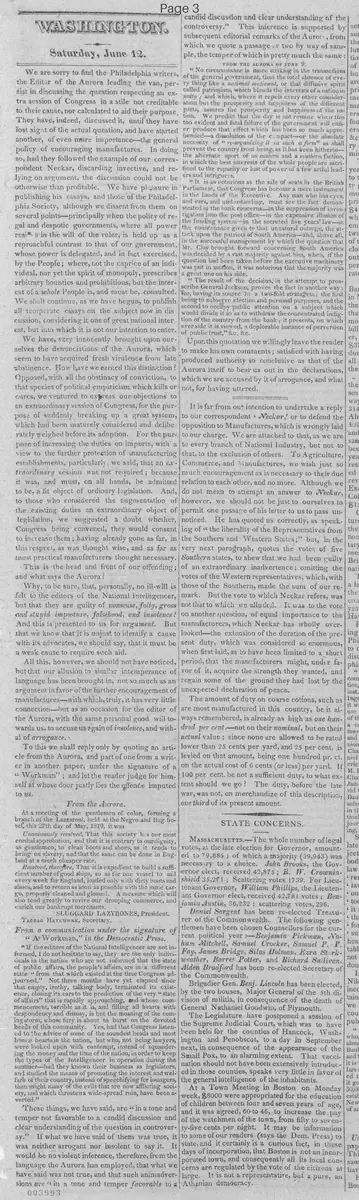
We are sorry to find the Philadelphia writers, the Editor of the Aurora leading the van, persist in discussing the question respecting an extra session of Congress in a style not creditable to their cause, nor calculated to aid their purpose. They have, indeed, discussed it, until they have lost sight of the actual question, and have started another, of even more importance—the general policy of encouraging manufactures. In doing so, had they followed the example of our correspondent Neckar, discarding invective, and relying on argument, the discussion could not be otherwise than profitable. We have pleasure in publishing his essays, and those of the Philadelphia Society, although we dissent from them on several points—principally when the policy of regal and despotic governments, where all power resides in the will of the ruler, is held up as a reproachful contrast to that of our government, whose power is delegated, and in fact exercised, by the People; where, not the caprice of an individual, nor yet the spirit of monopoly, prescribes arbitrary bounties and prohibitions, but the interest of a whole People is, and must be, consulted.
We shall continue, as we have begun, to publish all temperate essays on the subject now in discussion, considering it one of great national interest, but into which it is not our intention to enter.
We have, very innocently brought upon ourselves the denunciations of the Aurora, which seem to have acquired fresh virulence from late abstinence. How have we earned this distinction? Opposed, with all the obstinacy of conviction, to that species of political empiricism which kills or cures, we ventured to express our objections to an extraordinary session of Congress, for the purpose of suddenly breaking up a great system, which had been maturely considered and deliberately weighed before its adoption. For the purpose of increasing the duties on imports, with a view to the further protection of manufacturing establishments, particularly, we said, that an extraordinary session was not required; because it was, and must, on all hands, be admitted to be, a fit object of ordinary legislation. And, to those who considered the augmentation of the existing duties an extraordinary object of legislation, we suggested a doubt whether, Congress being convened, they would consent to increase them; having already gone as far, in this respect, as was thought wise, and as far as most practical manufacturers thought necessary.
This is the head and front of our offending; and what says the Aurora? Why, to be sure, that, personally, no ill-will is felt to the editors of the National Intelligencer, but that they are guilty of nonsense, folly, gross and stupid imposture, falsehood, and insolence! And this is presented to us for argument. But that we know that it is unjust to identify a cause with its advocates, we should say, that it must be a weak cause to require such aid.
All this, however, we should not have noticed, but that our allusion to similar intemperance of language has been brought in, not so much as an argument in favor of the further encouragement of manufactures—with which, truly, it has very little connection—but as an occasion for the editor of the Aurora, with the same personal good will towards us, to accuse us again of insolence, and withal of arrogance.
To this we shall reply only by quoting an article from the Aurora, and part of one from a writer in another paper, under the signature of a "Workman"; and let the reader judge for himself at whose door justly lies the offence imputed to Us.
From the Aurora.
At a meeting of the gentlemen of color, forming a branch of the Lazzaroni, held at the Negro and Bug hotel, this 27th day of May, 1819, it was
Unanimously resolved, That this society has our most cordial approbation, and that it is contrary to our dignity, as gentlemen, to clean boots and shoes, as it tends to bring on slavery, and that the same can be done in England at a much cheaper rate.
Resolved, therefore, That it is expedient to build a sufficient number of good ships, so as for one vessel to sail every week for England, loaded only with dirty boots and shoes, and to return as soon as possible with the same cargo, properly cleaned and glossed. A measure which will also tend greatly to revive our drooping commerce, and enrich our bankrupt merchants.
SLUGGARD LAZYBONES, President.
TAGRAG HATEWORK, Secretary.
From a communication under the signature of "A Workman," in the Democratic Press.
If the editors of the National Intelligencer are not informed, I do not hesitate to say, they are the only individuals in the nation who are not informed that the state of public affairs, the people's affairs, are in a different state from that which existed at the time Congress adjourned. Not three months have yet elapsed since that empty, frothy, talking body, terminated its existence, closing its ears to the prediction of the very "state of affairs" that is rapidly approaching, and whose commencement, terrible as it is, and filling all hearts with despondency and dismay, is but the moaning of the coming storm, whose fury is about to burst on the devoted heads of this community. Yes, had that Congress listened to the advice of some of the soundest heads and most honest hearts in the nation, but who, not being lawyers, were looked upon with contempt, instead of squandering the money and the time of the nation, in order to keep the types of the Intelligencer in operation during the summer—had they known their business as legislators, and studied the means of promoting the interest and welfare of their country, instead of speechifying for loungers, then might many of the evils that are now afflicting society, and which threaten a wide-spread ruin, have been averted.
These things, we have said, are "in a tone and temper not favorable to a candid discussion and clear understanding of the question in controversy." If what we have said of them was true, it was neither arrogant nor insolent to say it. It would be no violent inference, therefore, from the language the Aurora has employed, that what we have said was not true, and that such animadversions are "in a tone and temper favorable to a candid discussion and clear understanding of the controversy."
This inference is supported by subsequent editorial remarks of the Aurora, from which we quote a passage or two by way of sample, the temper of which is pretty much the same:
FROM THE AURORA OF JUNE 9.
"No circumstance is more striking in the transactions of the general government, than the total absence of every thing like a national sentiment, or that diffusive spirit called patriotism, which blends the interests of a nation in unity: and which, where it repels every other consideration but the prosperity and happiness of the different parts, assures the prosperity and happiness of the nation. We predict that the day is not remote when this too evident and fatal failure of the government will either produce that effect which has been so much apprehended—a dissolution of the compact—or the absolute necessity of "re-organizing it in such a form" as shall prevent the country from being, as it has been hitherto—the alternate sport of an eastern and a southern faction, in which the best interests of the whole people are sacrificed to the rapacity or lust of power of a few artful leaders and intriguers.
"It is as notorious as the sale of seats in the British Parliament, that Congress has become a mere instrument in the hands of the Executive. Any man who has eyes, and ears, and understanding, must see the fact demonstrated in the bank concerns—in the suppression of investigation into the post office—in the expensive illusion of the funding system—in the secreted five years' law—in the countenance given to that unnatural outrage, the attack upon the patriots of South America—and, above all, in the successful management by which the question that Mr. Clay brought forward concerning South America was decided by a vast majority against him, when, if the question had been taken before the executive machinery was put in motion, it was notorious that the majority was a great one on his side.
"The result of the decision, in the attempt to proscribe General Jackson, proves the fact in another way; for, having its source in a two-fold stratagem; the first being to subserve election and personal purposes, and the second to occupy public attention on a subject which would divide it so as to withdraw the concentrated indignation of the country from the bank; it presents, on whichever side it is viewed, a deplorable instance of perversion of public trust," &c. &c.
Upon this quotation we willingly leave the reader to make his own comments; satisfied with having produced authority so conclusive as that of the Aurora itself to bear us out in the declarations, which we are accused by it of arrogance, and what not, for having uttered.
It is far from our intention to undertake a reply to our correspondent 'Neckar,' or to defend the opposition to Manufactures, which is wrongly laid to our charge. We are attached to that, as we are to every branch of National Industry, but not to that, to the exclusion of others. To Agriculture, Commerce, and Manufactures, we wish just so much encouragement as is necessary to their due relation to each other, and no more. Although we do not mean to attempt an answer to Neckar, however, we should not be just to ourselves to permit one passage of his letter to us to pass unnoticed. He has quoted us correctly, as speaking of "the liberality of the Representatives from the Southern and Western States;" but, in the very next paragraph, quotes the votes of five Southern states, to shew that we had been guilty of an extraordinary inadvertence; omitting the votes of the Western representatives, which, with those of the Southern, made the sum of our remark. But the vote to which Neckar refers, was not that to which we alluded. It was to the vote on another question, of equal importance to the manufacturers, which Neckar has wholly overlooked—the extension of the duration of the present duty, which was considered so enormous, when first laid, as to have been limited to a short period, that the manufacturers might, under favor of it, acquire the strength they wanted, and regain some of the ground they had lost by the unexpected declaration of peace.
The amount of duty on coarse cottons, such as are most manufactured in this country, be it always remembered, is already as high as one hundred per cent.—not on their nominal, but on their actual value; since none are allowed to be rated lower than 25 cents per yard, and 25 per cent. is levied on that amount, being one hundred pr. ct. on the actual cost of 6 cents (or less) per yard. If 100 per cent. be not a sufficient duty, to what extent should we go? The duty, before the late war, was not, on merchandize of this description, one third of its present amount.
Saturday, June 12.
We are sorry to find the Philadelphia writers, the Editor of the Aurora leading the van, persist in discussing the question respecting an extra session of Congress in a style not creditable to their cause, nor calculated to aid their purpose. They have, indeed, discussed it, until they have lost sight of the actual question, and have started another, of even more importance—the general policy of encouraging manufactures. In doing so, had they followed the example of our correspondent Neckar, discarding invective, and relying on argument, the discussion could not be otherwise than profitable. We have pleasure in publishing his essays, and those of the Philadelphia Society, although we dissent from them on several points—principally when the policy of regal and despotic governments, where all power resides in the will of the ruler, is held up as a reproachful contrast to that of our government, whose power is delegated, and in fact exercised, by the People; where, not the caprice of an individual, nor yet the spirit of monopoly, prescribes arbitrary bounties and prohibitions, but the interest of a whole People is, and must be, consulted.
We shall continue, as we have begun, to publish all temperate essays on the subject now in discussion, considering it one of great national interest, but into which it is not our intention to enter.
We have, very innocently brought upon ourselves the denunciations of the Aurora, which seem to have acquired fresh virulence from late abstinence. How have we earned this distinction? Opposed, with all the obstinacy of conviction, to that species of political empiricism which kills or cures, we ventured to express our objections to an extraordinary session of Congress, for the purpose of suddenly breaking up a great system, which had been maturely considered and deliberately weighed before its adoption. For the purpose of increasing the duties on imports, with a view to the further protection of manufacturing establishments, particularly, we said, that an extraordinary session was not required; because it was, and must, on all hands, be admitted to be, a fit object of ordinary legislation. And, to those who considered the augmentation of the existing duties an extraordinary object of legislation, we suggested a doubt whether, Congress being convened, they would consent to increase them; having already gone as far, in this respect, as was thought wise, and as far as most practical manufacturers thought necessary.
This is the head and front of our offending; and what says the Aurora? Why, to be sure, that, personally, no ill-will is felt to the editors of the National Intelligencer, but that they are guilty of nonsense, folly, gross and stupid imposture, falsehood, and insolence! And this is presented to us for argument. But that we know that it is unjust to identify a cause with its advocates, we should say, that it must be a weak cause to require such aid.
All this, however, we should not have noticed, but that our allusion to similar intemperance of language has been brought in, not so much as an argument in favor of the further encouragement of manufactures—with which, truly, it has very little connection—but as an occasion for the editor of the Aurora, with the same personal good will towards us, to accuse us again of insolence, and withal of arrogance.
To this we shall reply only by quoting an article from the Aurora, and part of one from a writer in another paper, under the signature of a "Workman"; and let the reader judge for himself at whose door justly lies the offence imputed to Us.
From the Aurora.
At a meeting of the gentlemen of color, forming a branch of the Lazzaroni, held at the Negro and Bug hotel, this 27th day of May, 1819, it was
Unanimously resolved, That this society has our most cordial approbation, and that it is contrary to our dignity, as gentlemen, to clean boots and shoes, as it tends to bring on slavery, and that the same can be done in England at a much cheaper rate.
Resolved, therefore, That it is expedient to build a sufficient number of good ships, so as for one vessel to sail every week for England, loaded only with dirty boots and shoes, and to return as soon as possible with the same cargo, properly cleaned and glossed. A measure which will also tend greatly to revive our drooping commerce, and enrich our bankrupt merchants.
SLUGGARD LAZYBONES, President.
TAGRAG HATEWORK, Secretary.
From a communication under the signature of "A Workman," in the Democratic Press.
If the editors of the National Intelligencer are not informed, I do not hesitate to say, they are the only individuals in the nation who are not informed that the state of public affairs, the people's affairs, are in a different state from that which existed at the time Congress adjourned. Not three months have yet elapsed since that empty, frothy, talking body, terminated its existence, closing its ears to the prediction of the very "state of affairs" that is rapidly approaching, and whose commencement, terrible as it is, and filling all hearts with despondency and dismay, is but the moaning of the coming storm, whose fury is about to burst on the devoted heads of this community. Yes, had that Congress listened to the advice of some of the soundest heads and most honest hearts in the nation, but who, not being lawyers, were looked upon with contempt, instead of squandering the money and the time of the nation, in order to keep the types of the Intelligencer in operation during the summer—had they known their business as legislators, and studied the means of promoting the interest and welfare of their country, instead of speechifying for loungers, then might many of the evils that are now afflicting society, and which threaten a wide-spread ruin, have been averted.
These things, we have said, are "in a tone and temper not favorable to a candid discussion and clear understanding of the question in controversy." If what we have said of them was true, it was neither arrogant nor insolent to say it. It would be no violent inference, therefore, from the language the Aurora has employed, that what we have said was not true, and that such animadversions are "in a tone and temper favorable to a candid discussion and clear understanding of the controversy."
This inference is supported by subsequent editorial remarks of the Aurora, from which we quote a passage or two by way of sample, the temper of which is pretty much the same:
FROM THE AURORA OF JUNE 9.
"No circumstance is more striking in the transactions of the general government, than the total absence of every thing like a national sentiment, or that diffusive spirit called patriotism, which blends the interests of a nation in unity: and which, where it repels every other consideration but the prosperity and happiness of the different parts, assures the prosperity and happiness of the nation. We predict that the day is not remote when this too evident and fatal failure of the government will either produce that effect which has been so much apprehended—a dissolution of the compact—or the absolute necessity of "re-organizing it in such a form" as shall prevent the country from being, as it has been hitherto—the alternate sport of an eastern and a southern faction, in which the best interests of the whole people are sacrificed to the rapacity or lust of power of a few artful leaders and intriguers.
"It is as notorious as the sale of seats in the British Parliament, that Congress has become a mere instrument in the hands of the Executive. Any man who has eyes, and ears, and understanding, must see the fact demonstrated in the bank concerns—in the suppression of investigation into the post office—in the expensive illusion of the funding system—in the secreted five years' law—in the countenance given to that unnatural outrage, the attack upon the patriots of South America—and, above all, in the successful management by which the question that Mr. Clay brought forward concerning South America was decided by a vast majority against him, when, if the question had been taken before the executive machinery was put in motion, it was notorious that the majority was a great one on his side.
"The result of the decision, in the attempt to proscribe General Jackson, proves the fact in another way; for, having its source in a two-fold stratagem; the first being to subserve election and personal purposes, and the second to occupy public attention on a subject which would divide it so as to withdraw the concentrated indignation of the country from the bank; it presents, on whichever side it is viewed, a deplorable instance of perversion of public trust," &c. &c.
Upon this quotation we willingly leave the reader to make his own comments; satisfied with having produced authority so conclusive as that of the Aurora itself to bear us out in the declarations, which we are accused by it of arrogance, and what not, for having uttered.
It is far from our intention to undertake a reply to our correspondent 'Neckar,' or to defend the opposition to Manufactures, which is wrongly laid to our charge. We are attached to that, as we are to every branch of National Industry, but not to that, to the exclusion of others. To Agriculture, Commerce, and Manufactures, we wish just so much encouragement as is necessary to their due relation to each other, and no more. Although we do not mean to attempt an answer to Neckar, however, we should not be just to ourselves to permit one passage of his letter to us to pass unnoticed. He has quoted us correctly, as speaking of "the liberality of the Representatives from the Southern and Western States;" but, in the very next paragraph, quotes the votes of five Southern states, to shew that we had been guilty of an extraordinary inadvertence; omitting the votes of the Western representatives, which, with those of the Southern, made the sum of our remark. But the vote to which Neckar refers, was not that to which we alluded. It was to the vote on another question, of equal importance to the manufacturers, which Neckar has wholly overlooked—the extension of the duration of the present duty, which was considered so enormous, when first laid, as to have been limited to a short period, that the manufacturers might, under favor of it, acquire the strength they wanted, and regain some of the ground they had lost by the unexpected declaration of peace.
The amount of duty on coarse cottons, such as are most manufactured in this country, be it always remembered, is already as high as one hundred per cent.—not on their nominal, but on their actual value; since none are allowed to be rated lower than 25 cents per yard, and 25 per cent. is levied on that amount, being one hundred pr. ct. on the actual cost of 6 cents (or less) per yard. If 100 per cent. be not a sufficient duty, to what extent should we go? The duty, before the late war, was not, on merchandize of this description, one third of its present amount.
What sub-type of article is it?
Economic Policy
Partisan Politics
What keywords are associated?
Extra Session Congress
Import Duties
Protecting Manufactures
Aurora Editor
National Industry
Political Empiricism
Balanced Economy
What entities or persons were involved?
Editor Of The Aurora
Neckar
Philadelphia Society
Congress
National Intelligencer
A Workman
Editorial Details
Primary Topic
Opposition To Extra Session Of Congress For Protecting Manufactures Via Higher Import Duties
Stance / Tone
Defensive And Balanced Support For National Industries
Key Figures
Editor Of The Aurora
Neckar
Philadelphia Society
Congress
National Intelligencer
A Workman
Key Arguments
Extra Session Unnecessary For Increasing Import Duties, As It Is Ordinary Legislation.
Current Duties Already High (100% On Coarse Cottons).
Balanced Encouragement Needed For Agriculture, Commerce, And Manufactures.
Aurora's Intemperate Language Undermines Their Cause.
Congress Unlikely To Further Increase Duties.
Criticism Of Aurora's Accusations Of Nonsense And Insolence.