Thank you for visiting SNEWPapers!
Sign up free
Editorial
September 12, 1789
Gazette Of The United States
New York, New York County, New York
What is this article about?
An essay critiquing excessive admiration for ancient virtues, eloquence, and philosophy over modern equivalents, attributing it to familiarity, education biases, and cultural customs. Advocates using contemporary speeches and writings in schools to inspire national pride and appreciation.
Clipping
OCR Quality
98%
Excellent
Full Text
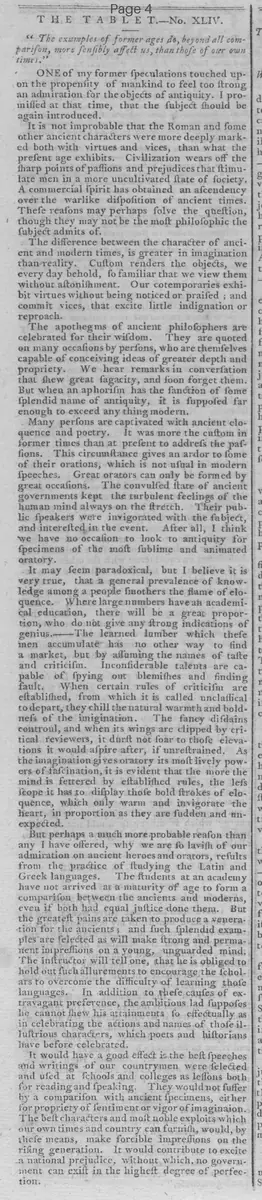
THE TABLET.-No. XLIV.
"The examples of former ages do, beyond all comparison, more sensibly affect us, than those of our own times."
ONE of my former speculations touched upon the propensity of mankind to feel too strong an admiration for the objects of antiquity. I promised at that time, that the subject should be again introduced.
It is not improbable that the Roman and some other ancient characters were more deeply marked both with virtues and vices, than what the present age exhibits. Civilization wears off the sharp points of passions and prejudices that stimulate men in a more uncultivated state of society. A commercial spirit has obtained an ascendency over the warlike disposition of ancient times. These reasons may perhaps solve the question, though they may not be the most philosophic the subject admits of.
The difference between the character of ancient and modern times, is greater in imagination than reality. Custom renders the objects, we every day behold, so familiar that we view them without astonishment. Our contemporaries exhibit virtues without being noticed or praised; and commit vices, that excite little indignation or reproach.
The apothegms of ancient philosophers are celebrated for their wisdom. They are quoted on many occasions by persons, who are themselves capable of conceiving ideas of greater depth and propriety. We hear remarks in conversation that show great sagacity, and soon forget them. But when an aphorism has the sanction of some splendid name of antiquity, it is supposed far enough to exceed any thing modern.
Many persons are captivated with ancient eloquence and poetry. It was more the custom in former times than at present to address the passions. This circumstance gives an ardor to some of their orations, which is not usual in modern speeches. Great orators can only be formed by great occasions. The convulsed state of ancient governments kept the turbulent feelings of the human mind always on the stretch. Their public speakers were invigorated with the subject, and interested in the event. After all, I think we have no occasion to look to antiquity for specimens of the most sublime and animated oratory.
It may seem paradoxical, but I believe it is very true, that a general prevalence of knowledge among a people smothers the flame of eloquence. Where large numbers have an academical education, there will be a great proportion, who do not give any strong indications of genius. The learned lumber which these men accumulate has no other way to find a market, but by assuming the names of taste and criticism. Inconsiderable talents are capable of spying out blemishes and finding fault. When certain rules of criticism are established, from which it is called unclassical to depart, they chill the natural warmth and boldness of the imagination. The fancy disdains control, and when its wings are clipped by critical reviewers, it durst not soar to those elevations it would aspire after, if unrestrained. As the imagination gives oratory its most lively powers of fascination, it is evident that the more the mind is fettered by established rules, the less scope it has to display those bold strokes of eloquence, which only warm and invigorate the heart, in proportion as they are sudden and unexpected.
But perhaps a much more probable reason than any I have offered, why we are so lavish of our admiration on ancient heroes and orators, results from the practice of studying the Latin and Greek languages. The students at an academy have not arrived at a maturity of age to form a comparison between the ancients and moderns, even if both had equal justice done them. But the greatest pains are taken to produce a veneration for the ancients; and such splendid examples are selected as will make strong and permanent impressions on a young, unguarded mind. The instructor will tell one, that he is obliged to hold out such allurements to encourage the scholars to overcome the difficulty of learning those languages. In addition to these causes of extravagant preference, the ambitious lad supposes he cannot show his attainments so effectually as in celebrating the actions and names of those illustrious characters, which poets and historians have before celebrated.
It would have a good effect if the best speeches and writings of our countrymen were selected and used at schools and colleges as lessons both for reading and speaking. They would not suffer by a comparison with ancient specimens, either for propriety of sentiment or vigor of imagination. The best characters and most noble exploits which our own times and country can furnish, would, by these means, make forcible impressions on the rising generation. It would contribute to excite a national prejudice, without which, no government can exist in the highest degree of perfection.
"The examples of former ages do, beyond all comparison, more sensibly affect us, than those of our own times."
ONE of my former speculations touched upon the propensity of mankind to feel too strong an admiration for the objects of antiquity. I promised at that time, that the subject should be again introduced.
It is not improbable that the Roman and some other ancient characters were more deeply marked both with virtues and vices, than what the present age exhibits. Civilization wears off the sharp points of passions and prejudices that stimulate men in a more uncultivated state of society. A commercial spirit has obtained an ascendency over the warlike disposition of ancient times. These reasons may perhaps solve the question, though they may not be the most philosophic the subject admits of.
The difference between the character of ancient and modern times, is greater in imagination than reality. Custom renders the objects, we every day behold, so familiar that we view them without astonishment. Our contemporaries exhibit virtues without being noticed or praised; and commit vices, that excite little indignation or reproach.
The apothegms of ancient philosophers are celebrated for their wisdom. They are quoted on many occasions by persons, who are themselves capable of conceiving ideas of greater depth and propriety. We hear remarks in conversation that show great sagacity, and soon forget them. But when an aphorism has the sanction of some splendid name of antiquity, it is supposed far enough to exceed any thing modern.
Many persons are captivated with ancient eloquence and poetry. It was more the custom in former times than at present to address the passions. This circumstance gives an ardor to some of their orations, which is not usual in modern speeches. Great orators can only be formed by great occasions. The convulsed state of ancient governments kept the turbulent feelings of the human mind always on the stretch. Their public speakers were invigorated with the subject, and interested in the event. After all, I think we have no occasion to look to antiquity for specimens of the most sublime and animated oratory.
It may seem paradoxical, but I believe it is very true, that a general prevalence of knowledge among a people smothers the flame of eloquence. Where large numbers have an academical education, there will be a great proportion, who do not give any strong indications of genius. The learned lumber which these men accumulate has no other way to find a market, but by assuming the names of taste and criticism. Inconsiderable talents are capable of spying out blemishes and finding fault. When certain rules of criticism are established, from which it is called unclassical to depart, they chill the natural warmth and boldness of the imagination. The fancy disdains control, and when its wings are clipped by critical reviewers, it durst not soar to those elevations it would aspire after, if unrestrained. As the imagination gives oratory its most lively powers of fascination, it is evident that the more the mind is fettered by established rules, the less scope it has to display those bold strokes of eloquence, which only warm and invigorate the heart, in proportion as they are sudden and unexpected.
But perhaps a much more probable reason than any I have offered, why we are so lavish of our admiration on ancient heroes and orators, results from the practice of studying the Latin and Greek languages. The students at an academy have not arrived at a maturity of age to form a comparison between the ancients and moderns, even if both had equal justice done them. But the greatest pains are taken to produce a veneration for the ancients; and such splendid examples are selected as will make strong and permanent impressions on a young, unguarded mind. The instructor will tell one, that he is obliged to hold out such allurements to encourage the scholars to overcome the difficulty of learning those languages. In addition to these causes of extravagant preference, the ambitious lad supposes he cannot show his attainments so effectually as in celebrating the actions and names of those illustrious characters, which poets and historians have before celebrated.
It would have a good effect if the best speeches and writings of our countrymen were selected and used at schools and colleges as lessons both for reading and speaking. They would not suffer by a comparison with ancient specimens, either for propriety of sentiment or vigor of imagination. The best characters and most noble exploits which our own times and country can furnish, would, by these means, make forcible impressions on the rising generation. It would contribute to excite a national prejudice, without which, no government can exist in the highest degree of perfection.
What sub-type of article is it?
Moral Or Religious
Education
What keywords are associated?
Antiquity Admiration
Ancient Vs Modern
Virtues Vices
Eloquence
Education Bias
National Prejudice
What entities or persons were involved?
Ancient Philosophers
Roman Characters
Ancient Orators
Editorial Details
Primary Topic
Excessive Admiration For Antiquity Over Modern Achievements
Stance / Tone
Critical Of Veneration For Ancients, Advocating Appreciation Of Contemporaries
Key Figures
Ancient Philosophers
Roman Characters
Ancient Orators
Key Arguments
Ancient Characters May Have Been More Marked By Virtues And Vices Due To Less Civilization.
Difference Between Ancient And Modern Is More Imagined Than Real, Due To Familiarity.
Modern Ideas Are Forgotten While Ancient Aphorisms Are Celebrated.
Ancient Eloquence Addressed Passions More, But Modern Oratory Can Be Equally Sublime.
Widespread Knowledge And Criticism Rules Stifle Eloquence And Imagination.
Study Of Latin And Greek In Youth Creates Bias Towards Ancients.
Use Modern Speeches And Writings In Education To Foster National Pride.