Thank you for visiting SNEWPapers!
Sign up free
The Daily Union
Washington, District Of Columbia
What is this article about?
Grand banquet at Philadelphia's Chinese Museum honoring Captain R. B. Matthews and officers of the steamer 'City of Glasgow' upon its arrival from Liverpool, featuring speeches by Governor Johnston, James Buchanan, and others promoting Pennsylvania's commercial interests, state unity, and a new steamship line.
Merged-components note: These components continue the narrative report of the great dinner in Philadelphia, with text flowing sequentially across pages.
Clippings
1 of 2
OCR Quality
Full Text
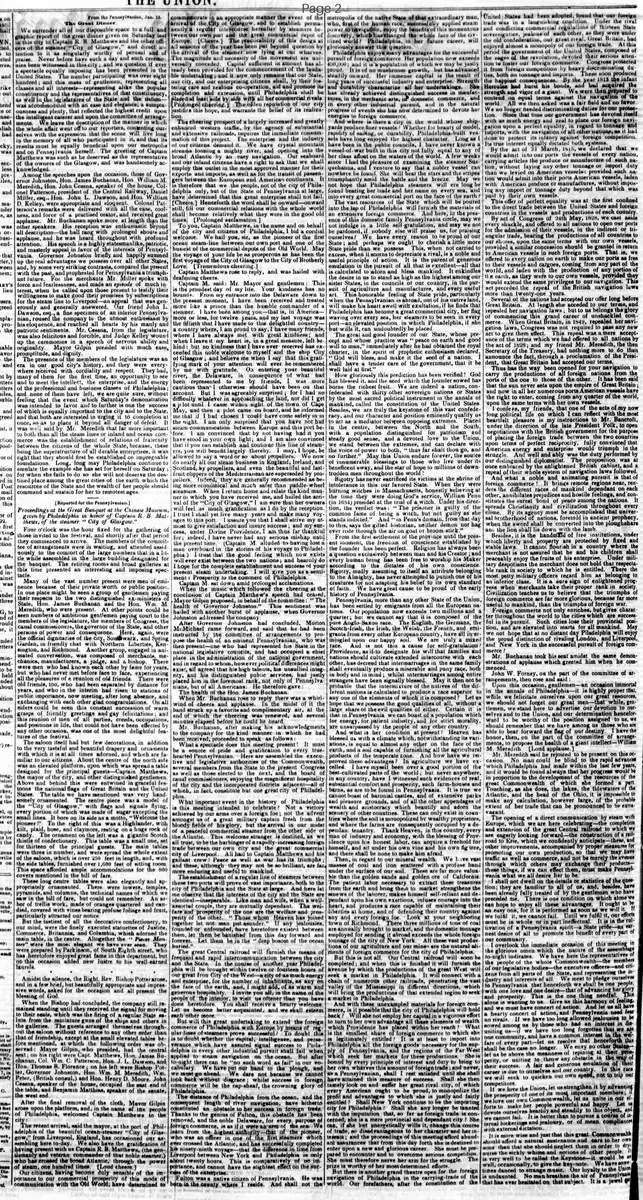
The Great Dinner.
We surrender all of our disposable space to a full and graphic report of the great dinner given on Saturday last in this city to Captain R. B. Matthews and the other officers of the steamer "City of Glasgow," and direct attention to it as singularly worthy of perusal and of praise. Never before have such a day and such ceremonies been witnessed in this city; and we question if ever a spectacle equally imposing has been presented in the United States. The number participating was over eight hundred; and this mass of gentlemen, representing all classes and all interests—representing alike the popular constituency and the representatives of that constituency, as well in the legislatures of the State and the nation was accommodated with an ease and elegance, a sumptuousness and plenty, that reflected the highest credit upon the intelligent caterer and upon the committee of arrangements. We leave the description of the manner in which the whole affair went off to our reporters, contenting ourselves with the expression that the scene will live long in the memory of all who participated in it, and that its results must be equally beneficial upon our metropolis and on Pennsylvania herself. The greeting of Captain Matthews was such as he deserved as the representative of the owners of the Glasgow, and was handsomely acknowledged.
Among the speeches upon the occasion, those of Governor Johnston, Hon. James Buchanan, Hon. William M. Meredith, Hon. John Cessna, speaker of the house, Colonel Patterson, president of the Central Railway, Daniel Miller, esq., Hon. John L. Dawson, and Hon. William D. Kelley, were appropriate and eloquent. Colonel Patterson's remarks were delivered with all the ease, coolness, and force of a practised orator, and received great applause. Mr. Buchanan spoke more at length than the other speakers. His reception was enthusiastic beyond all description—the hall rang with prolonged shouts and applause, and he was heard throughout with profound attention. His speech is a highly statesmanlike, patriotic, and masterly appeal in favor of the interests of Pennsylvania. Governor Johnston briefly and happily summed up the real advantages we possess over all other States, and, by some very striking contrasts, compared the present with the past, and prophesied for Pennsylvania a triumphant future. For the merchants Mr. Miller spoke with force and fearlessness, and made an episode of much interest, when he called upon those present to testify their willingness to make good their promises by subscriptions for the steam line to Liverpool—an appeal that was generously and generally answered. Our friend John L. Dawson, esq., a fine specimen of an interior Pennsylvanian, roused the company to the utmost enthusiasm by his eloquence, and reached all hearts by his manly and patriotic sentiments. Mr. Cessna, from the legislature, was also felicitous and forcible, and Judge Kelley wound up the ceremonies in a speech of nervous ability and originality.
Mayor Gilpin presided with much ease, promptitude, and dignity.
The presence of the members of the legislature was an era in our good city's history, and they were everywhere received with cordiality and respect. They had, many of them for the first time, an opportunity to see and to meet the intellect, the enterprise, and the energy of the professional and business classes of Philadelphia; and none of them have left, we are quite sure, without feeling that the event which Saturday's demonstration was intended to favor and to further is one the success of which is equally important to the city and to the State, and that both are interested in urging it to completion at once, so as to place it beyond all danger of defeat. It was well said by Mr. Meredith that far more important to both than all the steam lines or inland and ocean commerce was the establishment of relations of fraternity between the citizens of the whole State, because, these being the superstructure of all durable enterprises, it was right that they should first be established on impregnable foundations. Long, long may Philadelphia continue to emulate the example she has set for herself on Saturday: for when she fails to do so she will not deserve the destined place among the great cities of the earth which the resources of the State and the wealth of her people should command and sustain for her to remotest ages.
[Reported for the Pennsylvanian.]
Proceedings at the Great Banquet at the Chinese Museum given by Philadelphia in honor of Captain R. B. Matthews, of the steamer "City of Glasgow."
Four o'clock was the hour fixed for the gathering of those invited to the festival, and shortly after that period they commenced to arrive. The members of the committee of arrangements were in waiting, and attended assiduously to the comfort of the large numbers that in a little while assembled in the large building designated for the banquet. The retiring rooms and broad galleries at this time presented an interesting and imposing spectacle.
Many of the vast number present were men of eminence because of their private worth or public position. In one place might be seen a group of gentlemen paying their respects to the two distinguished ex-ministers of State, Hon. James Buchanan and the Hon. Wm. M. Meredith, who were present. At other points could be seen numbers of ambitious gentlemen paying court to the members of the legislature, the members of Congress, the canal commissioners, the governor of the State, and other persons of power and consequence. Here, again, were the official dignitaries of the City, Southwark, and Spring Garden, in friendly chat with Northern Liberties, Kensington, and Richmond. Another group, engaged in animated conversation, was composed of merchants, mechanics, manufacturers, a judge, and a bishop. There were men who had known each other by fame for years, but who had never met before face to face, experiencing all the pleasures of a reunion of old friends. There were old friends, too, who had been separated by distance for years, and who in the interim had risen to stations of public importance, now meeting, after long absence, and exchanging with each other glad congratulations. On all sides could be seen this constant succession of warm grasps of friendly greetings and gay felicitations; and this reunion of men of all parties, creeds, occupations, and positions in life, that could not have been effected by any other occasion, was one of the most delightful features of the festival.
The saloon itself had but few decorations, in addition to the very tasteful and beautiful drapery and ornaments with which it is at all times adorned, and which are familiar to our citizens. About the centre of the north side was an elevated platform, upon which was spread a table designed for the principal guests—Captain Matthews, the mayor of the city, and other distinguished gentlemen. Above and behind this were entwined in graceful festoons the national flags of Great Britain and the United States. The table we have mentioned was very handsomely ornamented. The centre piece was a model of the "City of Glasgow," with flags and signals flying every portion of which was made of sugar excepting the small lines. It bore on its side as a motto, "Welcome the pioneer!" To the right of this was a Highlander, with kilt, plaid, hose, and claymore, resting on a huge rock of candy.
The ornament on the left was a gigantic Scotch thistle of confectionery. This table was a small one, set for thirteen of the principal guests. The main tables were three in number, and were spread the whole extent of the saloon, which is over 250 feet in length, and, with the side tables, furnished over 1,600 feet of sitting room.
This space afforded ample accommodations for the 800 covers mentioned in the bill of fare.
These long centre tables were also elegantly and appropriately ornamented. There were towers, temples, pyramids, and columns, the technical names of which we saw in the bill of fare, but could not remember. An arbor of trellis work, made of oranges quartered and candied, covered with vines bearing profuse foliage and fruit, particularly attracted our notice.
But the tastiest of all the decorative confectionery, to our mind, were the finely executed statuettes of Justice, Commerce, Britannia, and Columbia, which adorned the main table, in the centre. Altogether the "Pieces Montees" were the most elegant we have ever seen. They were prepared by Parkinson, of South Eighth street, who has heretofore enjoyed great fame in this department, but on this occasion added new lustre to his well-earned laurels.
Amidst the silence, the Right. Rev. Bishop Potter arose, and in a few brief, but beautifully appropriate and impressive words, asked for the occasion and all present the blessing of God.
When the Bishop had concluded, the company still remained standing until they received the signal for moving to their seats, which was the firing of a regular State salute from the miniature guns of the ships and others in the galleries. The guests arranged themselves throughout the saloon without reference to any other order than that of friendship, except at the small elevated tables before mentioned, at which the following order was observed: Mayor Gilpin, who presided, had the central seat; on his right were Capt. Matthews, Hon. James Buchanan, Col. Wm. C. Patterson, Hon. J. L. Dawson, and Hon. Thomas B. Florence; on his left were Bishop Potter, Governor Johnston, Hon. Wm. M. Meredith, Wm. Peter, (British consul,) and Hon. Henry D. Moore. John Cessna, speaker of the house, occupied the east end of the table, and Benjamin Matthias, speaker of the senate, the west end.
After the final removal of the cloth, Mayor Gilpin arose upon the platform, and, in the name of the people of Philadelphia, welcomed Captain Matthews to the city:
The recent arrival, said the mayor, at the port of Philadelphia of the beautiful ocean-steamer "City of Glasgow," from Liverpool, England, has occasioned our assembling here to-day. We also have the gratification of having present with us Captain R. B. Matthews, (the gentlemanly and veteran commander of that noble steamer.) who has crossed the broad Atlantic, through the power of steam, one hundred times. [Loud cheers.]
Our citizens, having become duly sensible of the importance to our commercial prosperity of this mode of communication with the Old World, have determined to commemorate in an appropriate manner the event of the arrival of the City of Glasgow, and to establish permanently a regular intercourse hereafter by steamers between our own port and the great commercial depot of Europe. [Cheers.] The practicability of this design at all seasons of the year has been put beyond question by the arrival of the steamer now lying at our wharves.
The magnitude and necessity of the movement are universally conceded. Capital sufficient in amount has already been provided for the commencement of the laudable undertaking; and it now only remains that our State, our city, and our enterprising citizens shall, by their fostering care and zealous co-operation, aid and promote its completion and extension, until Philadelphia shall be placed at least side by side with all her commercial rivals. [Prolonged cheering.] The olden reputation of our city justifies this hope, and warrants the belief of its realization.
The cheering prospect of a largely increased and greatly enhanced western traffic, by the agency of substantial and extensive railroads, requires the immediate consummation of this project. The enterprise and the industry of our citizens demand it. We have crystal mountain streams forming a mighty river, and opening into the broad Atlantic by an easy navigation. Our seaboard and our inland citizens have a right to ask that we shall employ this outlet in the most approved manner for their exports and imports, as well as for the transit of passengers between the European and American continents. It is therefore that we the people, not of the city of Philadelphia only, but of the State of Pennsylvania at large, have determined that this great enterprise shall not fail. [Cheers.] Henceforth the word shall be onward—onward still, till our commercial relations with the whole world shall become relatively what they were in the good old times. [Prolonged acclamation.]
To you, Captain Matthews, in the name and on behalf of the city and citizens of Philadelphia, I bid a cordial welcome. We hail you, sir, as the pioneer of the first ocean steam-line between our own port and one of the busiest of the commercial depots of the Old World. May the voyage of your life be as prosperous as has been the first voyage of the City of Glasgow to the City of Brotherly Love. [Tremendous cheering.]
Captain Matthews rose to reply, and was hailed with deafening cheers.
Captain M. said: Mr. Mayor and gentlemen: This is the proudest day of my life. Your kindness has no bounds. From my entrance into the Delaware down to the present moment, I have been received and treated more like a prince than the humble commander of a steamer. I have been among you—that is, in America—more or less, for twelve years, and my last voyage was the fiftieth that I have made to this delightful country—a country where, I am proud to say, I have many friends where I have always met with great kindness; and when I leave it my heart is, in a great measure, left behind: but no kindness that I have ever received has exceeded this noble welcome to myself and the ship City of Glasgow; and believe me when I say that this gratifying mark of your attention will ever be remembered by me with gratitude.
On entering your beautiful river, the Delaware, in consequence of what had been represented to me by friends, I was more cautious than I otherwise should have been on that account. But I was agreeably surprised; for I had no difficulty whatever in approaching the land, nor did I get a pilot until I came within sight of the town of Cape May, and then a pilot came on board, and he informed me that if I had chosen I could have come safely in in the night. I am only surprised that you have not had steam communication between Europe and this port before. I am convinced that by not having had it you have stood in your own light; and I am also convinced that if you can establish and continue this line of steamers, you will benefit largely thereby. I may, I hope, be allowed to say a word or so about propellers. We now do nearly all our steam business in England, Ireland, and Scotland, by propellers, and even the beautiful and fast fruit clippers of the Mediterranean are superseded by propellers. Indeed, they are generally recommended as being more economical and much safer than paddle-wheel steamers. When I return home and relate the kind manner in which you have received me, and hailed the arrival of the "City of Glasgow," I am sure that her owners will feel as much gratification as I do by the reception. I trust I shall yet live many years and make many voyages to this port. I assure you that I shall strive my utmost to give satisfaction and insure success; and my success, under Divine Providence, I am thus far thankful for; indeed, I have never had any serious mishap until the present time. [Captain M. alluded to having lost a man overboard in the storm of his voyage to Philadelphia.] I trust that the good feeling which now exists will ever exist between the two nations; and heartily do I hope for the complete establishment and success of your present steam undertaking. I will give you as a sentiment: Prosperity to the commerce of Philadelphia
Captain M. sat down amid prolonged acclamations.
When the music which followed the cheering at the conclusion of Captain Matthews's speech had ceased,
Mayor Gilpin proposed, in behalf of the committee: "The health of Governor Johnston." This sentiment was hailed with another burst of applause, when Governor Johnston addressed the company.
After Governor Johnston had concluded, Morton McMichael came forward, and said that he had been instructed by the committee of arrangements to propose the health of an eminent Pennsylvanian, who was then present—one who had represented his State in the national legislative councils, and had occupied a chief place in the administration of the national government, and in regard to whom, however political differences might exist, all agreed that his high talents, his unsullied integrity, and his distinguished public services, had justly placed him in the foremost rank, not only of Pennsylvanians, but of all Americans. He therefore gave:
The health of the Hon. James Buchanan.
When Mr. Buchanan rose to reply there was a whirlwind of cheers and applause. In the midst of it the band struck up a favorite and complimentary air, at the end of which the cheering was renewed, and several minutes elapsed before he could be heard.
Mr. Buchanan, after making his acknowledgments to the company for the kind manner in which he had been received, proceeded to speak as follows:
What a spectacle does this meeting present! It must be a source of pride and gratification to every true-hearted Pennsylvanian. Here are assembled the executive and legislative authorities of the Commonwealth, several members from the State to the present Congress as well as those elected to the next, and the board of canal commissioners, enjoying the magnificent hospitality of the city and the incorporated districts adjacent—all of which, in fact, constitute but one great city of Philadelphia.
What important event in the history of Philadelphia is this meeting intended to celebrate? Not a victory achieved by our arms over a foreign foe; not the advent amongst us of a great military captain fresh from the bloody fields of his glory, but the arrival in our midst of a peaceful commercial steamer from the other side of the Atlantic.
This welcome stranger is destined, as we all trust, to be the harbinger of a rapidly-increasing foreign trade between our own city and the great commercial city of Liverpool. All hail to Captain Matthews and his gallant crew! Peace as well as war has its triumphs: and these, although they may not be so brilliant, are far more enduring and useful to mankind.
The establishment of a regular line of steamers between these two ports will prove of vast importance, both to the city of Philadelphia and the State at large. And here let me observe that the interests of the city and the State are identical—inseparable. Like man and wife, when a well-assorted couple, they are mutually dependent. The welfare and prosperity of the one are the welfare and prosperity of the other. "Those whom Heaven has joined together let not man put asunder." If any jealousies, founded or unfounded, have heretofore existed between them, let them be banished from this day forward and forever. Let them be in the "deep bosom of the ocean buried."
The great Central railroad will furnish the means of frequent and rapid intercommunication between the city and the State. In the course of another year Philadelphia will be brought within twelve or fourteen hours of our great Iron City of the West—a city of as much energy and enterprise, for the number of inhabitants, as any on the face of the earth, and, I might add, of as warm and generous hospitality. I invite you all, in the name of the people of the interior, to visit us oftener than you have done heretofore. You shall receive a hearty welcome. Let us become better acquainted, and we shall esteem each other more.
But will this great undertaking to extend the foreign commerce of Philadelphia with Europe by means of regular lines of steamers prove successful? To doubt this is to doubt whether the capital, intelligence, and perseverance which have assured signal success to Philadelphia in every other industrial pursuit shall fail when applied to steam navigation on the ocean.
But after to-night there can be "no such word as fail" in our vocabulary. We have put our hand to the plough, and we must go ahead. We dare not because we cannot look back without disgrace; whilst success in foreign commerce will be the cap-sheaf, the crowning glory of Philadelphia.
The distance of Philadelphia from the ocean, and the consequent length of river navigation, have hitherto constituted an obstacle to her success in foreign trade. Thanks to the genius of Fulton, this obstacle has been removed, and the noble Delaware, for every purpose of foreign commerce, is as if it were an arm of the sea. We learn from the highest authority—that of the pioneer, who was an officer in one of the first steamers which ever crossed the Atlantic, and had successfully completed his ninety-ninth voyage—that the difference in time from Liverpool between New York and Philadelphia is only about twenty hours. This is comparatively of no importance, and cannot have the slightest effect on the success of the enterprise.
Fulton was a native citizen of Pennsylvania. He was born in the county where I reside. And shall not the metropolis of the native State of that extraordinary man, who, first of the human race, successfully applied steam power to navigation, enjoy the benefits of this momentous discovery, which has changed the whole face of the civilized world? Philadelphia, in her future career, will gloriously answer this question.
Philadelphia enjoys many advantages for the successful pursuit of foreign commerce. Her population now exceeds 400,000; and it is a population of which we may be justly proud. It is of no mushroom growth, but has advanced steadily onward. Her immense capital is the result of long years of successful industry and enterprise. Strength and durability characterize all her undertakings. She has already achieved distinguished success in manufactures, in the mechanic arts, in domestic commerce, and in every other industrial pursuit, and in the natural progress of events she has now determined to devote her energies to foreign commerce.
And where is there a city in the world whose ship-yards produce finer vessels? Whether for beauty of model, rapidity of sailing, or durability, Philadelphia-built vessels have long enjoyed the highest character. Long as I have been in the public councils, I have never known a vessel-of-war built in this city not fully equal to any of her class afloat on the waters of the world. A few weeks since I had the pleasure of examining the steamer Susquehanna, and I venture to say that a nobler vessel can nowhere be found. She will bear the stars and the stripes triumphantly amid the battle and the breeze. May we not hope that Philadelphia steamers will ere long be found bearing her trade and her name on every sea, and into every great commercial port on the face of the earth?
The vast resources of the State which will be poured into the lap of Philadelphia will furnish the materials of an extensive foreign commerce. And here, in the presence of this domestic family Pennsylvania circle, may we not indulge in a little self-gratulation, and may we not be pardoned, if nobody else will praise us, for praising ourselves? We have every reason to be proud of our State; and perhaps we ought to cherish a little more State pride than we possess. This, when not carried to excess, when it scorns to depreciate a rival, is a noble and useful principle of action. It is the parent of generous emulation in the pursuit of all that is excellent—all that is calculated to adorn and bless mankind. It enkindles the desire in us to stand as high as the highest among our sister States, in the councils of our country, in the pursuit of agriculture and manufactures, and every useful art. This honorable feeling of State pride, particularly when the Pennsylvanian is abroad, out of his native land, will make his heart swell with exultation, if he finds that Philadelphia has become a great commercial city, her flag waving over every sea, her steamers to be seen in every port—an elevated position in which Philadelphia, if she but wills it, can undoubtedly be placed.
The great and good founder of our State, whose precept and whose practice was "peace on earth and good will to man," immediately after he had obtained the royal charter, in the spirit of prophetic enthusiasm declared. "God will bless, and make it the seed of a nation. I shall have a tender care of the government, that it be well laid at first."
How gloriously this prediction has been verified! God has blessed it, and the seed which the founder sowed has borne the richest fruit. We are indeed a nation, confederated with thirty other sovereign nations or States by the most sacred political instrument in the annals of mankind, called the constitution of the United States.
Besides, we are truly the keystone of this vast confederacy, and our character and position eminently qualify us to act as a mediator between opposing extremes. Placed in the centre, between the North and the South, with a population distinguished for patriotism and steady good sense, and a devoted love to the Union, we stand between the extremes, and can declare with the voice of power to both, "thus far shalt thou go, and no further." May this Union endure forever, the source of innumerable blessings to those who live under its beneficent sway, and the star of hope to millions of down-trodden men throughout the world!
Bigotry has never sacrificed its victims at the shrine of intolerance in this our favored State. When they were burning witches in Massachusetts, honestly believing at the time they were doing God's service, William Penn (in 1684) presided at the trial of a witch. Under his direction, the verdict was: "The prisoner is guilty of the common fame of being a witch, but not guilty as she stands indicted." And "in Penn's domain, from that day to this, says the gifted historian, neither demon nor hag ever rode through the air on goat or broom-stick."
From the first settlement of the province until the present moment, the freedom of conscience established by the founder has been perfect. Religion has always been a question exclusively between man and his Creator; and every human being has been free to worship his Maker according to the dictates of his own conscience.
Bigotry, madly assuming to itself an attribute belonging to the Almighty, has never attempted to punish one of his creatures for not adapting his belief to its own standard of faith. We have great cause to be proud of the early history of Pennsylvania.
Pennsylvania, more than any other State of the Union, has been settled by emigrants from all the European nations. Our population now exceeds two millions and a quarter; but we cannot say that it is composed of the pure Anglo-Saxon race. The English, the Germans, the Scotch-Irish, the Irish, the Welsh, the French, and emigrants from every other European country, have all intermingled upon our happy soil. We are truly a mixed race. And is not this a cause for self-gratulation?
Providence, as if to designate his will that families and nations should cultivate extended intercourse with each other, has decreed that intermarriages in the same family shall eventually produce a miserable and puny race, both in body and in mind; whilst intermarriages among entire strangers have been signally blessed. May it then not be probable that the intermixture of the natives of the different nations is calculated to produce a race superior to any one of the elements of which it is composed? Let us hope that we possess the good qualities of all, without a large share of the evil qualities of either. Certain it is that in Pennsylvania we can boast of a population which for energy, for patient industry, and for strict morality, are unsurpassed by the people of any other country.
And what is her condition at present? Heaven has blessed us with a climate which, notwithstanding its variations, is equal to almost any other on the face of the earth, and a soil capable of furnishing all the agricultural products of the temperate zone.
And how have we improved these advantages?
In agriculture we have excelled. I have myself been over a good portion of the best-cultivated parts of the world; but never anywhere, in any country, have I witnessed such evidences of real substantial comfort and prosperity, such farm-houses and barns, as are to be found in Pennsylvania. It is true we cannot boast of baronial castles, and of extensive parks and pleasure grounds, and of all the other appendages of wealth and aristocracy which beautify and adorn the scenery of other countries. These can only exist in countries where the soil is monopolized by wealthy proprietors, and where the farms are consequently occupied by a dependent tenantry. Thank Heaven, in this country, every man of industry and economy, with the blessing of Providence upon his honest labor, can acquire a freehold for himself, and sit under his own vine and his own fig tree, and there shall be none to make him afraid.
Then, in regard to our mineral wealth. We have vast masses of coal and iron scattered with a profuse hand under the surface of our soil. These are far more valuable than the golden sands and golden ore of California. The patient labor necessary to extract these treasures from the earth and bring them to market strengthens the sinews of the laborer, makes himself self-reliant and dependent upon his own exertions, infuses courage into the heart, and produces a race capable of maintaining their liberties at home, and of defending their country against any and every foreign foe. Look at your neighboring town of Richmond. There three millions of tons of coal are annually brought to market, and the domestic tonnage employed for sending it abroad exceeds the whole foreign tonnage of the city of New York. All these vast productions of our agriculture and our mine are the natural aliment of foreign commerce for the city of Philadelphia.
But this is not all. Our Central railroad will soon be completed; and when this is finished it will furnish the avenue by which the productions of the great West will seek a market in Philadelphia. It will connect with a chain of numerous other railroads penetrating the vast valley of the Mississippi in different directions, which will bring the productions of that extended region to seek a market in Philadelphia.
And with these unexampled materials for foreign commerce, is it possible that the city of Philadelphia will hold back? Will she not employ her capital in a vigorous effort to turn to her own advantage all these elements of wealth which Providence has placed within her reach? What is the smallest share of foreign commerce to which she is legitimately entitled? It is at least to import into Philadelphia all the foreign goods necessary for the supply of Pennsylvania, and the regions of the Far West which seek her markets for these productions.
She is bound by every principle of interest and duty to bring to her own wharves this amount of foreign trade; and never, as a Pennsylvanian, shall I rest satisfied until she shall have attained this measure of success.
Shall she then tamely look on and suffer her great rival city, of which every American ought to be proud, to monopolize the profit and advantages to which she is justly and fairly entitled? Shall New York continue to be the importing city for Philadelphia?
Shall she any longer be taunted with the imputation that, so far as foreign trade is concerned, she is a mere provincial and dependent city? She can, if she but energetically wills it, change this course of trade, so disadvantageous to her character and her interests; and the proceedings of this meeting afford abundant assurances that from this day forth she is destined to enter upon a new and glorious career. She must be prepared to encounter and to overcome serious competition. She must therefore nerve her arm for the struggle. The prize is worthy of her most determined efforts.
But there is another grand theatre open for the foreign navigation of Philadelphia in the carrying-trade of the world. Our forefathers, after the constitution of the United States had been adopted, found that our foreign trade was in a languishing condition. Under the rival and conflicting commercial regulations of thirteen State sovereignties, jealous of each other, as they were under the old confederation, our great rival, Great Britain, had enjoyed almost a monopoly of our foreign trade. At this period the government of the United States, composed of the sages of the revolution, devoted their serious attention to foster our foreign commerce.
Congress protected it from foreign competition by heavy discriminating duties, both on tonnage and imports.
These soon produced the happiest consequences. By the year 1815 the infant Hercules had burst his bonds, and had acquired the strength and vigor of a giant.
We were then prepared to contend on equal terms against the navigation of the world. All we then asked was a fair field and no favor.
We no longer needed discriminating duties for our protection.
Since that time our government has devoted itself with as much energy and zeal to place our foreign navigation upon a perfect equality, in regard to tonnage and imports, with the navigation of all other nations, as it had done to protect its infancy against foreign competition. Its true interest equally dictated both systems.
By the act of 31 March, 1815, we declared that we would admit into our ports the vessels of every nation, carrying articles the produce or manufacture of such nation, without laying any other tonnage or import duty than we levied on American vessels: provided such nation would admit into their ports American vessels, laden with American produce or manufactures, without imposing any import or tonnage duty beyond that which was paid by their own vessels.
This offer of perfect equality was at the first confined to the direct trade between the United States and foreign countries in the vessels and productions of each country.
By act of Congress of 24th May, 1828, we cast aside every shackle, and offered to all nations to open our ports for the admission of their vessels, in the indirect or triangular trade, bearing the productions of all countries to our shores, upon the same terms with our own vessels provided a similar concession should be granted in return to American vessels in such foreign ports.
That is, we offered to every nation on earth to make our ports as free to their vessels and cargoes, coming from any part of the world, and laden with the production of a portion of the earth, as they were to our own vessels, provided they would extend the same privileges to our navigation. This act preceded the repeal of the British navigation laws more than twenty-one years.
Several of the nations had accepted our offer long before Great Britain. At length she acceded to our terms, and repealed her navigation laws; but to us belongs the glory of commencing this grand career of unshackled commerce. When Great Britain, in 1849, repealed her navigation laws, Congress was not required to pass any new act to give them effect.
This repeal was a mere acceptance of the terms which we had offered to all nations by the act of 1828; and my friend Mr. Meredith, the then Secretary of the Treasury, had nothing more to do than announce the fact, through a proclamation of the President, that Great Britain had accepted our terms.
Thus has the way been opened for your navigation to carry the productions of all foreign nations from the ports of the one to those of the other. It has been said that the sun never sets upon the empire of Great Britain; and now in all her numerous ports American vessels have the right to enter, coming from any quarter of the world, upon the same terms with her own vessels.
I confess, my friends, that one of the acts of my now long political life on which I can reflect with the most heartfelt pleasure is my instructions to Mr. Bancroft, under the direction of the late President Polk, to open negotiations with the British government for the purpose of placing the foreign trade between the two countries upon terms of perfect reciprocity, fully convinced that American energy and enterprise would triumph in the struggle. And well and ably was the duty performed by our distinguished diplomatist. The proposition was at once embraced by the enlightened British cabinet, and a repeal of their whole system of navigation laws followed.
And what a noble and animating pursuit is that of foreign commerce! It brings remote regions near, renders the different races of mankind dependent on each other, annihilates prejudices and hostile feelings, and constitutes the surest bond of peace among the nations. It spreads Christianity and civilization throughout every clime. By its agency must be accomplished that universal brotherhood of nations, foretold in ancient prophecy, when the sword shall be converted into the ploughshare and the lion shall lie down with the lamb.
Besides, it is the handmaid of free institutions, under which liberty and property are protected by fixed and stable laws. It cannot flourish in a country where the merchant is not assured that he and his children shall peaceably enjoy the fruits of his enterprise. Under military despotisms the merchant does not hold that respectable rank in society to which he is entitled. There the most petty military officers regard him as belonging to an inferior class. It is a sure sign of enlightened progress when merchants take their proper rank in society.
Civilization teaches us to believe that the triumphs of foreign commerce are far more glorious, because far more useful to mankind, than the triumphs of foreign war.
Foreign commerce not only enriches, but gives character throughout the world to the cities which are successful in its pursuit. Such cities lose their provincial position, and are elevated into marts for all mankind. May we not hope that at no distant day Philadelphia will enjoy the proud distinction of rivaling London, and Liverpool, and New York in the successful pursuit of foreign commerce?
Mr. Buchanan took his seat amidst the same demonstrations of applause which greeted him when he commenced.
John W. Forney, on the part of the committee of arrangements, then rose and said:
Upon this occasion, gentlemen—an occasion immortal in the annals of Philadelphia—it is highly proper that, while we felicitate ourselves upon our great resources, we should not forget our great men—that while, gentlemen, we stand here to advertise our devotion to ourselves and to the Union, and our determination henceforth to be worthy of the position assigned to us, we should remember that we have among us those who are able to bear forward the flag of our destiny. I have the honor, then, on the part of the committee of arrangements, to propose the health of a giant intellect—William M. Meredith. [Loud applause.]
Mr. Meredith said he rejoiced to be present on this occasion. No man could be blind to the rapid advances which Philadelphia had made within the last few years and it would be found always that her progress would be in proportion to the development of the resources of the great Commonwealth of which she formed a part.
Touching, as she does, the lakes, the tidewaters of the Atlantic, and the head of the Ohio, it is impossible to make any calculation, however large, of the probable extent of her trade that can be pronounced to be extravagant.
The opening of a direct communication by steam with Europe, which we are here celebrating—the completion and extension of the great Central railroad to which we are eagerly looking forward—the construction of a railroad to Erie, which we confidently anticipate—these, and other improvements, accompanied by proper measures for promoting our own production, so that we may have traffic as well as commerce, and not be merely the avenue through which others may exchange their products—these things, if we can effect them, must make Pennsylvania what we all desire her to be.
I shall not dwell on the details or statistics of the question; they are familiar to all of us, and, besides, have been already fully treated of by the gentlemen who have preceded me.
There is one condition on which alone we can hope to enjoy all these advantages. It ought to be an easy one, for it is performed as soon as we will it. If we fulfil it, we cannot fail. Until we fulfil it, our efforts must be in whole or in part ineffectual. It is in the cultivation of a Pennsylvania spirit—a State pride—an earnest desire of all to promote the benefit of every part of our community.
I overlook the immediate occasion of this meeting in the glorious omen which the nature of the assemblage to-night indicates.
We have here the representatives of the people of the whole Commonwealth—the members of our legislative bodies the executive officers—and citizens from all parts of the State, and representing the industry and interests of all. We meet to pledge ourselves to Pennsylvania that henceforth we shall be one people, with one love and one desire—that of advancing her glory and prosperity.
This is the one thing needful. This alone is wanting to us. Give us this harmony of feeling. and we must have concert of action. And let us all have a hearty concert of action and Pennsylvania need fear no rivals. If we have too long allowed jealousies to be sowed among us by those who had an interest in disuniting us—if we have too long forgotten that we are one community, and have a common interest in the welfare of every part—let us resolve that henceforth this shall be the case no longer.
We envy no other States let us be above the meanness of repining at their prosperity, or uniting to throw any obstacle in the way of their success. A fair and generous emulation of their career is due to ourselves and our country. In this race we will seek to quicken our own speed, not to trip our competitors.
If we love the Union, let us strengthen it by advancing the prosperity of one of its most important members; it is well, occasionally, to give the key-note. We have some- times danced to strange music. Our loyalty to the Union is undaunted. No man breathes the air of Pennsylvania that has ever hesitated on that subject. It is a jewel forts to make her people powerful and happy. Let us welove our own Commonwealth, let us unite in our ef- devote ourselves heartily and steadily to this object, and we cannot fail. It is better than to pursue a course of internal bickerings and jealousy, or of mean, compliance with external dictation.
It is more wise and just that this great Commonwealth should afford a natural sustenance and care to her own sons than that she should neglect them in order to dry nurse the sickly whims and notions of other people. It is very well to be called the Keystone—it would be as
upon the inmost shrine of our hearts, Let us be as proud hereafter of that other jewel which has always been by its side—loyalty to Pennsylvania. Show me the man that will love, support, maintain, stand by her and will show you a brother No matter in what contests we may have engaged, by what dissensions we may have been estranged, by what devilish arts we may have been taught to look on each other as enemies fellow-citizens, let him show himself true to Pennsylvania, let him aid in placing her in that rank in the confederacy which she deserves to hold, let him assist in developing her resources and promoting her prosperity and welfare, and I will hail him as a patriot and lover of his country. Sir, we have many such—let us hope we shall all be such. I offer you as a toast— "The members of the legislature of Pennsylvania: The worthy representatives of a free people The above sentiment was received with cheers, and was responded to by John Ceasna, speaker of the house of representatives, as follows It affords me great pleasure, on the present occasion, to rise in order to attempt to respond to the sentiment just delivered by the very worthy and justly distinguished gentleman upon my left. It affords me great pleasure, on behalf of the legislature of Pennsylvania, most of whom are now here, and most of whom have partaken of the hospitality, and cordiality, and kindly sentiments and feelings offered by the constituted authorities of the city and county of Philadelphia. We hail it as a new era in the history of our great and glorious Commonwealth. We have come down among you from our native hills and mountains—we have come here from the far-off north, from the far-distant west, from all sections of our glorious old Commonwealth. We have left off for a few hours the arduous task of making laws, and the still more complex duty of making senators to make laws for you. We have come here in your midst to see the great portion of the people—a vast amount of the interest for whom these laws are to be made. We rejoice to meet you we have received a cordial and hearty welcome—one which, I am sure, no part of the legislature of Pennsylvania will ever forget. It has been remarked here this evening that, on some occasions, sometimes animosities and jealousies, or ill feelings have existed among us. Such may be the fact; and if there are, in the words of my friend, I trust that they may here, in this good feeling, and this spirit of Pennsylvania pride which has been manifested, be buried henceforth and forever. [Applause] If we, as representatives of Pennsylvania, have on any occasion exhibited any feeling of this kind, we trust that we will be forgiven, when you remember that our partialities for our own sections have been strengthened by the last lingering look we have cast upon our hill and mountain tops as we left our homes and friends behind us; but we will not forget, and I trust we never shall forget, that we are all integrals of the same great body, parts of the same great whole; that while we are promoting the interest of one section, we are at the same time advancing the interests of the whole. [Loud applause.] The prosperity the success, and well-doing of Philadelphia are the prosperity and the success of Pennsylvania. [Applause.] We remember that although we love our homes—although we have our sectional interests and advantages to promote—yet we can only promote them in the true spirit and the proper degree by promoting the interests and advantages of our great metropolis. [Applause.] While Philadelphia is enriched by allowing the State to pour into her lap her coal and her iron, her grain and her potatoes—while it is a market for all the produce of our people, of the bone and sinew of our land, you are enriched by receiving it. we are enriched by the fact that we have a market where it receives a ready sale. Our interests are mutual; we rejoice in the pride of Philadelphia and in the pride of Pennsylvania. It is true we may not perform our duty as well as we should; but we must, and we all do try to remember that we have sworn to support the constitution of Pennsylvania, and besides that, that when we receive the oath of office, we swear to support the constitution of the United States—[applause]—an instrument that we regard, not because we have taken an oath to support it, but because in the very inmost depths of our souls we love it. [Applause.] I delight in this exhibition of your hospitality. and in the opportunity that has been afforded to us all to witness this spectacle. Philadelphia is what she is, without all the advantages which we now expect very shortly to derive from this connexion, this great link of improvements, the advent of the first arrival of which we now celebrate. We have become what we are under a system of turnpikes and pick-axes. If Philadelphia can come to what she now is under this system, what will she be when she receives the whole Atlantic trade from the lakes on the north, the whole trade of the Mississippi valley on the south, by the Ohio river, coming to our great metropolis by way of the Pennsylvania railroad, with a foreign market opened by the steam line which is just going into operation? I say we, as Pennsylvanians, all rejoice in this exhibition. We look, too, upon the Pennsylvania railroad, when completed, as one of the greatest advantages which Pennsylvania ever can hope to derive from any quarter. This road will bring to you here the products, not only of the country through which it passes, but, by extending branches over every point where they may be useful, you will be able to gather into your lap the products and the iron and coal of the whole broad Commonwealth. Permit me, then, in conclusion, to propose a sentiment "The health of Col. Patterson, the president of the railroad company The toast having been responded to with great enthusiasm, Col. Patterson, the president of the Pennsylvania railroad, arose and spoke as follows: Mr. President, I regard the sentiment just offered by the honorable speaker of the house, and the manner in which it was received, not as a compliment personal to myself, but as a most gratifying evidence of the partiality with which the work with which I have the honor to be connected is regarded by the Commonwealth whose sagacious legislation created it, and by her metropolis, whose bold and liberal subscription insured its construction. As a mere Pennsylvania road, it could not fail to realize the brightest anticipations of its projectors, as well in its pecuniary results as in the invaluable social and political benefits accruing from its construction and use. Destined, as you have been told by the distinguished gentleman on my left, (Mr. Buchanan,) to bring the Birmingham of America within fourteen hours of her future London, it has, in its progress westward, laid bare hidden treasures immeasurably transcending those who have been buried for ages in the sands of the Sacramento, and has added to the value of the homesteads of the Keystone a sum far exceeding its entire cost. In its unfinished condition it has been the instrument of bringing to a just mutual appreciation State and city hitherto almost unknown to each other State whose prolific soil, mellowed by a genial climate, rests upon ore beds and coal banks which will remain to enrich without demoralizing their possessors, when the gold of California shall be remembered with the gold of Ophir, and a city whose incomparable facilities for manufacturing purposes, with her command of the great thoroughfare between the eastern and western waters, will enable her, with the aid of steam upon the land and steam upon the ocean, to vindicate the sagacity of her founder, reclaim her birthright, and assume her true position as the first city of the republic. Accustomed, however, to look beyond her own broad limits, and recognising, as she always does, her obligations to the great confederacy of which she is a member, Pennsylvania, while her own road was in its infancy, united with her younger sister in the West in the formation of the second link in the Atlantic and Pacific railroad. In every direction through the rich valleys and table lands of that fertile State, lateral roads are springing into existence, to concentrate upon the central line the surplus products of her soil, which have heretofore found a circuitous outlet to a distant and uncertain market through the Ohio and Mississippi rivers, or contributed to swell the enormous aggregate of lake commerce. And, Mr President and gentlemen, before the Pennsylvania railroad can, under the most favorable circumstances, be completed, Pittsburgh will be in communication, by first class railroads, with the cities of Cleveland and Cincinnati. The great corn-producing State of Indiana has provided the means of extending the road across her territory, and of largely increasing the facilities for pouring into it from the North and from the South the fruits of her teeming soil. Even now, before the stumps of her primeval forest have disappeared from the suburbs of her capital, it has become the centre on which six independent railroads converge—all, Mr. President, destined to minister to the prosperity of the main line of Philadelphia and of Pennsylvania. Illinois is still somewhat behind her sisters, probably because the hand of Providence, which graded her prairies, has left so little for man to do. Missouri has exemplified the indomitable energy of the people of the West in her arrangements for continuing the main line to her western frontier, near Independence. To that point, some twelve hundred and fifty miles, or sixty hours west of Philadelphia, this great national road—national in its extent, in its central location, and in its disregard of merely local interests—will be completed possibly within three, certainly within five years—completed, Mr. President, under authority conferred by State legislation, in a great measure by private means, and without any aid whatever from the general government. Having reached what was until very recently the very extreme western limit of civilization, the line strikes the trail of the buffaloes across the prairies; and whether it shall be deemed advisable to adopt the surveys of those primitive engineers, or those of a more modern school, no one conversant with the American character can doubt for a moment that it will be pressed forward by the shortest practicable route, till it finds its western terminus on the shores of the Pacific, and makes the pathway of the pioneer the highway of nations. It will soon be unnecessary, sir, for those who are charged with its management to speak for the Pennsylvania railroad, or for the great national road of which it forms a part. They will speak for themselves; and when they do, no effort will be necessary to obtain the means of completing the Liverpool line. Draining the most fertile plains of that broad valley which has produced the aliment on which the commerce of the western rivers and the lakes has grown to the enormous annual aggregate of eight hundred millions; using the Ohio river as a feeder when it is navigable, and supplying its place when it is not; furnishing the shortest route which has been or can be located from St. Louis or Chicago to Philadelphia, and not, Mr. President, to Philadelphia only but through Philadelphia to New York—a shorter and better route than can be obtained in any other direction—this "iron Mississippi," whose navigation can never be impeded by low water or fettered by ice—whose very overflows, like those of the Nile, enrich and fertilize—will pour into your warehouses and pile upon your wharves the wheat of the Ohio, the pork of Indiana, the wool of Illinois, the hemp of Missouri, the cotton of North Mississippi and Tennessee, the tobacco of Kentucky, the coal and iron of our own State, and cover the Delaware with steamships, not from Great Britain only, but from every important port of continental Europe. Yes, Mr. President and gentlemen, the locomotive will exercise a magnetic influence upon the steamship, and the formation of regular lines across the Atlantic will follow the completion of the Pennsylvania railroad, as harvest follows seed. You now see the sparse first fruits ripening around you; but the full fruition of the perennial harvest will be for your children and your children's children. I see before me a large representation from a class of my fellow-citizens of whom it has been well and truly said to-night that they know no such word as fail; and I beg to propose as a sentiment— "The Merchants of Philadelphia: Unless they are false to their trust, they will make our beautiful city the metropolis of a hemisphere." The company was then addressed by Messrs. Daniel L. Miller and W. Peter, (the British consul.) The following toast was then offered by Gideon G. Westcott, esq., chairman of the committee of arrangements: "Western Pennsylvania, and her talented son, Hon. J. L. Dawson, who honored us with his presence." Mr. Dawson spoke as follows: I return to this large and respectable collection of intelligent gentlemen my thanks for the cordiality with which the sentiment so complimentary to myself has just been received. I acknowledge my embarrassment for the want of appropriate language to give a true expression to my feelings. The occasion is one full of interest, designed to commemorate an event illustrative of the commercial progress of the city of Philadelphia. The "City of Glasgow," the first of a line of magnificent steamers, has passed in safety over the Atlantic from the shores of Old England, and cast her anchor amidst the congratulations of thousands in the peaceful waters of the Delaware. The city of Liverpool and her commercial interests are thus brought into close and direct connexion with the city of Philadelphia—time shortened, space and distance almost annihilated. If it was reserved for Gioja to present the mariner's compass to the world, and for Columbus to mark out a new track in the discovery of a continent, it would seem that it was left for the enterprise and genius of the Anglo-Saxon, through the agency of steam and electricity, to bring the two continents almost into actual connexion. The landing of this beautiful steamer, with her accomplished officers and gallant seamen, is a practical illustration—a brilliant commentary upon our national progress. Less than two centuries ago, and the spot upon which we now stand was a wilderness, the silence of which was but occasionally interrupted by the crash of the elements, and its solitudes traversed alone by the paths of the red man. The Delaware rolled into the great ocean of waters with its waves undisturbed by the motion of a sail, or unbroken even by the oar of the boatman. How changed is the scene! A beautiful city is nowhere, with a population of over four hundred thousand souls; with institutions of learning and of art; with an extended commerce far greater than that of Tyre or of Carthage in olden times, and with shipping to carry that commerce upon every ocean and into every sea, bringing back the products of every clime. But this is not all. The enterprise of the merchants of Philadelphia has not been confined alone to the surface of the waters, or to the continent of Europe. With an eagle eye they have looked beyond the summit of the Alleghany, to the vast basin of the Mississippi—a basin that is destined to yield, as has been so well remarked by the distinguished gentleman who preceded me, [Mr. Buchanan,] a trade far more valuable than the gold mines of California, and destined to contain a population almost equal to that of Europe. The great Central railway, under the management of its energetic president, and now in rapid progress of completion, when finished, will secure a full share of this invaluable trade. There will then be another new era to celebrate in the commercial progress of this great city—an event that will bring down the shores of the West to the markets of the East, almost between the rising and setting of the sun. It will secure to Philadelphia a trade the extent and value of which will be commensurate only to the boundless resources, the wealth, the enterprise, and prosperity of the great valley of the Mississippi. He that has not surveyed that country with his own eye can form but an inadequate idea, a limited conception, of its extent and its value. If the "City of Glasgow" would but tarry for a few days, we could give her a full cargo of the agricultural products of the valley of the Monongahela, and fit her out for the markets of Liverpool—the productions of a valley which but as yesterday was covered with the native forest, the home of savage warriors, but now presenting cultivated fields, growing towns, and luxuriant landscapes, and illustrious in history for containing the ever-memorable battle-field where Washington stood, and where the lamented Braddock fell. The coal-fields of Western Pennsylvania are almost unlimited, their value certainly incalculable, whilst the city of Pittsburgh presents a scene of manufacturing industry equal to that of Birmingham or Sheffield. My friends, in surveying our national progress, the extent of our commerce, the beauty, wealth, and population of our cities, as well as the boundless resources of the West, there is another thought that naturally suggests itself in close and inseparable connexion; and that is, that all this prosperity, all this rapid and unprecedented advance in population, in territory, in commerce, in navigation, in wealth, and in national power, must be sustained and viewed as dependent upon the true devotion, the patriotic ardor, the inflexible integrity, the unflinching and unconquerable determination with which we cherish and sustain in triumph the Union of the States. This can only be done by adhering to the spirit and letter of the federal constitution, by carrying out in good faith every guarantee that it contains. This done, and the City of Glasgow, under the direction of her gallant captain, may continue her trips, bringing Europe nearer and nearer to America. The merchants from the other side of the water may continue to come here and extend their commercial intercourse. Philadelphia will increase in population, in commerce, and in manufactures. So soon as the iron horse from the great Central railway is first seen to enter the Iron City, she may say to New York, We will now divide with you the trade of the West, and we will contend with you for the commerce of the world. The integrity of the Union and our national career will be upward and onward. The gallantry of our arms and the monuments of our national glory will survive as the common property and the common heritage of every citizen. Pennsylvania will retain her honored position of being the Keystone of the Federal Arch; whilst Philadelphia, her commercial metropolis, will continue the pride and boast of every citizen within her limits. In conclusion, permit me to offer as a sentiment— The City of Philadelphia and the City of Liverpool: May they prosper by means of the City of Glasgow." When Mr. Dawson had concluded, Mayor Gilpin said that the interest which had been shown by the audience during the last hour led him to believe they still wanted more. Whereupon there arose a great cry of "Moore, Moore, Moore;" which was responded to by the honorable member from the third district, who was followed by Judge Kelley. We wish it were in our power to publish all these speeches, the toasts, correspondence, &c., but we must forbear. We have already exceeded our available limits.
What sub-type of article is it?
What themes does it cover?
What keywords are associated?
What entities or persons were involved?
Where did it happen?
Story Details
Key Persons
Location
Chinese Museum, Philadelphia
Event Date
Saturday Last
Story Details
A lavish banquet attended by over 800 guests honors the arrival of the steamer 'City of Glasgow' from Liverpool, with speeches by prominent figures emphasizing Philadelphia's commercial potential, state unity, railroad expansion, and the establishment of a regular steamship line to Europe.