Thank you for visiting SNEWPapers!
Sign up free
The National Intelligencer And Washington Advertiser
Washington, District Of Columbia
What is this article about?
U.S. House of Representatives proceedings on Jan. 5-6, 1807: treasury reports, presidential messages on navy frigates and Michigan laws, petitions and resolutions on militia, post roads, fortifications, turnpikes; debates on slave importation ban and crimes punishment bill; passage of relief bills for Hearn and Little.
Merged-components note: Continuation of the report on U.S. House of Representatives proceedings over multiple days, split across components. Relabeled the 'story' component to 'domestic_news' for consistency as it is legislative reporting.
Clippings
1 of 2
OCR Quality
Full Text
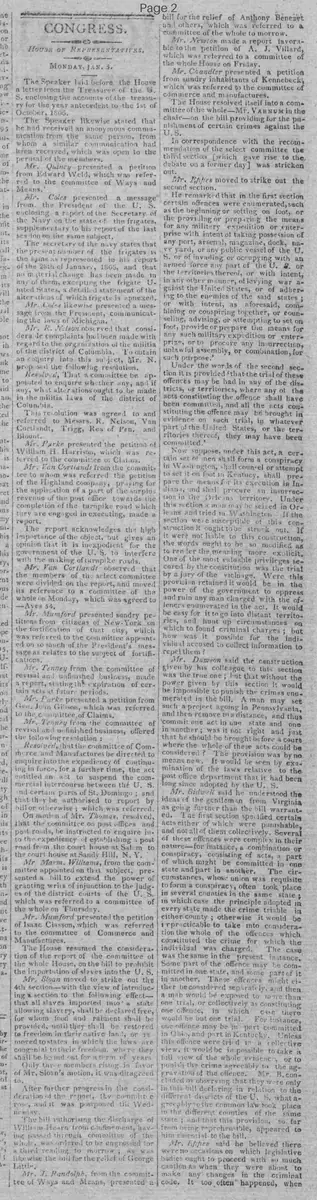
HOUSE OF REPRESENTATIVES
MONDAY, JAN. 5.
The Speaker laid before the House a letter from the Treasurer of the U. S. enclosing the accounts of the treasury for the year antecedent to the 1st of October, 1806.
The Speaker likewise stated that he had received an anonymous communication from the same person, from whom a similar communication had been received, which was open to the perusal of the members.
Mr. Quincy presented a petition from Edward Weld, which was referred to the committee of Ways and Means.
Mr. Coles presented a message from the President of the U. S. enclosing a report of the Secretary of the Navy on the state of the frigates, supplementary to his report of the last session on the same subject.
The secretary of the navy states that the present number of the frigates is the same as represented in his report of the 28th of January, 1806, and that no material change has been made in any of them, excepting the frigate United States, a detailed statement of the alterations of which frigate is annexed.
Mr. Coles likewise presented a message from the President, communicating the laws of Michigan.
Mr. R. Nelson observed that considerable complaints had been made with regard to the organization of the militia of the district of Columbia. To obtain an enquiry into this subject, Mr. N. proposed the following resolution.
Resolved, That a committee be appointed to enquire whether any, and if any, what alterations ought to be made in the militia laws of the district of Columbia.
This resolution was agreed to and referred to Messrs. R. Nelson, Van Cortlandt, Trigg, Rea of Pen. and Blount.
Mr. Parke presented the petition of William H. Harrison, which was referred to the committee of Claims.
Mr. Van Cortlandt from the committee to whom was referred the petition of the Highland company, praying for the application of a part of the surplus revenue of the post office towards the completion of the turnpike road which they are engaged in executing, made a report.
The report acknowledges the high importance of the object, but gives an opinion that it is inexpedient for the government of the U. S. to interfere with the making of turnpike roads.
Mr. Van Cortlandt observed that the members of the select committee were divided on the report, and moved its reference to a committee of the whole on Monday, which was agreed to—Ayes 54.
Mr. Mumford presented sundry petitions from citizens of New York on the fortification of that city, which was referred to the committee appointed on so much of the President's message as relates to the subject of fortifications.
Mr. Tenney from the committee of revisal and unfinished business, made a report, stating the expiration of certain acts at future periods.
Mr. Parke presented a petition from Gen. John Gibson, which was referred to the committee of Claims.
Mr. Tenney from the committee of revisal and unfinished business, offered the following resolution :
Resolved, that the committee of Commerce and Manufactures be directed to enquire into the expediency of continuing in force, for a further time, the act entitled an act to suspend the commercial intercourse between the U. S. and certain parts of St. Domingo ; and that they be authorised to report by bill or otherwise ; which was referred.
On motion of Mr. Thomas, resolved, that the committee on post offices and post roads, be instructed to enquire into the expediency of establishing a post road from the court house at Salem to the court house at Sandy Hill, N. Y.
Mr. Marm. Williams, from the committee appointed on that subject, presented a bill to extend the power of granting writs of injunction to the judges of the district courts of the U. S. which was referred to a committee of the whole on Thursday.
Mr. Munford presented the petition of Isaac Classon, which was referred to the committee of Commerce and Manufactures.
The House resumed the consideration of the report of the committee of the whole House, on the bill to prohibit the importation of slaves into the U. S.
Mr. Sloan moved to strike out the 4th section--with the view of introducing a section to the following effect— that all slaves imported into a state allowing slavery, shall be declared free, for whom food and raiment shall be provided, until they shall be restored to freedom in their native land, or removed to states in which the laws are congenial to their freedom. where they shall be hired out for a term of years Only three members rising in favor of Mr. Sloan's motion, it was disagreed to.
After further progress in the consideration of the report. the committee rose, and it was postponed til Wednesday.
The bill authorising the discharge of William Hearn from confinement, having passed through committee of the whole, was ordered to be engrossed for a third reading to morrow ; as was likewise the bill for the relief of George Little
Mr. J. Randolph, from the committee of Ways and Means, presented a bill for the relief of Anthony Benezet and others. which was referred to a committee of the whole to morrow.
Mr. Newton made a report favorable to the petition of A. J. Villard, which was referred to a committee of the whole House on Friday.
Mr. Chandler presented a petition from sundry inhabitants of Kennebeck, which was referred to the committee of commerce and manufactures.
The House resolved itself into a committee of the whole—Mr. VARNUM in the chair—on the bill providing for the punishment of certain crimes against the U. S.
In correspondence with the recommendation of the select committee the third section [which gave rise to the debate on a former day] was stricken out.
Mr. Emnes moved to strike out the second section.
He remarked that in the first section certain offences were enumerated, such as the beginning or setting on foot, or the providing or preparing the means for any military expedition or enterprise with intent of taking possession of any port, arsenal, magazine, dock, navy yard, or any public vessel of the U. S. or of invading or occupying with an armed force any part of the U. S. or the territories thereof, or with intent, in any other manner, of levying war against the United States, or of adhering to the enemies of the said states ; or with intent, as aforesaid, combining or conspiring together, or counseling, advising, or attempting to set on foot, provide or prepare the means for any such military expedition or enterprise, or to procure any insurrection, unlawful assembly, or combination, for such purpose.'
Under the words of the second section it is provided 'that the trial of these offences may be had in any of the districts, or territories, where any of the acts constituting the offence shall have been committed, and all the acts constituting the offence may be brought in evidence on such trial, in whatever part of the United States, or the territories thereof, they may have been committed.'
Now suppose, under this act, a certain set of men shall form a conspiracy in Washington, shall counsel or attempt to set it on foot in Kentucky, shall prepare the means for its execution in Indiana, and shall procure an insurrection in the Orleans territory. Under this section a man may be seized in Orleans and tried in Washington If the section were susceptible of this construction it ought to be struck out. If it were not liable to this construction, the words ought to be so modified as to render the meaning more explicit.
One of the most valuable privileges secured by the constitution was the trial by a jury of the vicinage. Were this provision retained it would be in the power of the government to oppress and ruin any man charged with the offences enumerated in the act. It would be easy for it to go into distant territories, and hunt up circumstances on which to found criminal charges ; but how was it possible for the individual accused to collect information to repel them?
Mr. Dawson said the construction given by his colleague to this section was the true one; but that without the power given by this section it would be impossible to punish the crimes enumerated in the bill. A man may set such a project agoing in Pennsylvania, and then remove to a distance, and thus commit one act in one state and one in another; was it not right and just that he should be brought before a court where the whole of these acts could be considered ? The provision was by no means new. It would be seen by examination of the laws relative to the post office department that it had been long since adopted by the U. S.
Mr. Bidwell said he understood the ideas of the gentleman from Virginia as going further than the bill warranted. The first section specified certain acts either of which were punishable, and not all of them collectively. Several of these offences were complex in their nature for instance, a combination or conspiracy, consisting of acts, a part of which might be committed in one state and part in another. The circumstances, whose union was requisite to form a conspiracy, often took place in several counties in the same state; in which case the principle adopted in every state made the crime triable in either county ; otherwise it would be impracticable to take into consideration the whole of the offences which constituted the crime for which the individual was charged. The case was the same in the present instance. Some part of the offence may be committed in one state, and some part of it in another. These offences might either be considered separately, and then a man would be exposed to more than one trial, or collectively as constituting one offence, in which case there would be but one trial. For instance, one offence may be in part committed in Ohio, and part in Kentucky. Unless this offence were tried in a collective view. it would be impossible to take a full view of the whole evidence or to punish the crime agreeably to the aggravation of the offence. Mr. B. concluded by observing that they were only in this bill declaring in relation to the different districts of the U. S. what agreeably to the common law took place in the different counties of the same state ; and that this provision, so far from being reprehensible, appeared to him essential to the bill.
Mr. Emnes said he believed there were no occasions on which legislative bodies ought to proceed with so much caution as when they were about to make any changes in the criminal code. It too often happened, when
They passed a law for a particular occasion, that they lost sight of the rights of the citizen, and established a dangerous precedent. It was his wish always to legislate on general principles, and not for particular occasions; and that they should confine themselves to the passage of such laws as might be safely administered at all times as the laws of the land. The gentleman from Mass. had confined his observations to the latter part of the objections he had made to the section, viz. the testimony to be adduced. But he would ask whether as a candid man he could obviate the first objection he had stated? If a man committed different acts in fifty different sections of the union, he might, under this provision, be taken in any one of them, and be tried and punished where it would be impossible for him to get testimony, and where he would be borne down by the arm of power. The language of the section is the trial may be had in any of the districts, where any of the acts constituting the offence shall have been committed. What are these acts? The first is the beginning or setting on foot a military expedition--this is one distinct act; the furnishing a conspiracy or combination--this is another act: and so of all the other acts recited in the bill; under which a man may be seized and dragged here for trial, provided any one of the offences was committed here, though all the rest were committed elsewhere.
Mr. Eppes said he had another objection to this provision. It gave the officers a right to seize a man, and try him in that district most prejudiced against him. In one district he may be very obnoxious: in another highly popular. He believed this was very much the case at present. Would this be fair? If gentlemen are disposed to act properly, let the offence be tried in the district where it is committed. Let them adhere to the principles of the constitution.
Mr. E. said, that gentlemen might have an opportunity of turning their attention to the subject, he would move that the committee should rise.
Mr. Bidwell said before the question was taken on the rising of the Committee, he wished for a moment to examine the nature of the objection offered by the gentleman from Virginia. The enumeration in the first section explained the different offences, and classes of offences, each of which made a different offence. The second section did not say one offence, committed in one place, should be tried in another. It is only in case of a combination of offences that this is to take place. The gentleman says, part of a conspiracy may take place in Kentucky, and part in another district. You must either then unite these offences, or render a person punishable for every part or circumstance, which collectively are made to constitute an entire whole. The having but one trial is for the benefit of the defendant, by which he is saved from the necessity of undergoing several trials in different districts and for different offences. The constitution, it is true, provides that the trial shall be in the district in which the offence is committed; but if the offence be not committed in a particular district, Congress may fix the place where the trial shall be had. Mr. B. said it appeared to him that the true spirit of the constitution was pursued by this law, which provides that a man may be tried in either district where any part of the offence is committed; and that when so tried there shall be a bar to any other trial for the same offence. So far from introducing a new principle, Mr. B. was of opinion the same course would be pursued without any special provision, which however was desirable, as making the point explicit, and placing it beyond all doubt. He said he had no other objection to the committee rising, than that arising from delay. The sooner the bill was passed the better; for although it could not operate on past offences, if passed in season, it might perhaps operate on acts which might take place after its passage.
Mr. Smilie said the provision in the bill had been so well explained by the gentleman from Massachusetts that he was surprised how any doubts could be entertained respecting it. It was well known that in the case of treason a man might commit one act in one state, and a different act in another state. Was he in this case to be tried twice for the same offence? This would be unconstitutional. So in this case, a conspiracy might be composed of various acts committed in different states. Would gentlemen be for trying the man accused of a conspiracy in different states, and for every act committed by him? Surely not.
Mr. Eppes said he would call the attention of the committee to two clauses of the constitution.
"The trial of all crimes, except in cases of impeachment, shall be by jury; and such trial shall be held in the state where the said crimes shall have been committed; but when not committed within any state, the trial shall be at such place or places as the Congress may by law have directed."
"In all criminal prosecutions the accused shall enjoy the right to a speedy and public trial, by an impartial jury of the state and district wherein the crime shall have been committed."
Mr. N. Williams said he apprehended, though he was sorry to make the observation, that the honorable gentleman from Virginia who objected to the 2nd section of the bill, did not correctly understand it. That according to his own understanding, the section did not contemplate the trial of distinct offences in any district or territory in which the offence should not have been committed. The words of the section are "that the trial of the above offences, may be had in any of the districts, and where any of the acts constituting the offence shall have been committed, &c." By this it clearly appeared, that when the offence to be tried, was made up of various acts, some of which were committed in one district and some in another, the offence might be tried in either of these districts.
Mr. W. said he should vote against the postponement, as he did not see the least difficulty in the case. The bill contained no new principle--none that was not known and applied in cases of treason, familiar to every one, and in cases of larceny, in which it was every day's practice to prosecute an offender in any county where the goods were found upon him, although stolen in another county. He said the bill appeared to him highly important, and he was sorry to discover a disposition in the House to delay the business under discussion.
Mr. Alston did not agree with the gentleman last up. On the contrary, he considered this section as exceptionable. What does it say? That you may try a man in any one of the districts where he may have committed an offence. This was putting a power into the hands of the prosecutor to harass the accused beyond that which the constitution even contemplated. He thought the section might be so worded as to obviate the objections that had been raised.
Mr. Eppes said it was very possible, as stated by the gentleman from New York, that he did not understand the section correctly, as he did not pretend to high genius. His strongest objection to the section was that it gave the prosecutor a right to try the offence in that place where the strongest prejudice might exist against the accused.
Mr. Eppes here recapitulated his first remarks, and added that, according to the second section, a man could be tried for any of the offences enumerated in the first section, in any one of the districts of the U. S. provided any of those acts shall have been committed in it. He would ask whether this would not be a violation of the constitution which guaranteed a jury of the vicinage to the accused? He would ask how a man could be tried here by an impartial jury collected from New Orleans, Kentucky and Indiana?
Mr. Jackson said that the section, according to the construction given it by his colleague, was highly objectionable, and stared the constitution in the face, and ought not to receive the patronage of the House. He, however, believed that the object of his colleague as well as the friends of the bill might be effected by taking a middle course; by confining the trial of the accused to the district in which he shall be arrested. This would preclude the possibility of an individual being transported for trial from one place to another, and his being thus dragged to a place where the rage of implacable passions may condemn him though innocent. If some such amendment were not made Mr. J. said he should vote for striking out the section: and if the section should neither be amended or stricken out, he should vote against the bill.
Mr. Sloan said that while they were so jealous of the rights of the citizen, it became them not to be indifferent to the safety of the community. He apprehended that the intention of this law was to nip in the bud plans that were treasonable and destructive of the peace of the U. S. The provision contained in the 2d section appeared to him highly necessary to guard the rights of the community.
Mr. Dawson said it was the opinion of the committee that introduced the bill, that a man must be tried in the district where he was apprehended, and this, he considered as the true construction. He did not think that a man could be transported from one district to another. Indeed he was at a loss to know under what legal authority this could be done. He believed this the fair construction of the law; but if gentlemen wished to make its language more explicit, he had no objection to an amendment to that effect.
Mr. G. W. Campbell observed that the section might be so modified as to make it correspond with the ideas of both sides of the House. It was essential to fix some place for the trial of crimes, which should be partly committed in one state and partly in another. It was material to determine in which state the crime should be tried, which circumstance ought not to be left to the option of the prosecutor or the government. If the bill were so amended, it would answer every valuable purpose for which it was framed. He, therefore, proposed, in case the committee did not rise, to offer an amendment to the 2nd section, providing that the trial should take place in the district "in which the defendant shall be arrested, or into which he shall be first brought."
Mr. Eppes withdrew his motion for the rising of the committee, when the question was taken on his motion to strike out the 2nd section, which was disagreed to—Ayes 21.
Mr. G. W. Campbell then offered his amendment.
Mr. Jackson said it did not remove his objections to the section. Suppose a man were apprehended in a place where the offence with which he is accused was not committed. Would it not be competent under this provision to carry him to a place where he might be the victim of the most implacable feelings.
Mr. G. W. Campbell replied that the provision embraced such cases, and that the effect apprehended by the gentleman would not follow.
On motion of Mr. Smilie, the Committee rose without coming to a decision on the amendment, when the House
TUESDAY, Jan. 6.
Mr. Holmes, from the Committee of Claims, made a report on the petition of Daniel Gelder, stating that his case is already provided for. The House concurred in giving him leave to withdraw his papers.
Mr. Holmes, from the said committee, made an unfavorable report on the petition of Mary Gresham, in which the House concurred.
Mr. Tallmadge presented a petition from Ann Welsh, which was referred to the committee of Claims.
On motion of Mr. Parke, Resolved, That the committee on public lands be instructed to enquire into the expediency of establishing an office for the sale of the lands of the U. S. west of the Greenville treaty boundary line, and east of the Vincennes and Delaware purchases, and that they report by bill or otherwise.
Mr. Early, from the Committee of Commerce and Manufactures, presented a bill to provide for surveying the coasts of the U. S. which was referred to a committee of the whole on Monday.
On motion of Mr. Clark, Resolved, That the Committee on post offices and post roads be instructed to enquire into the expediency of continuing the post road from Athens to New Orleans, through W. Florida, south of the line of demarcation, with the consent of the Spanish government, and to report by bill or otherwise.
Mr. Canton presented the petition of Peter Lord, which was referred to the committee of Claims.
A bill authorising the discharge of William Harn from imprisonment, was read the third time and passed—Ayes 71.
A message was received from the Senate, stating that they had passed the bill making military appropriations for the year 1807, without amendment.
A bill for the relief of George Little was read the third time. The bill makes provision for a claim preferred by capt. Little, commander of a ship of the U. S. arising out of the following circumstances. During our differences with France, a law was passed prohibiting commercial intercourse with France. Under this law, and the orders given by the executive government, capt. Little captured the Flying Fish, which, on an adjudication by the courts of the U. S. was restored as an illegal prize, and damages awarded against capt. Little, who claims an indemnity from the government, on the ground of having in the capture executed the orders given him by the secretary of the navy.
The debate principally turned on the point, whether the law, or the instructions, ought to have been the guide of capt. Little. As the report of the committee of claims, with the report of the secretary of the navy, state all the important facts in this case, we shall confine ourselves to a publication of these documents at an early period.
Messrs. Holmes, Tallmadge, Cook, Dana, Hastings, Quincy, and Alexander advocated: and Messrs. Smilie, Gregg, Chandler, Bedinger, and Fisk, opposed the passage of the bill.
When the question was taken by yeas and nays, and the bill passed—Yeas 70, Nays 41.
The Speaker laid before the House a communication from the Post Master General, stating the respective sums paid to his clerks, which was referred to the Post Office committee.
Mr. Stanton, from the committee on claims barred by statutes of limitation, made a report, recommending that all just and equitable claims for services rendered, or supplies furnished during the revolutionary war with G. Britain, &c. now barred, ought to be provided for by law.
Referred to the committee of the whole on Thursday.
Mr. Early from the committee of Commerce and Manufactures made a report unfavorable to the petition of Reuben Alby, in which the House concurred.
Mr. Eppes moved to discharge the committee of the whole from the further consideration of the bill providing for the punishment of certain crimes against the U. S. with the view of recommitting it for amendment to a select committee: which motion was lost by the casting vote of the Speaker—Ayes 50—Noes 50.
What sub-type of article is it?
What keywords are associated?
What entities or persons were involved?
Where did it happen?
Domestic News Details
Primary Location
Washington
Event Date
Monday, Jan. 5 And Tuesday, Jan. 6, 1807
Key Persons
Outcome
bills passed for discharge of william hearn and relief of george little; motions and amendments debated on crimes bill; various petitions referred and reports made.
Event Details
The House received treasury accounts, anonymous communication, presidential messages on navy frigates and Michigan laws; presented and referred petitions from Edward Weld, William H. Harrison, Gen. John Gibson, Isaac Classon, sundry New York citizens, A. J. Villard, Kennebeck inhabitants, Ann Welsh, Peter Lord; resolutions on militia organization in D.C., post road from Salem to Sandy Hill N.Y., continuing St. Domingo intercourse suspension, public lands office west of Greenville line, post road through W. Florida; reports on Highland company turnpike, expiration of acts, navy frigates, fortifications; bill to extend injunction powers; resumed consideration of slave importation prohibition bill, Sloan's motion rejected; bills ordered engrossed for Hearn and Little; bill for Benezet relief referred; committee on crimes bill struck third section, debated and rejected striking second section on trial jurisdiction, Campbell's amendment proposed, committee rose; on Jan. 6, reports on Gelder and Gresham petitions, bill on coast surveying referred, post road resolution, Hearn bill passed, Senate message on military appropriations, Little relief bill passed after debate, Post Master General communication, report on barred claims referred, unfavorable report on Alby petition, motion to recommit crimes bill lost.