Thank you for visiting SNEWPapers!
Sign up free
Literary
September 26, 1832
Vandalia Whig And Illinois Intelligencer
Vandalia, Fayette County, Illinois
What is this article about?
Ernest and Emily Darley, newly married against his uncle Sir Edward's wishes, live in poverty in London. The uncle demands repayment of £3,400 in debts and reveals his deep hatred for Emily's deceased parents due to past romantic and violent entanglements.
Clipping
OCR Quality
95%
Excellent
Full Text
From Blackwood's Magazine, for June.
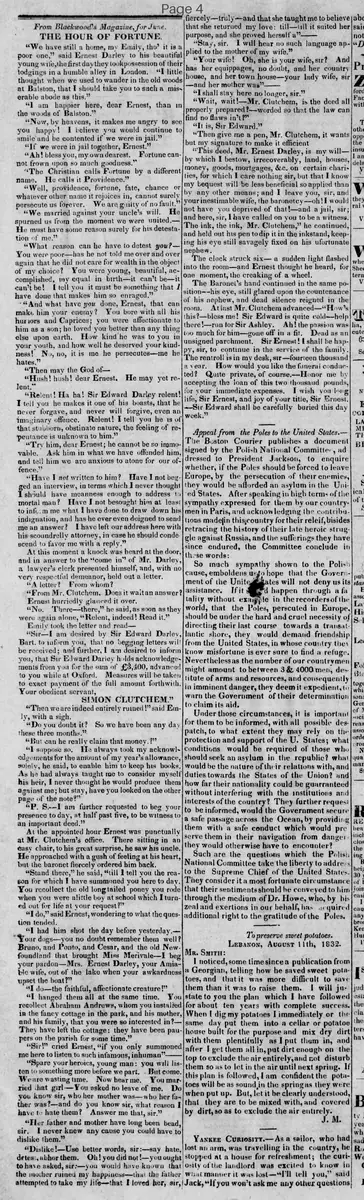
THE HOUR OF FORTUNE
"We have still a home, my Emily, tho' it is a poor one," said Ernest Darley to his beautiful young wife, the first day they took possession of their lodgings in a humble alley in London. "I little thought when we used to wander in the old woods at Balston, that I should take you to such a miserable abode as this."
"I am happier here, dear Ernest, than in the woods of Balston."
"Now, by heavens, it makes me angry to see you happy! I believe you would continue to smile and be contented if we were in jail."
"If we were in jail together, Ernest."
"Ah! bless you, my own dearest. Fortune cannot frown upon so much goodness."
"The Christian calls Fortune by a different name. He calls it Providence."
"Well, providence, fortune, fate, chance or whatever other name it rejoices in, cannot surely persecute us forever. We are guilty of no fault."
"We married against your uncle's will. He spurned us from the moment we were united. He must have some reason surely for his detestation of me."
"What reason can he have to detest you? You were poor—has he not told me over and over again that he did not care for wealth in the object of my choice? You were young, beautiful, accomplished, my equal in birth—it can't be—it can't be! I tell you it must be something that I have done that makes him so enraged."
"And what have you done, Ernest, that can make him your enemy? You bore with all his humors and caprices; you were affectionate to him as a son; he loved you better than anything else upon earth. How kind he was to you in your youth, and how well he deserved your kindness! No, no, it is me he persecutes—me he hates."
"Then may the God of—"
"Hush! hush! dear Ernest. He may yet relent."
"Relent! Ha ha! Sir Edward Darley relent! I tell you he makes it one of his boasts, that he never forgave, and never will forgive, even an imaginary offence. Relent! I tell you he is of that stubborn, obstinate nature, the feeling of repentance is unknown to him."
"Try him, dear Ernest; he cannot be so immovable. Ask him in what we have offended him, and tell him we are anxious to atone for our offence."
"Have I not written to him? Have I not begged an interview, in terms which I never thought I should have meanness enough to address to mortal man? Have I not besought him at least to inform me what I have done to draw down his indignation, and has he ever even deigned to send me an answer? I have left our address here with his scoundrelly attorney, in case he should condescend to favor me with a reply."
At this moment a knock was heard at the door, and in answer to the "come in" of Mr. Darley, a lawyer's clerk presented himself, and, with no very respectful demeanor, held out a letter.
"A letter? From whom?"
"From Mr. Clutchem. Does it wait an answer?"
Ernest hurriedly glanced it over.
"No. There—there," he said, as soon as they were again alone, "Relent, indeed! Read it."
Emily took the letter and read—
"Sir—I am desired by Sir Edward Darley, Bart. to inform you, that no begging letters will be received; and further, I am desired to inform you, that Sir Edward Darley holds acknowledgements from you for the sum of £3,400, advanced to you while at Oxford. Measures will be taken to exact payment of the full amount forthwith.
Your obedient servant,
SIMON CLUTCHEM."
"Then we are indeed entirely ruined!" said Emily, with a sigh.
"Do you doubt it? So we have been any day these three months."
"But can he really claim that money?"
"I suppose so. He always took my acknowledgements for the amount of my year's allowance, solely, he said, to enable him to keep his books. As he had always taught me to consider myself his heir, I never thought he would produce them against me; but stay, have you looked on the other page of the note?"
"P. S.—I am further requested to beg your presence to day, at half past five, to be witness to an important deed."
At the appointed hour Ernest was punctually at Mr. Clutchem's office. There sitting in an easy chair, to his great surprise, he saw his uncle.
He approached with a gush of feeling at his heart, but the baronet fiercely ordered him back.
"Stand there," he said, "till I tell you the reason for which I have summoned you here to day.
You recollect the old long tailed pony you rode when you were a little boy at school which I turned out for life at your request?"
"I do," said Ernest, wondering to what the question tended.
"I had him shot the day before yesterday. Your dogs—you no doubt remember them well? Bruno, and Ponto, and Cesar, and the old Newfoundland that brought Miss Merivale—I beg your pardon—Mrs. Ernest Darley, your amiable wife, out of the lake when your awkwardness upset the boat?"
"I do—the faithful, affectionate creature!"
"I hanged them all at the same time. You recollect Abraham Andrews, whom you installed in the fancy cottage in the park, and his mother, and his family, that you were so interested in? They have left the cottage: they have been paupers on the parish for some time."
"Sir!" cried Ernest, "if you only summoned me here to listen to such infamous, inhuman—"
"Spare your heroics, young man: you will listen to something more before we part. But come. We are wasting time. Now hear me. You married that girl. You asked no leave of me. Do you know sir, who her mother was—who her father was?—and do you know sir, what reason I have to hate them? Answer me that, sir."
"Her father and mother have long been dead, sir. I never knew any cause you could have to dislike them."
"Dislike!—Use better words, sir:—say hate, detest, abhor them. Oh! you did not!—you ought to have asked, sir:—you would have known that the mother ruined my happiness—that the father attempted to take my life—that I loved her, sir,
THE HOUR OF FORTUNE
"We have still a home, my Emily, tho' it is a poor one," said Ernest Darley to his beautiful young wife, the first day they took possession of their lodgings in a humble alley in London. "I little thought when we used to wander in the old woods at Balston, that I should take you to such a miserable abode as this."
"I am happier here, dear Ernest, than in the woods of Balston."
"Now, by heavens, it makes me angry to see you happy! I believe you would continue to smile and be contented if we were in jail."
"If we were in jail together, Ernest."
"Ah! bless you, my own dearest. Fortune cannot frown upon so much goodness."
"The Christian calls Fortune by a different name. He calls it Providence."
"Well, providence, fortune, fate, chance or whatever other name it rejoices in, cannot surely persecute us forever. We are guilty of no fault."
"We married against your uncle's will. He spurned us from the moment we were united. He must have some reason surely for his detestation of me."
"What reason can he have to detest you? You were poor—has he not told me over and over again that he did not care for wealth in the object of my choice? You were young, beautiful, accomplished, my equal in birth—it can't be—it can't be! I tell you it must be something that I have done that makes him so enraged."
"And what have you done, Ernest, that can make him your enemy? You bore with all his humors and caprices; you were affectionate to him as a son; he loved you better than anything else upon earth. How kind he was to you in your youth, and how well he deserved your kindness! No, no, it is me he persecutes—me he hates."
"Then may the God of—"
"Hush! hush! dear Ernest. He may yet relent."
"Relent! Ha ha! Sir Edward Darley relent! I tell you he makes it one of his boasts, that he never forgave, and never will forgive, even an imaginary offence. Relent! I tell you he is of that stubborn, obstinate nature, the feeling of repentance is unknown to him."
"Try him, dear Ernest; he cannot be so immovable. Ask him in what we have offended him, and tell him we are anxious to atone for our offence."
"Have I not written to him? Have I not begged an interview, in terms which I never thought I should have meanness enough to address to mortal man? Have I not besought him at least to inform me what I have done to draw down his indignation, and has he ever even deigned to send me an answer? I have left our address here with his scoundrelly attorney, in case he should condescend to favor me with a reply."
At this moment a knock was heard at the door, and in answer to the "come in" of Mr. Darley, a lawyer's clerk presented himself, and, with no very respectful demeanor, held out a letter.
"A letter? From whom?"
"From Mr. Clutchem. Does it wait an answer?"
Ernest hurriedly glanced it over.
"No. There—there," he said, as soon as they were again alone, "Relent, indeed! Read it."
Emily took the letter and read—
"Sir—I am desired by Sir Edward Darley, Bart. to inform you, that no begging letters will be received; and further, I am desired to inform you, that Sir Edward Darley holds acknowledgements from you for the sum of £3,400, advanced to you while at Oxford. Measures will be taken to exact payment of the full amount forthwith.
Your obedient servant,
SIMON CLUTCHEM."
"Then we are indeed entirely ruined!" said Emily, with a sigh.
"Do you doubt it? So we have been any day these three months."
"But can he really claim that money?"
"I suppose so. He always took my acknowledgements for the amount of my year's allowance, solely, he said, to enable him to keep his books. As he had always taught me to consider myself his heir, I never thought he would produce them against me; but stay, have you looked on the other page of the note?"
"P. S.—I am further requested to beg your presence to day, at half past five, to be witness to an important deed."
At the appointed hour Ernest was punctually at Mr. Clutchem's office. There sitting in an easy chair, to his great surprise, he saw his uncle.
He approached with a gush of feeling at his heart, but the baronet fiercely ordered him back.
"Stand there," he said, "till I tell you the reason for which I have summoned you here to day.
You recollect the old long tailed pony you rode when you were a little boy at school which I turned out for life at your request?"
"I do," said Ernest, wondering to what the question tended.
"I had him shot the day before yesterday. Your dogs—you no doubt remember them well? Bruno, and Ponto, and Cesar, and the old Newfoundland that brought Miss Merivale—I beg your pardon—Mrs. Ernest Darley, your amiable wife, out of the lake when your awkwardness upset the boat?"
"I do—the faithful, affectionate creature!"
"I hanged them all at the same time. You recollect Abraham Andrews, whom you installed in the fancy cottage in the park, and his mother, and his family, that you were so interested in? They have left the cottage: they have been paupers on the parish for some time."
"Sir!" cried Ernest, "if you only summoned me here to listen to such infamous, inhuman—"
"Spare your heroics, young man: you will listen to something more before we part. But come. We are wasting time. Now hear me. You married that girl. You asked no leave of me. Do you know sir, who her mother was—who her father was?—and do you know sir, what reason I have to hate them? Answer me that, sir."
"Her father and mother have long been dead, sir. I never knew any cause you could have to dislike them."
"Dislike!—Use better words, sir:—say hate, detest, abhor them. Oh! you did not!—you ought to have asked, sir:—you would have known that the mother ruined my happiness—that the father attempted to take my life—that I loved her, sir,
What sub-type of article is it?
Prose Fiction
What themes does it cover?
Love Romance
Moral Virtue
Liberty Freedom
What keywords are associated?
Marriage Against Will
Family Conflict
Disinheritance
Poverty
Uncle Hatred
Literary Details
Title
The Hour Of Fortune
Key Lines
"We Have Still A Home, My Emily, Tho' It Is A Poor One," Said Ernest Darley To His Beautiful Young Wife, The First Day They Took Possession Of Their Lodgings In A Humble Alley In London.
"The Christian Calls Fortune By A Different Name. He Calls It Providence."
"Sir—I Am Desired By Sir Edward Darley, Bart. To Inform You, That No Begging Letters Will Be Received; And Further, I Am Desired To Inform You, That Sir Edward Darley Holds Acknowledgements From You For The Sum Of £3,400, Advanced To You While At Oxford. Measures Will Be Taken To Exact Payment Of The Full Amount Forthwith.
Your Obedient Servant,
Simon Clutchem."
"You Married That Girl. You Asked No Leave Of Me. Do You Know Sir, Who Her Mother Was—Who Her Father Was?—And Do You Know Sir, What Reason I Have To Hate Them?"