Thank you for visiting SNEWPapers!
Sign up free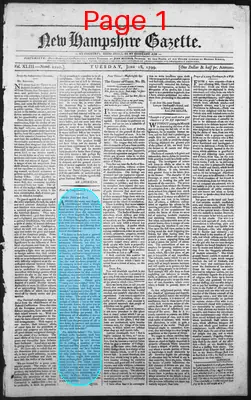
Literary
June 18, 1799
The New Hampshire Gazette
Portsmouth, Rockingham County, New Hampshire
What is this article about?
A humorous letter in the Georgetown Gazette recounts Dr. Belknap's account of Sir Edwin Sandys sending young women to Virginia in 1620-1621 as wives for planters, priced in tobacco (120-150 lbs), prioritized over other debts. The author satirizes modern bachelors, suggesting tobacco could buy wives today.
Clipping
OCR Quality
95%
Excellent
Full Text
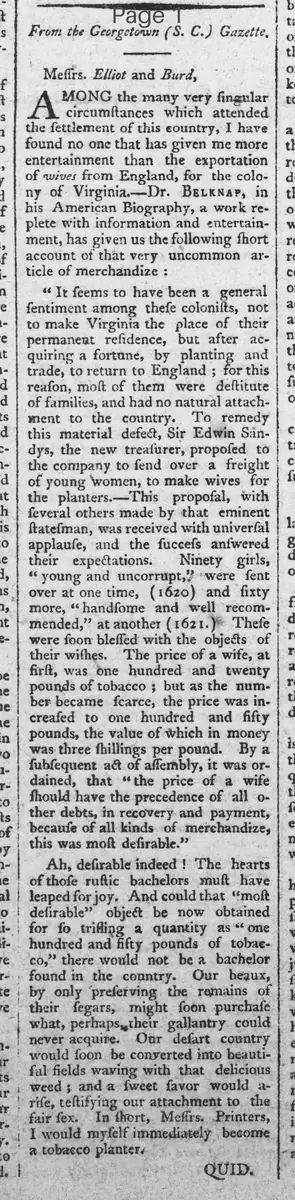
From the Georgetown (S. C.) Gazette.
Messrs. Elliot and Burd,
Among the many very singular circumstances which attended the settlement of this country, I have found no one that has given me more entertainment than the exportation of wives from England, for the colony of Virginia.—Dr. Belknap, in his American Biography, a work replete with information and entertainment, has given us the following short account of that very uncommon article of merchandize:
"It seems to have been a general sentiment among these colonists, not to make Virginia the place of their permanent residence, but after acquiring a fortune, by planting and trade, to return to England: for this reason, most of them were destitute of families, and had no natural attachment to the country. To remedy this material defect, Sir Edwin Sandys, the new treasurer, proposed to the company to send over a freight of young women, to make wives for the planters.—This proposal, with several others made by that eminent statesman, was received with universal applause, and the success answered their expectations.
Ninety girls, "young and uncorrupt," were sent over at one time, (1620) and sixty more, "handsome and well recommended," at another (1621.) These were soon blessed with the objects of their wishes. The price of a wife, at first, was one hundred and twenty pounds of tobacco; but as the number became scarce, the price was increased to one hundred and fifty pounds, the value of which in money was three shillings per pound. By a subsequent act of assembly, it was ordained, that "the price of a wife should have the precedence of all other debts, in recovery and payment, because of all kinds of merchandize, this was most desirable."
Ah, desirable indeed! The hearts of those rustic bachelors must have leaped for joy. And could that "most desirable" object be now obtained for so trifling a quantity as "one hundred and fifty pounds of tobacco," there would not be a bachelor found in the country. Our beaux, by only preserving the remains of their segars, might soon purchase what, perhaps their gallantry could never acquire. Our desert country would soon be converted into beautiful fields waving with that delicious weed; and a sweet favor would arise, testifying our attachment to the fair sex. In short, Messrs. Printers, I would myself immediately become a tobacco planter.
QUID
Messrs. Elliot and Burd,
Among the many very singular circumstances which attended the settlement of this country, I have found no one that has given me more entertainment than the exportation of wives from England, for the colony of Virginia.—Dr. Belknap, in his American Biography, a work replete with information and entertainment, has given us the following short account of that very uncommon article of merchandize:
"It seems to have been a general sentiment among these colonists, not to make Virginia the place of their permanent residence, but after acquiring a fortune, by planting and trade, to return to England: for this reason, most of them were destitute of families, and had no natural attachment to the country. To remedy this material defect, Sir Edwin Sandys, the new treasurer, proposed to the company to send over a freight of young women, to make wives for the planters.—This proposal, with several others made by that eminent statesman, was received with universal applause, and the success answered their expectations.
Ninety girls, "young and uncorrupt," were sent over at one time, (1620) and sixty more, "handsome and well recommended," at another (1621.) These were soon blessed with the objects of their wishes. The price of a wife, at first, was one hundred and twenty pounds of tobacco; but as the number became scarce, the price was increased to one hundred and fifty pounds, the value of which in money was three shillings per pound. By a subsequent act of assembly, it was ordained, that "the price of a wife should have the precedence of all other debts, in recovery and payment, because of all kinds of merchandize, this was most desirable."
Ah, desirable indeed! The hearts of those rustic bachelors must have leaped for joy. And could that "most desirable" object be now obtained for so trifling a quantity as "one hundred and fifty pounds of tobacco," there would not be a bachelor found in the country. Our beaux, by only preserving the remains of their segars, might soon purchase what, perhaps their gallantry could never acquire. Our desert country would soon be converted into beautiful fields waving with that delicious weed; and a sweet favor would arise, testifying our attachment to the fair sex. In short, Messrs. Printers, I would myself immediately become a tobacco planter.
QUID
What sub-type of article is it?
Essay
Satire
What themes does it cover?
Commerce Trade
Social Manners
What keywords are associated?
Virginia Colony
Wives Exportation
Tobacco Payment
Historical Anecdote
Bachelor Satire
Sir Edwin Sandys
What entities or persons were involved?
Quid
Literary Details
Author
Quid
Subject
Exportation Of Wives From England For The Colony Of Virginia
Form / Style
Humorous Historical Reflection In Prose
Key Lines
Ninety Girls, "Young And Uncorrupt," Were Sent Over At One Time, (1620) And Sixty More, "Handsome And Well Recommended," At Another (1621.)
The Price Of A Wife, At First, Was One Hundred And Twenty Pounds Of Tobacco; But As The Number Became Scarce, The Price Was Increased To One Hundred And Fifty Pounds
By A Subsequent Act Of Assembly, It Was Ordained, That "The Price Of A Wife Should Have The Precedence Of All Other Debts, In Recovery And Payment, Because Of All Kinds Of Merchandize, This Was Most Desirable."