Thank you for visiting SNEWPapers!
Sign up free
The Augusta Courier
Augusta, Richmond County, Georgia
What is this article about?
Herman Talmadge reports on the 1957 Senate Internal Security Subcommittee's criticism of U.S. Supreme Court decisions since 1956, which allegedly aid communists and criminals by invalidating anti-subversion laws and limiting investigations, urging congressional action to restore state rights and security.
Merged-components note: Image likely a portrait associated with the Herman Talmadge report, merged due to sequential reading order and spatial proximity.
Clipping
OCR Quality
Full Text
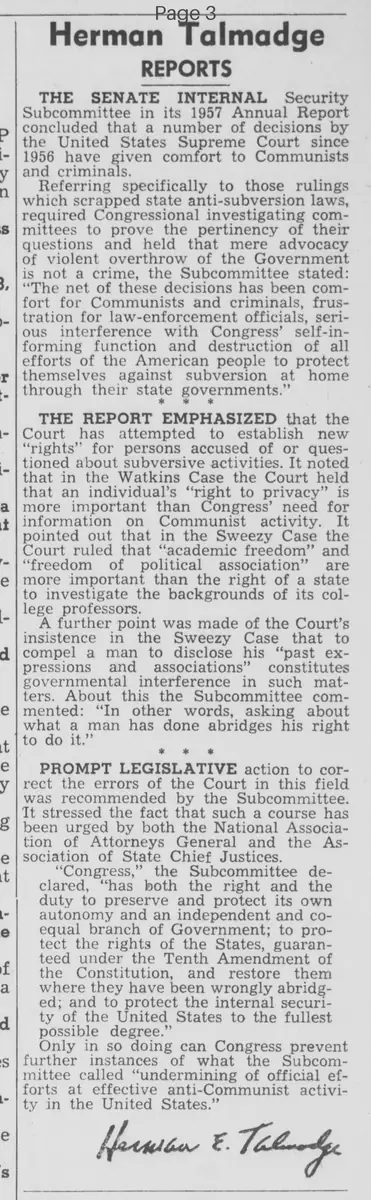
THE SENATE INTERNAL Security Subcommittee in its 1957 Annual Report concluded that a number of decisions by the United States Supreme Court since 1956 have given comfort to Communists and criminals.
Referring specifically to those rulings which scrapped state anti-subversion laws, required Congressional investigating committees to prove the pertinency of their questions and held that mere advocacy of violent overthrow of the Government is not a crime. the Subcommittee stated:
"The net of these decisions has been comfort for Communists and criminals, frustration for law-enforcement officials, serious interference with Congress' self-informing function and destruction of all efforts of the American people to protect themselves against subversion at home through their state governments."
THE REPORT EMPHASIZED that the Court has attempted to establish new "rights" for persons accused of or questioned about subversive activities. It noted that in the Watkins Case the Court held that an individual's "right to privacy" is more important than Congress' need for information on Communist activity. It pointed out that in the Sweezy Case the Court ruled that "academic freedom" and "freedom of political association" are more important than the right of a state to investigate the backgrounds of its college professors.
A further point was made of the Court's insistence in the Sweezy Case that to compel a man to disclose his "past expressions and associations" constitutes governmental interference in such matters. About this the Subcommittee commented: "In other words, asking about what a man has done abridges his right to do it."
PROMPT LEGISLATIVE action to correct the errors of the Court in this field was recommended by the Subcommittee.
It stressed the fact that such a course has been urged by both the National Association of Attorneys General and the Association of State Chief Justices.
"Congress," the Subcommittee declared, "has both the right and the duty to preserve and protect its own autonomy and an independent and co-equal branch of Government; to protect the rights of the States, guaranteed under the Tenth Amendment of the Constitution, and restore them where they have been wrongly abridged; and to protect the internal security of the United States to the fullest possible degree.
Only in so doing can Congress prevent further instances of what the Subcommittee called "undermining of official efforts at effective anti-Communist activity in the United States." 9)
What sub-type of article is it?
What themes does it cover?
What keywords are associated?
What entities or persons were involved?
Where did it happen?
Story Details
Key Persons
Location
United States
Event Date
1957
Story Details
The Senate Internal Security Subcommittee's 1957 report criticizes Supreme Court decisions since 1956 for aiding communists and criminals by invalidating anti-subversion laws and limiting investigations, recommending congressional action to protect state rights and national security.