Thank you for visiting SNEWPapers!
Sign up free
Editorial
June 12, 1812
Martinsburgh Gazette
Martinsburg, Berkeley County, West Virginia
What is this article about?
The Martinsburgh Gazette editor defends his prior remarks on a petition circulating in Jefferson County opposing the embargo and war, criticizing its circulation and intent as insulting to Federalists and their congressional representative. He rebuts attacks from a 'Republican petitioner' in the Farmer's Repository, denying mutinous opposition and clarifying his warnings against political agitation.
Clipping
OCR Quality
95%
Excellent
Full Text
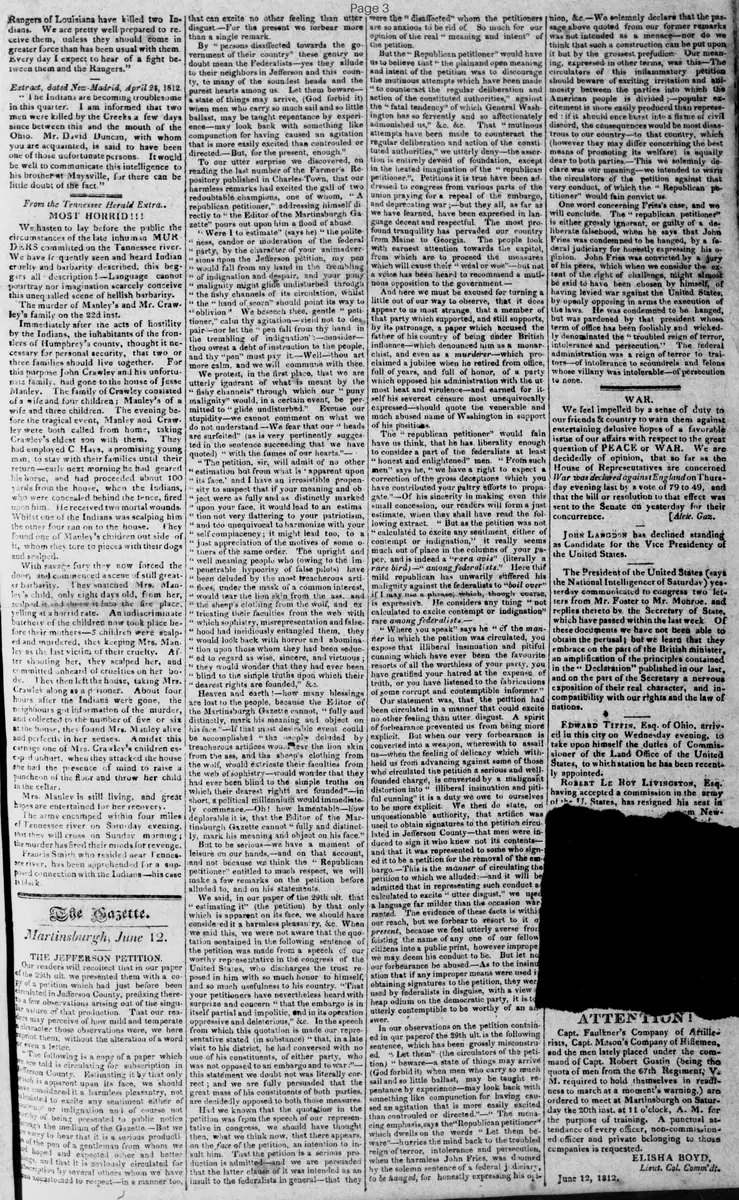
THE JEFFERSON PETITION
Our readers will recollect that in our paper of the 29th ult. we presented them with a copy of a petition which had just before been circulated in Jefferson County, prefixing thereto a few observations arising out of the singular nature of that production. That our readers may perceive of how mild and temperate a character those observations were, we here reprint them, without the alteration of a word or even a letter.
"The following is a copy of a paper which we are told is circulating for subscription in Jefferson County. Estimating it by that only which is apparent upon its face, we should have considered it a harmless pleasantry, not calculated to excite any contempt or indignation worthy of being presented to public notice through the medium of the Gazette.—But we are sorry to hear that it is a serious production of the pen of a mad hopeful and that it is seriously circulated for subscription by several gentleman from whom we have expected other and better things, and whom we have been accustomed to respect--in a manner too, that can excite no other feeling than utter disgust.—For the present we forbear more than a single remark. By "persons disaffected towards the government of their country" these gentry no doubt mean the Federalists—yes they allude to their neighbors in Jefferson and this county, to many of the soundest heads and the purest hearts among us. Let them beware—a state of things may arrive, (God forbid it) when men who carry so much sail and so little ballast, may be taught repentance by experience—may look back with something like compunction for having caused an agitation that is more easily excited than controuled or directed. But, for the present, enough."
To our utter surprise we discovered, on reading the last number of the Farmer's Repository published in Charles-Town, that our harmless remarks had excited the gall of two redoubtable champions, one of whom, "A republican petitioner," addressing himself directly to "the Editor of the Martinsburgh Gazette" pours out upon him a flood of abuse.
"Were I to estimate"(says he) "the politeness, candor or moderation of the federal party, by the character of your animadversions upon the Jefferson petition, my pen would fall from my hand in the trembling of indignation and despair, and your puny malignity might glide undisturbed through the fishy channels of its circulation, whilst the "hand of scorn" should point its way to oblivion" We beseech thee, gentle "petitioner," calm thy agitation—yield not to despair—nor let the "pen fall from thy hand in the trembling of indignation':—consider—thou owest a debt of instruction to the people, and thy "pen" must pay it.—Well—thou art more calm, and we will commune with thee.
We protest, in the first place, that we are utterly ignorant of what is meant by the "fishy channels" through which our "puny malignity" would, in a certain event, be permitted to "glide undisturbed." Excuse our stupidity—we cannot comment on what we do not understand—We fear that our "heads are surfeited" (as is very pertinently suggested in the sentence succeeding that we have quoted) "with the fumes of our hearts."—
"The petition, sir, will admit of no other estimation but from what is apparent upon its face.' and I have an irresistible propensity to suspect that if your meaning and object were as fully and as distinctly marked upon your face, it would lead to an estimation not very flattering to your patriotism. and too unequivocal to harmonize with your self complacency; it might lead too, to a just appreciation of the motives of some others of the same order. The upright and well meaning people who (owing to the impenetrable hypocrisy of false pilots) have been deluded by the most treacherous artifices, under the mask of a common interest would tear the lion skin from the ass, and the sheep's clothing from the wolf, and extricating their faculties from the web with which sophistry, misrepresentation and falsehood had insidiously entangled them, they would look back with horror and abomination upon those whom they had been seduced to regard as wise, sincere, and virtuous; they would wonder that they had ever been blind to the simple truths upon which their dearest rights are founded," &c.
Heaven and earth!—how many blessings are lost to the people, because the Editor of the Martinsburgh Gazette cannot, "fully and distinctly, mark his meaning and object on his face."—If that most desirable event could be accomplished "the needy deluded by treacherous artifices would tear the lion skin from the ass, and the sheep's clothing from the wolf, would extricate their faculties from the web of sophistry—would wonder that they had ever been blind to the simple truths on which their dearest rights are founded"—in short, a political millennium would immediately commence.—Oh! how lamentable—how deplorable it is, that the Editor of the Martinsburgh Gazette cannot "fully and distinctly mark his meaning and object on his face."
But to be serious—we have a moment of leisure on our hands, and on that account, and not because we think the "Republican petitioner" entitled to much respect, we will make a few remarks on the petition before alluded to. and on his statements.
We said, in our paper of the 29th ult. that "estimating it" (the petition) by that only which is apparent on its face, we should have considered it a harmless pleasantry, &c. When we said this, we were not aware that the quotation contained in the following sentence of the petition was made from a speech of our worthy representative in the congress of the United States, who discharges the trust reposed in him with so much honor to himself, and so much usefulness to his country. "That your petitioners have nevertheless heard with surprize and concern " that the embargo is in itself partial and impolitic, and in its operation oppressive and deleterious," &c. In the speech from which this quotation is made our representative stated (in substance) " that, in a late visit to his district, he had conversed with no one of his constituents, of either party, who was not opposed to an embargo and to war :"— this statement we doubt not was literally correct; and we are fully persuaded that the great mass of his constituents of both parties, are decidedly opposed to both those measures.
Had we known that the quotation in the petition was from the speech of our representative in congress, we should have thought then, what we think now, that there appears, on the face of the petition, an intention to insult him. That the petition is a serious production is admitted—and we are persuaded that the latter clause of it was intended as an insult to the federalists in general—that they were the "disaffected" whom the petitioners are so anxious to be rid of. So much for our opinion of the real "meaning and intent" of the petition.
But the "Republican petitioner" would have us to believe that "the plain and open meaning and intent of the petition was to discourage the mutinous attempts which have been made "to counteract the regular deliberation and action of the constituted authorities," against the "fatal tendency" of which General Washington has so fervently and so affectionately admonished us." &c. &c. That "mutinous attempts have been made to counteract the regular deliberation and action of the constituted authorities," we utterly deny—the assertion is entirely devoid of foundation, except in the heated imagination of the "republican petitioner." Petitions it is true have been addressed to congress from various parts of the union praying for a repeal of the embargo, and deprecating war;—but they all, as far as we have learned, have been expressed in language decent and respectful. The most profound tranquility has pervaded our country from Maine to Georgia. The people look with earnest attention towards the capitol, from which are to proceed the measures which will cause their "weal or woe"—but not a voice has been heard to recommend a mutinous opposition to the government.—
And here we must be excused for turning a little out of our way to observe, that it does appear to us most strange, that a member of that party which supported, and still supports, by its patronage, a paper which accused the father of his country of being under British influence—which denounced him as a monarchist, and even as a murderer—which proclaimed a jubilee when he retired from office, full of years, and full of honor, of a party which opposed his administration with the utmost heat and virulence—and earned for itself his severest censure most unequivocally expressed—should quote the venerable and much abused name of Washington in support of his position.
The "republican petitioner" would fain have us think, that he has, liberality enough to consider a part of the federalists at least "honest and enlightened" men. "From such men" says he, "we have a right to expect a correction of the gross deceptions which you have contributed your paltry efforts to propagate." Of his sincerity in making even this small concession, our readers will form a just estimate, when they shall have read the following extract. "But as the petition was not calculated to excite any sentiment, either of contempt or indignation," it really seems much out of place in the columns of your paper. and is indeed a "rara avis" (literally a rare bird)—"among federalists." Here this mild republican has unwarily suffered his malignity against the federalists to "boil over" if I may use a phrase; which, though coarse, is expressive. He considers any thing "not calculated to excite contempt or indignation" rare among federalists.—
"Where you speak" says he "of the manner in which the petition was circulated, you expose that illiberal insinuation and pitiful cunning which have ever been the favourite resorts of all the worthless of your party, you have gratified your hatred at the expense of truth, or you have listened to the fabrications of some corrupt and contemptible informer."
Our statement was, that the petition had been circulated in a manner that could excite no other feeling than utter disgust. A spirit of forbearance prevented us from being more explicit. But when our very forbearance is converted into a weapon, wherewith to assail us—when the feeling of delicacy which withheld us from advancing against some of those who circulated the petition a serious and well founded charge, is converted by a malignant distortion into "illiberal insinuation and pitiful cunning" it is a duty we owe to ourselves to be more explicit. We then do state, on unquestionable authority, that artifice was used to obtain signatures to the petition circulated in Jefferson County—that men were induced to sign it who knew not its contents—and that it was represented to some who signed it to be a petition for the removal of the embargo.—This is the manner of circulating the petition to which we alluded: and it will be admitted that in representing such conduct as calculated to excite "utter disgust," we used a language far milder than the occasion warranted. The evidence of these facts is within our reach, but we forbear to resort to it at present, because we feel utterly averse from foisting the name of any one of our fellow citizens into a public print, however improper we may deem his conduct to be. But let not our forbearance be abused.—As to the insinuation that if any improper means were used in obtaining signatures to the petition, they were used by federalists in disguise, with a view to heap odium on the democratic party, it is too utterly contemptible to be worthy of an answer.
In our observations on the petition contained in our paper of the 29th ult. is the following sentence, which has been grossly misconstrued. "Let them" (the circulators of the petition) "beware—a state of things may arrive (God forbid it) when men who carry so much sail and so little ballast, may be taught repentance by experience—may look back with something like compunction for having caused an agitation that is more easily excited than controuled or directed."—"The menacing emphasis," says the "Republican petitioner" which dwells on the words "Let them beware"—hurries the mind back to the troubled reign of terror, intolerance and persecution, when the harmless John Fries, was doomed by the solemn sentence of a federal judiciary, to be hanged, for honestly expressing his opinion, &c.—We solemnly declare that the passage above quoted from our former remarks was not intended as a menace—nor do we think that such a construction can be put upon it but by the grossest prejudice. Our meaning, expressed in other terms, was this—The circulaters of this inflammatory petition should beware of exciting irritation and animosity between the parties into which the American people is divided;—popular excitement is more easily produced than repressed: if it should once burst into a flame of civil discord, the consequences would be most disastrous to our country—to that country, which (however they may differ concerning the best means of promoting its welfare) is equally dear to both parties. This we solemnly declare was our meaning—we intended to warn the circulators of the petition against that very conduct, of which the "Republican petitioner" would fain convict us.
One word concerning Fries's case, and we will conclude. The "republican petitioner" is either grossly ignorant, or guilty of a deliberate falsehood, when he says that John Fries was condemned to be hanged, by a federal judiciary for honestly expressing his opinion. John Fries was convicted by a jury of his peers, which when we consider the extent of the right of challenge, might almost be said to have been chosen by himself, of having levied war against the United States, by openly opposing in arms the execution of the laws. He was condemned to be hanged, but was pardoned by that president whose term of office has been foolishly and wickedly denominated the "troubled reign of terror, intolerance and persecution." The federal administration was a reign of terror to traitors—of intolerance to scoundrels and felons whose villany was intolerable—of persecution to none.
Our readers will recollect that in our paper of the 29th ult. we presented them with a copy of a petition which had just before been circulated in Jefferson County, prefixing thereto a few observations arising out of the singular nature of that production. That our readers may perceive of how mild and temperate a character those observations were, we here reprint them, without the alteration of a word or even a letter.
"The following is a copy of a paper which we are told is circulating for subscription in Jefferson County. Estimating it by that only which is apparent upon its face, we should have considered it a harmless pleasantry, not calculated to excite any contempt or indignation worthy of being presented to public notice through the medium of the Gazette.—But we are sorry to hear that it is a serious production of the pen of a mad hopeful and that it is seriously circulated for subscription by several gentleman from whom we have expected other and better things, and whom we have been accustomed to respect--in a manner too, that can excite no other feeling than utter disgust.—For the present we forbear more than a single remark. By "persons disaffected towards the government of their country" these gentry no doubt mean the Federalists—yes they allude to their neighbors in Jefferson and this county, to many of the soundest heads and the purest hearts among us. Let them beware—a state of things may arrive, (God forbid it) when men who carry so much sail and so little ballast, may be taught repentance by experience—may look back with something like compunction for having caused an agitation that is more easily excited than controuled or directed. But, for the present, enough."
To our utter surprise we discovered, on reading the last number of the Farmer's Repository published in Charles-Town, that our harmless remarks had excited the gall of two redoubtable champions, one of whom, "A republican petitioner," addressing himself directly to "the Editor of the Martinsburgh Gazette" pours out upon him a flood of abuse.
"Were I to estimate"(says he) "the politeness, candor or moderation of the federal party, by the character of your animadversions upon the Jefferson petition, my pen would fall from my hand in the trembling of indignation and despair, and your puny malignity might glide undisturbed through the fishy channels of its circulation, whilst the "hand of scorn" should point its way to oblivion" We beseech thee, gentle "petitioner," calm thy agitation—yield not to despair—nor let the "pen fall from thy hand in the trembling of indignation':—consider—thou owest a debt of instruction to the people, and thy "pen" must pay it.—Well—thou art more calm, and we will commune with thee.
We protest, in the first place, that we are utterly ignorant of what is meant by the "fishy channels" through which our "puny malignity" would, in a certain event, be permitted to "glide undisturbed." Excuse our stupidity—we cannot comment on what we do not understand—We fear that our "heads are surfeited" (as is very pertinently suggested in the sentence succeeding that we have quoted) "with the fumes of our hearts."—
"The petition, sir, will admit of no other estimation but from what is apparent upon its face.' and I have an irresistible propensity to suspect that if your meaning and object were as fully and as distinctly marked upon your face, it would lead to an estimation not very flattering to your patriotism. and too unequivocal to harmonize with your self complacency; it might lead too, to a just appreciation of the motives of some others of the same order. The upright and well meaning people who (owing to the impenetrable hypocrisy of false pilots) have been deluded by the most treacherous artifices, under the mask of a common interest would tear the lion skin from the ass, and the sheep's clothing from the wolf, and extricating their faculties from the web with which sophistry, misrepresentation and falsehood had insidiously entangled them, they would look back with horror and abomination upon those whom they had been seduced to regard as wise, sincere, and virtuous; they would wonder that they had ever been blind to the simple truths upon which their dearest rights are founded," &c.
Heaven and earth!—how many blessings are lost to the people, because the Editor of the Martinsburgh Gazette cannot, "fully and distinctly, mark his meaning and object on his face."—If that most desirable event could be accomplished "the needy deluded by treacherous artifices would tear the lion skin from the ass, and the sheep's clothing from the wolf, would extricate their faculties from the web of sophistry—would wonder that they had ever been blind to the simple truths on which their dearest rights are founded"—in short, a political millennium would immediately commence.—Oh! how lamentable—how deplorable it is, that the Editor of the Martinsburgh Gazette cannot "fully and distinctly mark his meaning and object on his face."
But to be serious—we have a moment of leisure on our hands, and on that account, and not because we think the "Republican petitioner" entitled to much respect, we will make a few remarks on the petition before alluded to. and on his statements.
We said, in our paper of the 29th ult. that "estimating it" (the petition) by that only which is apparent on its face, we should have considered it a harmless pleasantry, &c. When we said this, we were not aware that the quotation contained in the following sentence of the petition was made from a speech of our worthy representative in the congress of the United States, who discharges the trust reposed in him with so much honor to himself, and so much usefulness to his country. "That your petitioners have nevertheless heard with surprize and concern " that the embargo is in itself partial and impolitic, and in its operation oppressive and deleterious," &c. In the speech from which this quotation is made our representative stated (in substance) " that, in a late visit to his district, he had conversed with no one of his constituents, of either party, who was not opposed to an embargo and to war :"— this statement we doubt not was literally correct; and we are fully persuaded that the great mass of his constituents of both parties, are decidedly opposed to both those measures.
Had we known that the quotation in the petition was from the speech of our representative in congress, we should have thought then, what we think now, that there appears, on the face of the petition, an intention to insult him. That the petition is a serious production is admitted—and we are persuaded that the latter clause of it was intended as an insult to the federalists in general—that they were the "disaffected" whom the petitioners are so anxious to be rid of. So much for our opinion of the real "meaning and intent" of the petition.
But the "Republican petitioner" would have us to believe that "the plain and open meaning and intent of the petition was to discourage the mutinous attempts which have been made "to counteract the regular deliberation and action of the constituted authorities," against the "fatal tendency" of which General Washington has so fervently and so affectionately admonished us." &c. &c. That "mutinous attempts have been made to counteract the regular deliberation and action of the constituted authorities," we utterly deny—the assertion is entirely devoid of foundation, except in the heated imagination of the "republican petitioner." Petitions it is true have been addressed to congress from various parts of the union praying for a repeal of the embargo, and deprecating war;—but they all, as far as we have learned, have been expressed in language decent and respectful. The most profound tranquility has pervaded our country from Maine to Georgia. The people look with earnest attention towards the capitol, from which are to proceed the measures which will cause their "weal or woe"—but not a voice has been heard to recommend a mutinous opposition to the government.—
And here we must be excused for turning a little out of our way to observe, that it does appear to us most strange, that a member of that party which supported, and still supports, by its patronage, a paper which accused the father of his country of being under British influence—which denounced him as a monarchist, and even as a murderer—which proclaimed a jubilee when he retired from office, full of years, and full of honor, of a party which opposed his administration with the utmost heat and virulence—and earned for itself his severest censure most unequivocally expressed—should quote the venerable and much abused name of Washington in support of his position.
The "republican petitioner" would fain have us think, that he has, liberality enough to consider a part of the federalists at least "honest and enlightened" men. "From such men" says he, "we have a right to expect a correction of the gross deceptions which you have contributed your paltry efforts to propagate." Of his sincerity in making even this small concession, our readers will form a just estimate, when they shall have read the following extract. "But as the petition was not calculated to excite any sentiment, either of contempt or indignation," it really seems much out of place in the columns of your paper. and is indeed a "rara avis" (literally a rare bird)—"among federalists." Here this mild republican has unwarily suffered his malignity against the federalists to "boil over" if I may use a phrase; which, though coarse, is expressive. He considers any thing "not calculated to excite contempt or indignation" rare among federalists.—
"Where you speak" says he "of the manner in which the petition was circulated, you expose that illiberal insinuation and pitiful cunning which have ever been the favourite resorts of all the worthless of your party, you have gratified your hatred at the expense of truth, or you have listened to the fabrications of some corrupt and contemptible informer."
Our statement was, that the petition had been circulated in a manner that could excite no other feeling than utter disgust. A spirit of forbearance prevented us from being more explicit. But when our very forbearance is converted into a weapon, wherewith to assail us—when the feeling of delicacy which withheld us from advancing against some of those who circulated the petition a serious and well founded charge, is converted by a malignant distortion into "illiberal insinuation and pitiful cunning" it is a duty we owe to ourselves to be more explicit. We then do state, on unquestionable authority, that artifice was used to obtain signatures to the petition circulated in Jefferson County—that men were induced to sign it who knew not its contents—and that it was represented to some who signed it to be a petition for the removal of the embargo.—This is the manner of circulating the petition to which we alluded: and it will be admitted that in representing such conduct as calculated to excite "utter disgust," we used a language far milder than the occasion warranted. The evidence of these facts is within our reach, but we forbear to resort to it at present, because we feel utterly averse from foisting the name of any one of our fellow citizens into a public print, however improper we may deem his conduct to be. But let not our forbearance be abused.—As to the insinuation that if any improper means were used in obtaining signatures to the petition, they were used by federalists in disguise, with a view to heap odium on the democratic party, it is too utterly contemptible to be worthy of an answer.
In our observations on the petition contained in our paper of the 29th ult. is the following sentence, which has been grossly misconstrued. "Let them" (the circulators of the petition) "beware—a state of things may arrive (God forbid it) when men who carry so much sail and so little ballast, may be taught repentance by experience—may look back with something like compunction for having caused an agitation that is more easily excited than controuled or directed."—"The menacing emphasis," says the "Republican petitioner" which dwells on the words "Let them beware"—hurries the mind back to the troubled reign of terror, intolerance and persecution, when the harmless John Fries, was doomed by the solemn sentence of a federal judiciary, to be hanged, for honestly expressing his opinion, &c.—We solemnly declare that the passage above quoted from our former remarks was not intended as a menace—nor do we think that such a construction can be put upon it but by the grossest prejudice. Our meaning, expressed in other terms, was this—The circulaters of this inflammatory petition should beware of exciting irritation and animosity between the parties into which the American people is divided;—popular excitement is more easily produced than repressed: if it should once burst into a flame of civil discord, the consequences would be most disastrous to our country—to that country, which (however they may differ concerning the best means of promoting its welfare) is equally dear to both parties. This we solemnly declare was our meaning—we intended to warn the circulators of the petition against that very conduct, of which the "Republican petitioner" would fain convict us.
One word concerning Fries's case, and we will conclude. The "republican petitioner" is either grossly ignorant, or guilty of a deliberate falsehood, when he says that John Fries was condemned to be hanged, by a federal judiciary for honestly expressing his opinion. John Fries was convicted by a jury of his peers, which when we consider the extent of the right of challenge, might almost be said to have been chosen by himself, of having levied war against the United States, by openly opposing in arms the execution of the laws. He was condemned to be hanged, but was pardoned by that president whose term of office has been foolishly and wickedly denominated the "troubled reign of terror, intolerance and persecution." The federal administration was a reign of terror to traitors—of intolerance to scoundrels and felons whose villany was intolerable—of persecution to none.
What sub-type of article is it?
Partisan Politics
Economic Policy
War Or Peace
What keywords are associated?
Jefferson Petition
Embargo Opposition
Federalist Republican Debate
Political Agitation
Mutinous Attempts
Washington Quote
Fries Case
What entities or persons were involved?
Federalists
Republicans
Editor Of The Martinsburgh Gazette
Republican Petitioner
Jefferson County Petitioners
Congressional Representative
General Washington
John Fries
Editorial Details
Primary Topic
Defense Of Remarks On The Jefferson Petition Opposing The Embargo
Stance / Tone
Pro Federalist Rebuttal Against Republican Criticism
Key Figures
Federalists
Republicans
Editor Of The Martinsburgh Gazette
Republican Petitioner
Jefferson County Petitioners
Congressional Representative
General Washington
John Fries
Key Arguments
The Petition Insults The Congressional Representative And Federalists By Labeling Them Disaffected.
Circulation Involved Artifice, Deceiving Signers About Contents.
No Mutinous Opposition Exists; Petitions Are Respectful.
Warnings Against Agitation Aim To Prevent Civil Discord, Not Menace.
John Fries Was Convicted Of Treason, Not Mere Opinion, And Pardoned.
Criticizes Republicans For Past Attacks On Washington.