Thank you for visiting SNEWPapers!
Sign up free
The National Intelligencer And Washington Advertiser
Washington, District Of Columbia
What is this article about?
U.S. House debates and amends Senate bill establishing government for Louisiana Territory, including judicial provisions, nullification of certain land grants, and legislative council structure; bill passes March 1804 after votes on amendments.
Clipping
OCR Quality
Full Text
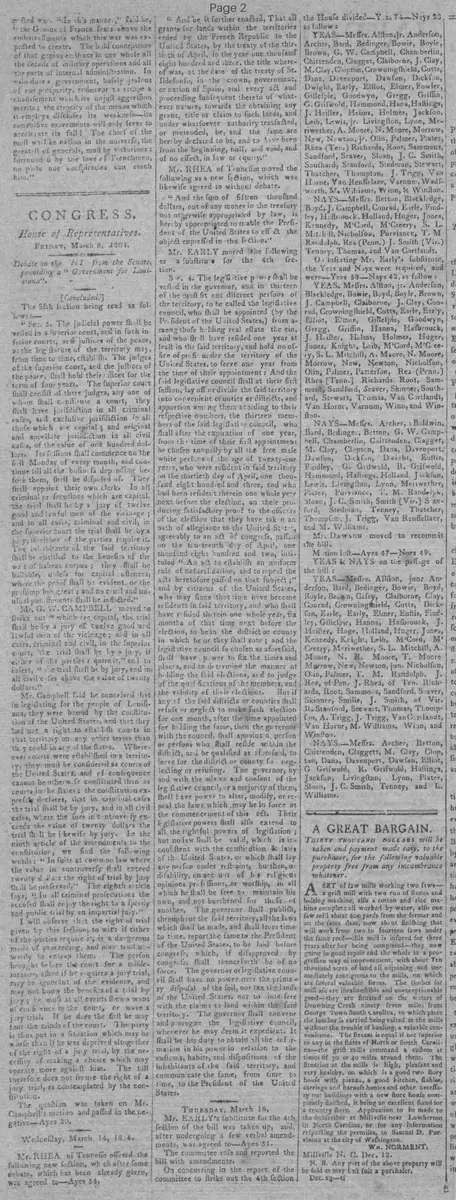
House of Representatives.
FRIDAY, March 8, 1801.
Debate on the bill from the Senate providing a "Government for Louisiana".
[Concluded.]
The fifth section being read as follows:
Iowa:--
"Sec. 5. The judicial power shall be vested in a superior court, and in such inferior courts, and justices of the peace, as the legislature of the territory may, from time to time, establish. The judges of the superior Court, and the justices of the peace, shall hold their offices for the term of four years. The superior court shall consist of three judges, any one of whom shall constitute a court, they shall have jurisdiction in all criminal cases, and exclusive jurisdiction in all those which are capital; and original and appellate jurisdiction in all civil cases, of the value of one hundred dollars. Its sessions shall commence on the first Monday of every month, and continue till all the business depending before them, shall be disposed of. They shall appoint their own clerk. In all criminal prosecutions which are capital, the trial shall be by a jury of twelve good and lawful men of the vicinage; and in all cases, criminal and civil, in the superior court the trial shall be by a jury, if either of the parties require it. The inhabitants of the said territory shall be entitled to the benefits of the writ of habeas corpus; they shall be bailable, unless for capital offences, where the proof shall be evident, or the presumption great; and no cruel and unusual punishments shall be inflicted."
Mr. G. W. CAMPBELL moved to strike out "which are capital, the trial shall be by a jury of twelve good and lawful men of the vicinage; and in all cases, criminal and civil, in the superior Court, the trial shall be by a jury, if either of the parties require it," and to insert, "the trial shall be by jury, and in all civil cases above the value of twenty dollars."
Mr. Campbell said he conceived that in legislating for the people of Louisiana, they were bound by the constitution of the United States, and that they had not a right to establish courts in that territory on any other terms than they could in any of the states. Wherever courts were established in a territory, they must be considered as courts of the United States, and of consequence cannot be otherwise constituted than as courts in the states: the constitution expressly declares, that in criminal cases the trial shall be by jury, and in all civil cases, where the value in controversy exceeds the value of twenty dollars the trial shall be likewise by jury. In the ninth article of the amendments to the constitution, we find the following words: "In suits at common law where the value in controversy shall exceed twenty dollars the right of trial by jury shall be preserved." The eighth article says, "In all criminal prosecutions the accused shall enjoy the right to a speedy and public trial by an impartial jury."
I will observe that the right of trial given by this section, to wit: if either of the parties require it, is a dangerous mode of proceeding, and may tend unnecessarily to entrap them. The person brought before the court or a magistrate, asked if he requires a jury trial, may be ignorant of the evidence, and may not know the benefits of a trial by jury; he must at all events either want confidence in the court, or waive a jury trial. If he does the former he may sour the minds of the court. The party is thus put in a situation which may be worse than if he was deprived altogether of the right of a jury trial, by the necessity of making a choice which may operate more against him. The bill therefore does not secure the right of a jury trial, as contemplated by the constitution.
The question was taken on Mr. Campbell's motion and passed in the negative--Ayes 20.
Wednesday, March 14, 1804.
Mr. RHEA of Tennessee offered the following new section, which after some debate, which has been already given, was agreed to--Ayes 54.
"And be it further enacted, That all grants of lands within the territories ceded by the French Republic to the United States, by the treaty of the thirtieth of April, in the year one thousand eight hundred and three, the title whereof was, at the date of the treaty of St. Ildefonso, in the crown, government, or nation of Spain, and every act and proceeding subsequent thereto of whatsoever nature, towards the obtaining any grant, title or claim to such lands, and under whatsoever authority transacted, or pretended, be, and the same are hereby declared to be, and to have been from the beginning, null, and void, and of no effect, in law or equity."
Mr. RHEA of Tennessee moved the following as a new section, which was likewise agreed to without debate.
"And the sum of fifteen thousand dollars, out of any money in the treasury not otherwise appropriated by law, is hereby appropriated to enable the President of the United States to effect the object expressed in this section."
Mr. EARLY moved the following as a substitute for the 4th section.
Sec. 4. The legislative power shall be vested in the governor, and in thirteen of the most fit and discreet persons of the territory, to be called the legislative council, who shall be appointed (by the President of the United States,) from among those holding real estate the fee, and who shall have resided one year at least in the said territory, and hold no office of profit under the territory of the United States, to serve one year from the time of their appointment: And the said legislative council shall at their first session, lay off or divide the said territory into convenient counties or districts, and apportion among them according to their respective numbers, the thirteen members of the said legislative Council, who shall after the expiration of one year, from the time of their first appointment be chosen annually by all the free male white persons of the age of twenty-one years, who were resident in said territory on the thirtieth day of April, one thousand eight hundred and three, and who had been resident therein one whole year next before the election, on their producing satisfactory proof to the officers of the election that they have taken an oath of allegiance to the United States, agreeably to an act of congress, passed on the fourteenth day of April, one thousand eight hundred and two, intituled "An act to establish an uniform rule of naturalization, and to repeal the acts heretofore passed on that subject;" and by citizens of the United States, who may since that time have become residents in said territory, and who shall have resided therein one whole year, six months of that time next before the election, to be in the district or county in which he or they shall vote; and the legislative Council so chosen as aforesaid shall have power to fix the times and places, and to determine the manner of holding the said elections, and to judge of the qualifications of the members, and the validity of their elections. But if any of the said districts or counties shall refuse or neglect to make such election for one month, after the time appointed for holding the same, then the governor with the council, shall appoint a person or persons who shall reside within the district, and be qualified as aforesaid, to serve for the district or county so neglecting or refusing. The governor, by and with the advice and consent of the legislative council, or a majority of them shall have power to alter, modify, or repeal the laws which may be in force at the commencement of this act. Their legislative powers shall also extend to all the rightful powers of legislation; but no law shall be valid, which is inconsistent with the constitution & laws of the United States, or which shall lay any person under restraint, burden, or disability, on account of his religious opinions professions, or worship, in all which he shall be free to maintain his own, and not burthened or tho another. The governor shall publish, throughout the said territory, all the laws which shall be made, and shall from time to time, report the same to the President of the United States, to be laid before congress, which, if disapproved by congress, shall thenceforth be of no force. The governor or legislative council shall have no power over the primary disposal of the soil, nor tax the lands of the United States, nor to interfere with the claims to land within the said territory. The governor shall convene and prorogue the legislative council, whenever he may deem it expedient. It shall be his duty to obtain all the information in his power in relation to the customs, habits, and dispositions of the inhabitants of the said territory, and communicate the same, from time to time, to the President of the United States.
Thursday, March 16.
Mr. EARLY's substitute for the 4th section of the bill was taken up, and, after undergoing a few verbal amendments, was agreed to--Ayes 31.
The committee rose and reported the bill with amendments.
On concurring in the report of the committee to strike out the 4th section of the bill, the House divided--Yeas 74--Nays 23 as follow:
YEAS--Messrs. Alston, jr. Anderson, Archer, Bard, Bedinger, Bowie, Boyle, Brown, G. W. Campbell, Chamberlin, Chittenden, Clagget, Claiborne, J. Clay, M. Clay, Clopton, Crowningshield, Cutts, Dana, Davenport, Dawson, Dickson, Dwight, Early, Elliot, Elmer, Fowler, Gillespie, Goodwyn, Gregg, Griffin, G. Griswold, Hammond, Hanna, Hastings, J. Heister, Helms, Holmes, Jackson, Leib, Lewis, jr. Livingston, Lyon, Meriwether, A. Moore, N. Moore, Morrow, New, Newton, jr. Olin, Palmer, Plater, Rhea (Ten.) Richards, Root, Sammons, Sandford, Seaver, Sloan, J. C. Smith, Southard, Stanford, Stedman, Stewart, Thatcher, Thompson, J. Trigg, Van Horne, Van Rensselaer, Varnum, Wadsworth, M. Williams, Winn, & Winton.
NAYS--Messrs. Betton, Blackledge, Boyce, J. Campbell, Conrad, Earle, Findley, Habrouck, Holland, Huger, Jones, Kennedy, M'Cord, M'Creery, S. L. Mitchell, Nicholson, Purviance, T. M. Randolph, Rea (Penn.) J. Smith (Vir.) Tenney, Thomas, and Van Cortlandt.
On inserting Mr. Early's substitute, the Yeas and Nays were required, and were--Yeas 58 Nays 42, as follow:
YEAS. Messrs. Alston, jr. Anderson, Blackledge, Bowie, Boyd, Boyle, Brown, J. Campbell, Claiborne, J. Clay, Conrad, Crowningshield, Cutts, Earle, Early, Elliot, Elmer, Gillespie, Goodwyn, Gregg, Griffin, Hanna, Habrouck, I. Heister, Helms, Holmes, Huger, Jones, Knight, Leib, M'Cord, M'Creery, S. L. Mitchell, A. Moore, N. Moore, Morrow, New, Newton, Nicholson, Olin. Palmer. Patterson, Rea (Penn. Rhea [Tenn.] Richards. Root, Sammons, Sandford, Seaver, Skinner, Southard, Stewart, Thomas, Van Cortlandt, Van Horne, Varnum, Winn, and Winston.
NAYS--Messrs. Archer, Baldwin, Bard, Bedinger, Betton, G. W. Campbell, Chamberlin, Chittenden, Clagget, M. Clay, Clopton, Dana, Davenport, Dawson, Dickson, Dwight, Eustis, Findley, G. Griswold, R. Griswold, Hammond, Hastings, Holland. Jackson, Lewis, Livingston, Lyon, Meriwether, Plater, Purviance, T. M. Randolph, Sloan, J. C. Smith, Smith [Vir.] Stanford, Stedman, Tenney, Thatcher, Thompson, J. Trigg, Van Rensselaer, and M. Williams.
Mr. Dawson moved to recommit the bill.
Motion lost--Ayes 47--Noes 49.
YEAS & NAYS on the passage of the bill :
YEAS--Messrs. Alston, jun: Anderson, Bard, Bedinger, Bowie, Boyd, Boyle, Brown, Carey, Claiborne, Clay, Conrad, Crowningshield, Cutts, Dickson, Earle, Early, Elmer, Eustis, Findley, Gillespie, Hanna, Habrouck, J. Heister, Hogg, Holland, Huger, Jonas, Kennedy, Knight, Leib, M'Cord, M Creery, Meriwether, S. L. Mitchell, A. Moore, N. R. Moore, T. Moore, Morrow, New, Newton, jun. Nicholson, Olin, Palmer, T. M. Randolph, J. Rea, of Pen. I. Rhea, of Ten. Richards, Root, Sammons, Sandford, Seaver. Skinner, Smilie, J. Smith, of Vir. R. Stanford, Stewart, Thomas, Thompson, A. Trigg, J. Trigg, Van Cortlandt. Van Horne, M. Williams, Winn, and Winston.
NAYS.--Messrs. Archer, Betton, Chittenden, Claggett, M. Clay, Clopton, Dana, Davenport, Dawson, Elliot, G Griswold, R. Griswold, Hastings, Jackson, Livingston, Lyon, Plater, Sloan, J. C. Smith, Tenney, and L. Williams.
What sub-type of article is it?
What keywords are associated?
What entities or persons were involved?
Where did it happen?
Domestic News Details
Primary Location
House Of Representatives
Event Date
March 8, 1801; March 14, 1804; March 16, 1804
Key Persons
Outcome
motion by campbell on jury trial passed in negative (ayes 20); rhea's section on land grants agreed to (ayes 54); early's substitute for 4th section agreed to (ayes 31); bill reported with amendments; concurrence in striking 4th section (yeas 74, nays 23); inserting early's substitute (yeas 58, nays 42); recommit motion lost (ayes 47, noes 49); bill passage (yeas listed, nays listed).
Event Details
Debate in House of Representatives on Senate bill for Louisiana government. Discussion on fifth section regarding judicial power and jury trials; Campbell moved amendment for mandatory jury trials in criminal cases and civil cases over $20, arguing constitutional requirements, but motion failed. On March 14, 1804, Rhea offered and passed section nullifying Spanish land grants post-St. Ildefonso treaty; appropriation of $15,000 for President. Early's substitute for 4th section on legislative council structure, elections, and powers agreed to on March 16 after amendments. Committee reported bill; House concurred in changes and passed it with recorded yeas and nays.