Thank you for visiting SNEWPapers!
Sign up free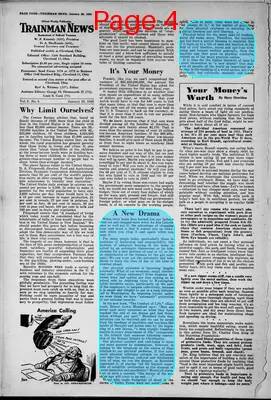
Editorial
January 28, 1952
Trainman News
Indianapolis, Marion County, Indiana
What is this article about?
This editorial critiques the increasing automation of modern life, from physical comforts to economic and social issues, warning that over-reliance on machines and government erodes human initiative, cultural, and spiritual values. Referencing Lewis Mumford's 'The Conduct of Life,' it calls for a 'new drama' of profound societal transformation to restore deeper human engagement, contrasting with the self-reliant spirit of America's founders.
Clipping
OCR Quality
98%
Excellent
Full Text
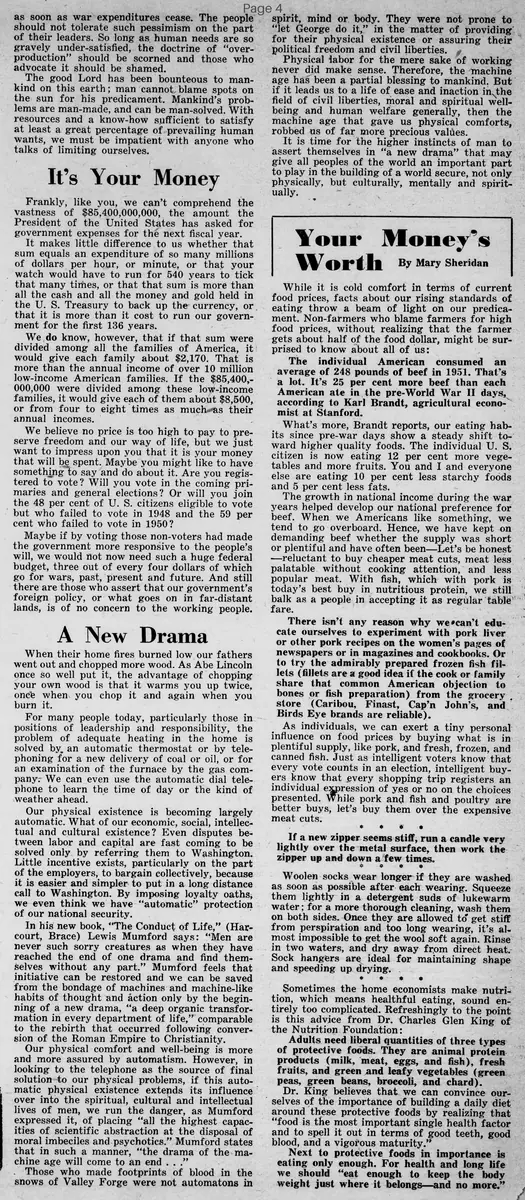
A New Drama
When their home fires burned low our fathers went out and chopped more wood. As Abe Lincoln once so well put it, the advantage of chopping your own wood is that it warms you up twice, once when you chop it and again when you burn it.
For many people today, particularly those in positions of leadership and responsibility, the problem of adequate heating in the home is solved by an automatic thermostat or by telephoning for a new delivery of coal or oil, or for an examination of the furnace by the gas company. We can even use the automatic dial telephone to learn the time of day or the kind of weather ahead.
Our physical existence is becoming largely automatic. What of our economic, social, intellectual and cultural existence? Even disputes between labor and capital are fast coming to be solved only by referring them to Washington.
Little incentive exists, particularly on the part of the employers, to bargain collectively, because it is easier and simpler to put in a long distance call to Washington. By imposing loyalty oaths, we even think we have "automatic" protection of our national security.
In his new book, "The Conduct of Life," (Harcourt, Brace) Lewis Mumford says: "Men are never such sorry creatures as when they have reached the end of one drama and find themselves without any part." Mumford feels that initiative can be restored and we can be saved from the bondage of machines-and machine-like habits of thought and action only by the beginning of a new drama, "a deep organic transformation in every department of life," comparable to the rebirth that occurred following conversion of the Roman Empire to Christianity.
Our physical comfort and well-being is more and more assured by automatism. However, in looking to the telephone as the source of final solution to our physical problems, if this automatic physical existence extends its influence over into the spiritual, cultural and intellectual lives of men, we run the danger, as Mumford expressed it, of placing "all the highest capacities of scientific abstraction at the disposal of moral imbeciles and psychotics." Mumford states that in such a manner, "the drama of the machine age will come to an end..."
Those who made footprints of blood in the snows of Valley Forge were not automatons in spirit, mind or body. They were not prone to "let George do it," in the matter of providing for their physical existence or assuring their political freedom and civil liberties.
Physical labor for the mere sake of working never did make sense. Therefore, the machine age has been a partial blessing to mankind. But if it leads us to a life of ease and inaction in the field of civil liberties, moral and spiritual well-being and human welfare generally, then the machine age that gave us physical comforts, robbed us of far more precious values.
It is time for the higher instincts of man to assert themselves in "a new drama" that may give all peoples of the world an important part to play in the building of a world secure, not only physically, but culturally, mentally and spiritually.
When their home fires burned low our fathers went out and chopped more wood. As Abe Lincoln once so well put it, the advantage of chopping your own wood is that it warms you up twice, once when you chop it and again when you burn it.
For many people today, particularly those in positions of leadership and responsibility, the problem of adequate heating in the home is solved by an automatic thermostat or by telephoning for a new delivery of coal or oil, or for an examination of the furnace by the gas company. We can even use the automatic dial telephone to learn the time of day or the kind of weather ahead.
Our physical existence is becoming largely automatic. What of our economic, social, intellectual and cultural existence? Even disputes between labor and capital are fast coming to be solved only by referring them to Washington.
Little incentive exists, particularly on the part of the employers, to bargain collectively, because it is easier and simpler to put in a long distance call to Washington. By imposing loyalty oaths, we even think we have "automatic" protection of our national security.
In his new book, "The Conduct of Life," (Harcourt, Brace) Lewis Mumford says: "Men are never such sorry creatures as when they have reached the end of one drama and find themselves without any part." Mumford feels that initiative can be restored and we can be saved from the bondage of machines-and machine-like habits of thought and action only by the beginning of a new drama, "a deep organic transformation in every department of life," comparable to the rebirth that occurred following conversion of the Roman Empire to Christianity.
Our physical comfort and well-being is more and more assured by automatism. However, in looking to the telephone as the source of final solution to our physical problems, if this automatic physical existence extends its influence over into the spiritual, cultural and intellectual lives of men, we run the danger, as Mumford expressed it, of placing "all the highest capacities of scientific abstraction at the disposal of moral imbeciles and psychotics." Mumford states that in such a manner, "the drama of the machine age will come to an end..."
Those who made footprints of blood in the snows of Valley Forge were not automatons in spirit, mind or body. They were not prone to "let George do it," in the matter of providing for their physical existence or assuring their political freedom and civil liberties.
Physical labor for the mere sake of working never did make sense. Therefore, the machine age has been a partial blessing to mankind. But if it leads us to a life of ease and inaction in the field of civil liberties, moral and spiritual well-being and human welfare generally, then the machine age that gave us physical comforts, robbed us of far more precious values.
It is time for the higher instincts of man to assert themselves in "a new drama" that may give all peoples of the world an important part to play in the building of a world secure, not only physically, but culturally, mentally and spiritually.
What sub-type of article is it?
Social Reform
Moral Or Religious
What keywords are associated?
Automation
Machine Age
Cultural Transformation
Human Initiative
Lewis Mumford
Civil Liberties
Social Reform
Spiritual Well Being
What entities or persons were involved?
Abe Lincoln
Lewis Mumford
Valley Forge Revolutionaries
Editorial Details
Primary Topic
Critique Of Automation And Call For A New Cultural Drama
Stance / Tone
Cautionary Advocacy For Human Initiative And Societal Transformation
Key Figures
Abe Lincoln
Lewis Mumford
Valley Forge Revolutionaries
Key Arguments
Automation Provides Physical Comfort But Risks Eroding Economic, Social, Intellectual, And Cultural Initiative
Reliance On Washington For Labor Disputes And National Security Diminishes Collective Bargaining And Personal Responsibility
Lewis Mumford Argues For A 'New Drama' Of Deep Organic Transformation To Counter Machine Bondage
Over Automation Could Place Scientific Power In The Hands Of Moral Imbeciles, Ending The Machine Age Drama Perilously
Historical Figures Like Those At Valley Forge Exemplified Non Automatic Spirit In Securing Freedoms
Machine Age Is A Partial Blessing But Threatens Civil Liberties, Moral, And Spiritual Well Being If It Leads To Inaction
Higher Human Instincts Must Drive A New Global Drama For Comprehensive Security